OBJ 转 STL 教程 — 免费在线网格转换
OBJ 转 STL 是简单的转换
OBJ 和 STL 都是没有曲线、没有参数化历史的三角网格格式。互转直白:从 OBJ 读三角形,往 STL 写三角形。几何无损 — OBJ 里的每个三角形对应 STL 里的一个 — 但 OBJ 独有的东西全没了。UV 纹理坐标、材质分配(.mtl 文件)、顶点颜色、平滑组、命名对象层级都掉地上了,因为 STL 不存这些。3D 打印没问题,切片软件只要水密几何。可视化或游戏资源就降级了。本指南讲什么时候哪个格式赢、丢什么、怎么不上传到山寨在线转换站完成转换。
OBJ 和 STL 实际存的是什么
OBJ 是 ASCII 文本格式,来自 Wavefront Technologies(90 年代)。它存顶点(v 行)、纹理坐标(vt)、法线(vn)、面(f 行索引这三种)。它支持任意顶点数的多边形(三角形、四边形、n 边形),并配套独立的 .mtl 文件描述材质。STL 是更简单的格式,1989 年为 3D Systems 的 SLA 打印机发明。它只存三角形 — 每三角形三个顶点一个面法线 — ASCII 文本或二进制(每三角形 50 字节)。STL 不知道材质、纹理、面之外的法线、顶点共享、层级是啥。OBJ 转 STL 意味着把任何四边形/n 边形三角化,扔掉除三角形以外的一切。
转换保留什么、丢什么
- 几何保留 — OBJ 里每个顶点和面都到 STL 里。四边形和 n 边形自动三角化(大多数转换器用 ear-clipping 或 fan triangulation)。
- 材质丢了 — STL 没有材质概念。.mtl 文件完全忽略。如果你的 OBJ 用多个材质做颜色分区,STL 会塌成一个无色网格。
- 纹理丢了 — UV 坐标、纹理图引用全没了。STL 只有几何。
- 层级扁平化 — OBJ 的命名对象组(o、g 行)在二进制 STL 里合成一个网格。ASCII STL 支持 'solid 名字' 但实际上每文件就一个。
- 文件大小 — 同样几何下二进制 STL 通常比 ASCII OBJ 小(50 字节/三角形 vs ~100 字符/三角形),尽管两者存同样多三角形。
- 可逆?— STL 转 OBJ 干净,但材质回不来。OBJ→STL→OBJ 来回不无损:从带纹理 OBJ 开始,以无色 OBJ 结束。 —
五步把 OBJ 转 STL
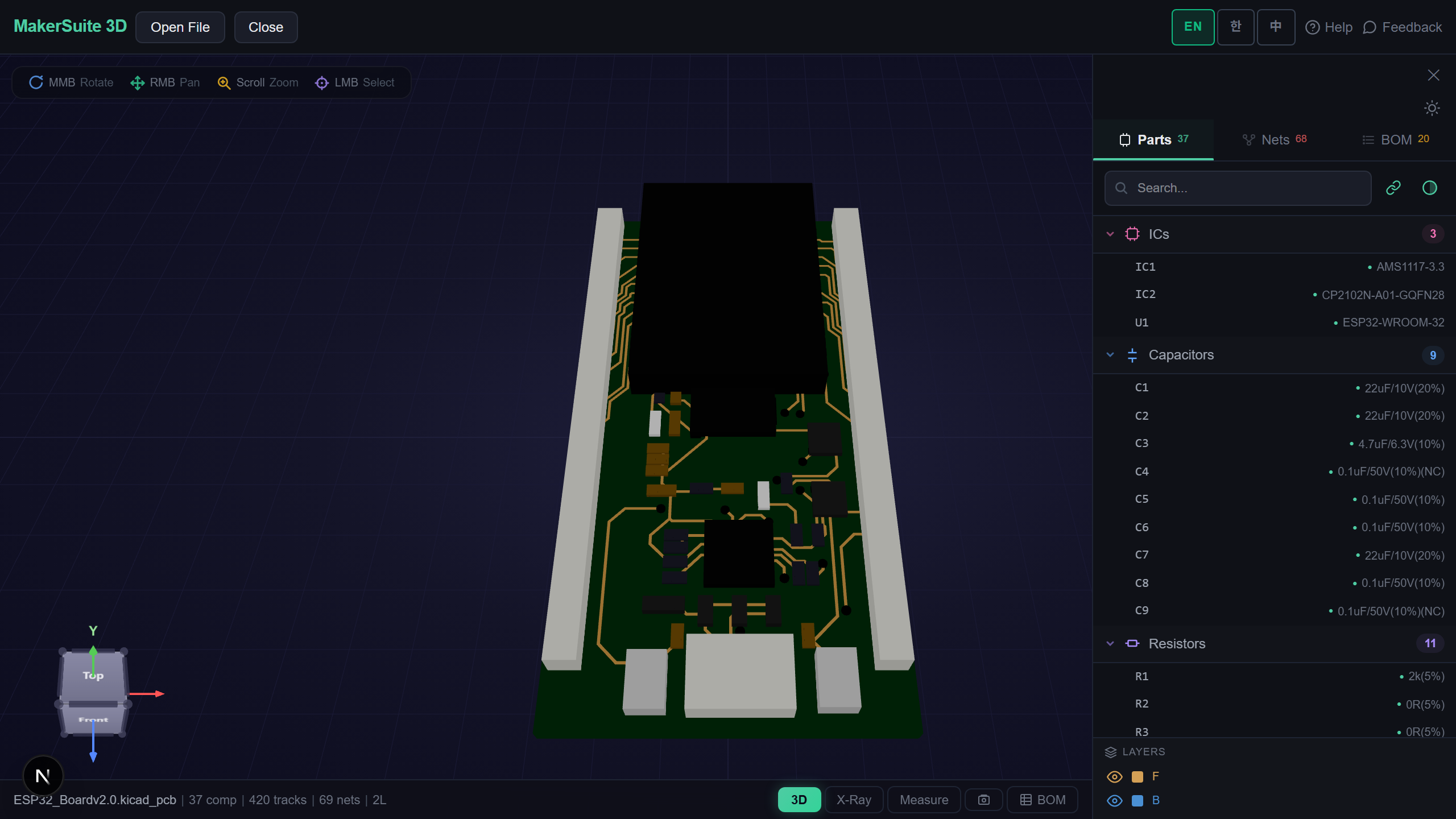
- Open pcbviewer.app — 先把 .obj 文件拖到 MakerSuite 3D 查看器看几何。验证模型是不是你期望的,没有缺面或翻法线。
- 点 Export 按钮选 STL。工具会三角化任何非三角形面,写二进制 STL,提供下载。一般网格毫秒级完成。
- 批量转换用 Blender 命令行:blender --background --python-expr "import bpy; bpy.ops.wm.obj_import(filepath='in.obj'); bpy.ops.wm.stl_export(filepath='out.stl')" 套个 shell 循环。
- 重新打开 STL 在 MakerSuite 3D 里验证。检查三角形数符合预期(没丢退化三角形),检查包围盒等于 OBJ 的,要打印的话检查模型水密。
- 目标是 3D 打印的话,发切片软件之前跑非流形检查。来自带颜色 OBJ 的 STL 通常不丢几何但可能暴露原 OBJ 容忍的非流形边。
把 OBJ 和转出来的 STL 一起丢进 MakerSuite 3D — 视觉 diff 在送切片之前确认三角化没把东西搞砸。
免费试用 MakerSuite 3D什么时候用 OBJ vs STL
3D 打印 STL 赢 — 每个切片软件(Cura、PrusaSlicer、Bambu Studio、Lychee)都把 STL 当参考格式,二进制 STL 紧凑解析快。CAD-to-CAM 交付也是 STL 赢,因为 CAM 软件期望水密三角形不带额外元数据。OBJ 在所有视觉用途里赢:游戏资源流水线、建筑可视化渲染、摄影测量输出、雕塑工具(ZBrush、Blender)都在 OBJ 里保留纹理和材质。转换只能单向无损 — OBJ→STL 丢材质,STL→OBJ 不会加回材质。可能用到纹理就选 OBJ,只要几何且要最大兼容性就选 STL。
OBJ 转 STL 是正解的场景
- 雕塑模型送 3D 打印 — ZBrush/Blender 导 OBJ,切片软件要 STL,简单无损几何交付
- 摄影测量流水线 — RealityCapture/Meshroom 输出带纹理 OBJ,你只要几何做 CNC 或分析
- 游戏资源 3D 打印 — OBJ 格式角色或道具资源,粉丝要打印实体,材质无关
- CAD 插件输出 — 老 CAD 工具导 OBJ,下游工具要 STL,转换搭桥
- 资源流水线清理 — 归档前剥离材质,更小的 STL 是规范的 '只要几何' 格式
在浏览器里转换,不上传
在线 OBJ 转 STL 转换器(Convertio、AnyConv、FreeOnlineConverter)都要把文件传到他们服务器。NDA 工作、扫描的人脸(医疗/牙科)、未发布产品设计直接出局。MakerSuite 3D 在浏览器里通过 JavaScript 解析 OBJ 并导出 STL — 不走服务器、不上传、别人硬盘上没缓存副本。打开文件、导出、保存、完事。几何留在你机器上。
STL 是错误选择的时候
如果下游工具能读 OBJ,就保留 OBJ。STL 是 1987 年为 stereolithography 设计的,每三角形存三个顶点不共享 — 也就是一个 quad 变成两个共有六个顶点的三角形而不是共享四个。对于密集网格,OBJ 文件小 30-50%,因为 OBJ 存顶点列表并从三角形引用。游戏引擎、Web 查看器和大多数现代可视化工具原生处理 OBJ。推向 STL 几乎总是由不知好歹的切片器或 CAM 工具驱动。
纹理坐标是最常被怀念的牺牲品。如果您的 OBJ 带 .mtl 文件和纹理图像,那对可视化是必要的,但对 STL 不可见。转换后模型只是灰色几何。如果您的 OBJ 转 STL 流水线是用于 3D 打印,没问题 — 打印机不在乎纹理。如果是用于任何可视化或渲染,停下来重新考虑 3MF(保留材质)或 GLB(嵌入纹理)是不是更好的目标格式。
常见问题
Will my OBJ textures show up in the STL?
No. STL has no concept of textures, materials, or UV coordinates — it stores triangle geometry only. The .mtl file your OBJ references and any .png/.jpg textures get ignored entirely during conversion. If color and texture matter (game asset, archviz render, photogrammetry handoff), keep the OBJ or convert to a format that supports materials like FBX, glTF, or 3MF. STL is the right choice when you only need geometry — 3D printing, CNC, mesh analysis, finite element prep.
Why does my OBJ have quads but STL only has triangles?
STL was specified for stereolithography in 1989 with triangles only — no quads, no n-gons. OBJ supports faces of any vertex count. During conversion, every quad in your OBJ gets split into two triangles, every n-gon gets fan-triangulated. Most converters use ear-clipping for non-convex polygons. The geometry stays the same, but the triangle count roughly doubles for a quad-heavy model. This is fine for printing — slicers triangulate internally anyway — but causes confusion when you compare 'face count' between the OBJ and the STL.
ASCII STL or binary STL — which should I use?
Binary STL almost always. Binary stores 50 bytes per triangle (12 bytes for the normal, 36 bytes for three vertices, 2 bytes attribute byte count), which is roughly 4× smaller than ASCII for the same model. ASCII STL is human-readable but slow to parse and bloated on disk. Slicers, CAD software, and CAM tools handle binary STL natively. The only reason to write ASCII is for debugging or version control diffability — and even then, OBJ is a better choice for diffability since it's already text.
Will my OBJ be watertight after conversion?
Watertight or not is a property of the source geometry, not the conversion. If the OBJ had non-manifold edges, holes, or T-junctions, the STL inherits all of them. The conversion is geometric — it preserves vertices and faces verbatim — so problems in the OBJ become problems in the STL. Run a non-manifold check on the OBJ before converting if you're going to 3D print. MakerSuite 3D's mesh repair detects non-manifold edges, flipped normals, and holes; fix them in the OBJ first, then convert to STL.
Can I convert OBJ to STL in batch?
Yes, several ways. (1) Blender command line: blender --background --python-expr "import bpy; bpy.ops.wm.obj_import(filepath='in.obj'); bpy.ops.wm.stl_export(filepath='out.stl')" wrapped in a shell loop. (2) MeshLab CLI: meshlabserver -i in.obj -o out.stl with a script. (3) Custom Python with trimesh library: import trimesh; mesh = trimesh.load('in.obj'); mesh.export('out.stl'). For one-off conversions or interactive use, MakerSuite 3D handles single files in the browser. For 100+ files, write a shell script with one of the CLI tools.
相关文章
拖入 OBJ 文件 — 浏览器里转 STL,零上传
打开 3D 查看器