STL 转 STEP 教程 — Mesh-to-BRep 真相
STL 转 STEP 不是转换 — 是重建
STL 文件存的是三角网格 — 一堆近似原始几何的扁平三角形。STEP 文件存的是边界表示(B-rep)— 精确的数学曲面(平面、圆柱、NURBS)和它们的拓扑。从网格到 B-rep 需要从三角形里恢复原始曲面,这本身就难,而且永远是有损的。FreeCAD 的 'Convert to solid' 或 Fusion 360 的 'Mesh to BRep' 对干净的基本形状(盒子、圆柱、简单旋转体)能用,但自由曲面有机 STL(雕塑、扫描件、复杂 3D 打印件)转出来就是一坨没法编辑、烘焙了几千个三角面的大形状。老实说:STL→STEP 是变通方案,不是真正的转换。如果你需要可编辑的 CAD 几何,就用 STL 当视觉参考在 CAD 里重画一遍。
STL 和 STEP 实际存的是什么
STL 文件是一份三角形扁平列表,每个三角形由三个顶点和一个法线定义。ASCII STL 是人类可读的文本,二进制 STL 是每三角形 50 字节的记录。没有曲面连续性、没有参数化历史、没有 '这是个圆柱' 的概念 — 就是一袋三角形。STEP(ISO 10303-21)存 B-rep 几何:每个面(平面、圆柱、圆锥、圆环、NURBS 曲面)的精确数学方程、每个面的边界曲线、把这一切连起来的拓扑。STEP 圆柱是一个面、一个方程;STL 圆柱是 200 个三角形近似那个面。STL 转 STEP 需要从三角形云里推出原始方程 — 简单基本体可行,有机形状很难,没人工清理的噪声扫描数据基本不可能。
每个工具实际能干什么
- FreeCAD — 免费、开源。Mesh > Convert to Solid 把整个 STL 变成一个没有曲面分解的 STEP 面。结果:一个不能编辑的大体,CAM 能用但参数化编辑没戏。任何 STL 都能跑,再脏也行。
- Fusion 360 Mesh-to-BRep — Personal 许可免费。Mesh 工作区 > Modify > Convert Mesh,选 Faceted(每个三角形一个面,没用)、Prismatic(识别平面和基本体,工程零件最佳)或 Organic(T-spline 拟合,雕塑件好)。Prismatic 模式三角形上限约 50,000。
- Geomagic Design X — 收费(许可约 $15K)。行业标准逆向工程工具。区域识别、基本体拟合、曲面放样 — 从扫描数据生成干净的参数化 STEP。航空航天和医疗器械行业用来数字化实物零件。
- OpenSCAD / Blender — 不是为这个设计的。OpenSCAD 只能写 STL,Blender 的 CAD 插件是网格修改器包装,不产生真 B-rep。STL 转 STEP 跳过这俩。
- MeshLab + 自定义工作流 — 开源网格修复(平滑、抽稀、补洞)后再丢进 FreeCAD 或 Fusion。带噪声的扫描数据有用,但不改变 mesh-to-BRep 的本质问题。
- 在线转换器(MakeXYZ、Convertio、AnyConv)— 全是服务器端包了 FreeCAD 或 OpenCASCADE。结果跟本地跑 FreeCAD 一样,区别是你的几何上传到第三方。NDA 工作不要用。 —
五步处理 STL 转 STEP
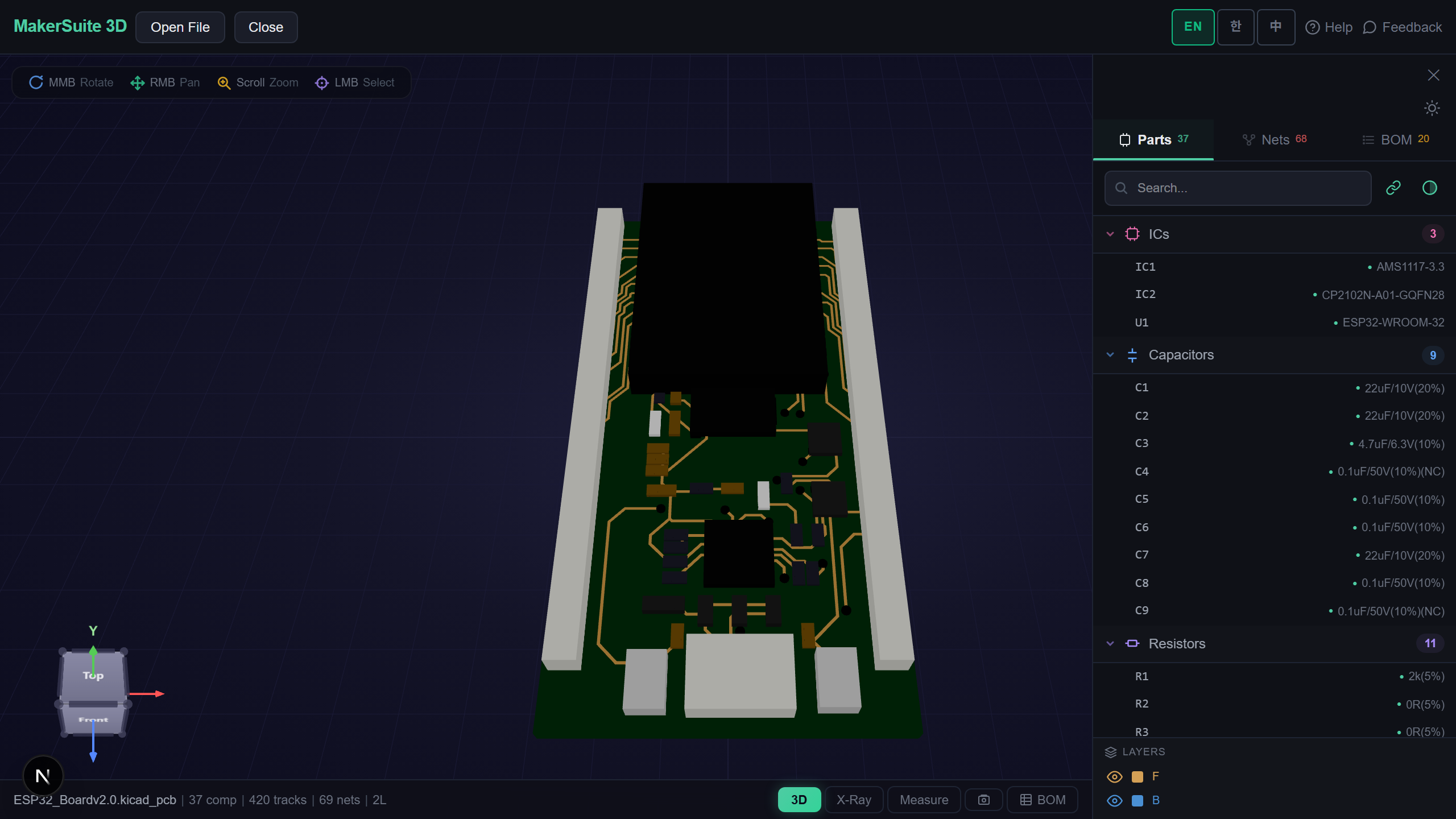
- Open pcbviewer.app — 先把 STL 拖到 MakerSuite 3D 检查一下。三角形数小于 5K 且平面清晰意味着 prismatic 转换能成;超过 100K 三角形或有机形状意味着用 Fusion 360 organic 模式或者干脆别转。
- 先试最简单的路 — FreeCAD 的 Mesh > Convert to Solid。如果你只要一个闭合 STEP 用于 CAM/CNC 交付(不需要参数化编辑),几秒钟搞定。输出是一个没有可编辑特征的形状,但几何是对的。
- 想要可编辑 CAD 几何,在 Fusion 360 里打开 STL,切到 Mesh 工作区,跑 Convert Mesh。工程零件(支架、外壳)选 Prismatic,雕塑形状选 Organic。调面数容差 — 太低丢细节,太高曲面数无法管理。
- 验证结果 — 把 STEP 导回来,跟原始 STL 一起拖进 MakerSuite 3D。视觉对比可以在送 CNC 厂之前抓住 mesh-to-BRep 工具偷偷塞进去的丢失特征、丢失的孔、曲面伪影。
- 如果转出来的 STEP 不够能编辑,正确的做法是用 STL 当视觉底图在 CAD 里重画。Fusion、SolidWorks、Onshape 都支持 — 导入 STL,锁成参考体,在上面画草图。比转换慢,但能产生有编辑历史的真参数化 CAD。
在把转出来的 STEP 送制造之前,把原 STL 和新 STEP 一起拖到 MakerSuite 3D — 视觉 diff 可以抓住 mesh-to-BRep 工具偷偷塞进去的曲面伪影和丢失特征。
免费试用 MakerSuite 3D为什么 STL 转 STEP 对制造重要
大多数 CNC 厂、钣金供应商、注塑商都要 STEP 或 IGES,不要 STL。STL 在 3D 打印里行得通是因为切片软件原生处理三角网格,但跑 CNC 铣床的 CAM 操作员需要连续曲面才能生成干净的刀路。给 CNC 厂提交 STL 通常会触发一轮反复 — 厂家加价做转换、转换是近似的、最终零件跟预期对不上。自己做 STL→STEP 转换 — 哪怕不完美 — 能让你掌控几何,省下厂家的逆向工程费。老实的工作流:尽你所能做最好的转换,然后在签制造 PO 之前把 STEP 跟原 STL 视觉对比。
什么时候 STL 转 STEP 是正解
- 3D 打印原型转 CNC 量产 — 支架在 PLA 上跑通了,现在要换铝,但只有 STL
- 开源硬件集成 — Thingiverse 模型要跟你的 CAD 装到一起,源文件没了
- 老项目档案恢复 — 老项目源丢了,版本控制里只剩 STL
- 扫描件数字化 — 实物零件扫成 STL,需要 CAD 模型做再设计或逆向工程
- 跨工具协作 — 合作方发 STL,你的团队用 SolidWorks/Inventor,需要 B-rep 输入
在浏览器里验证,不上传
STL 或 STEP 形式的机械设计通常带专有几何 — 产品外壳、安装支架、内部机构。在线 STL→STEP 转换器要求你把文件传到他们服务器,对 NDA 工作来说立刻出局。MakerSuite 3D 用 JavaScript 和 OCCT WASM 在浏览器里完整解析两种格式 — 不走服务器、不上传、不留缓存。一个标签开原 STL,另一个开转出来的 STEP,视觉对比。你的几何不出本机,转换发生在你掌控的工具(FreeCAD、Fusion)里。
STL→STEP 完全行不通的时候
有机、雕塑、扫描的网格是最差情况。手工雕的角色或 3D 扫描的骨头的 50 万三角形网格没有规范曲面 — 每个三角形都是没有边界表示能精确捕获的自由曲面的一部分。FreeCAD 和 Fusion 360 会出 STEP,但那是包含数千个细分小面的 STEP,技术上是 B-rep 但对参数化编辑无用。如果下游需要标注或修改形状,正确的做法是在 CAD 工具里从头重建,而非转换。
另一个 STL→STEP 失败模式是非 watertight 或自相交网格。切片器容忍小缺陷(重叠三角形、近零厚度边),但 mesh-to-BRep 转换在它们上直接失败。MakerSuite 的 Manifold-3D 网格修复 pass 抓住大部分这些问题 — 把 STL 拖进 3D 查看器,跑修复,再导出清洁的 STL 送到 FreeCAD。修复-然后-转换流水线在直接转换静默产生破损 STEP 文件的地方成功。
常见问题
Can you really convert STL to STEP?
Not losslessly. STL stores triangulated surfaces — a mesh of flat triangles approximating the original geometry. STEP stores boundary representation (B-rep) — exact mathematical surfaces (planes, cylinders, NURBS) and their topology. Going mesh → B-rep requires reconstructing the surfaces from triangles, which is genuinely hard and always lossy. Tools like FreeCAD's 'Convert to solid' or Fusion 360's 'Mesh to BRep' work for clean primitive shapes (boxes, cylinders, simple revolutions), but freeform organic STLs (sculpts, scans, complex 3D prints) come out as one giant unedited shape with thousands of triangle facets baked in. The honest answer is: STL→STEP is a workaround, not a real conversion. If you need editable CAD geometry, recreate the part in CAD using the STL as visual reference.
When does STL to STEP actually work well?
When the STL was generated from CAD primitives in the first place. If someone exported a simple bracket, mounting plate, or enclosure as STL and you need it back in STEP for assembly with other CAD parts, mesh-to-BRep tools can usually reconstruct it cleanly. Look for these signs: low triangle count (under 5,000), flat or single-curvature surfaces, sharp edges between faces. STLs from MRI scans, photogrammetry, or sculpting tools (ZBrush, Blender) will not convert into useful STEP — the surface complexity is in millions of triangles with no underlying primitives to recover.
Is there an online STL to STEP converter that works?
Yes, several exist (MakeXYZ, Convertio, AnyConv) but they all run the same FreeCAD or OpenCASCADE algorithms server-side. The result is identical to running FreeCAD locally — and you upload your geometry to a third party. For sensitive designs, install FreeCAD (free, open-source) or use Fusion 360's free Personal license and run the conversion locally. For viewing and verifying, MakerSuite 3D opens both .stl and .step files in the browser without uploading — useful for previewing the input STL and the converted STEP side by side before committing to a manufacturing handoff.
Why is mesh-to-BRep so hard?
B-rep surfaces are continuous mathematical equations — a cylinder is one equation, a plane is one equation. A triangle mesh approximates these with thousands of tiny flat polygons. Reverse-engineering means looking at a cloud of triangles and inferring 'these 200 triangles are actually one cylinder of radius R centered at (x,y,z)'. Algorithms (RANSAC primitive detection, region growing, NURBS fitting) work but require clean input and produce 'best fit' surfaces, not the original. Fusion 360's parametric Mesh-to-BRep uses prismatic/organic mode flags to bias toward primitives or freeform — neither is perfect. Industry tools like Geomagic Design X exist specifically for this problem and cost thousands of dollars.
What's the right workflow if I need to edit a 3D print model in CAD?
Best to worst: (1) Get the original CAD source — ask the designer, check Thingiverse for source files, look for .step or .f3d files. (2) Recreate in CAD using the STL as a visual underlay — Fusion 360, SolidWorks, and Onshape all let you import an STL as a reference body and sketch over it. (3) Use Fusion 360 Mesh workspace to remesh, simplify, then convert prismatic regions to BRep. (4) Last resort: STL → STEP via FreeCAD as a single shape (one closed body, no editable features, no parametric history). Manufacturing handoff to CNC shops still works because the geometry is closed, but you can't change anything without going back to mesh editing.
相关文章
拖入 STL 或 STEP — 视觉验证转换结果,零上传
打开 3D 查看器