PLY 文件查看器在线 — 免费 Stanford 格式查看器
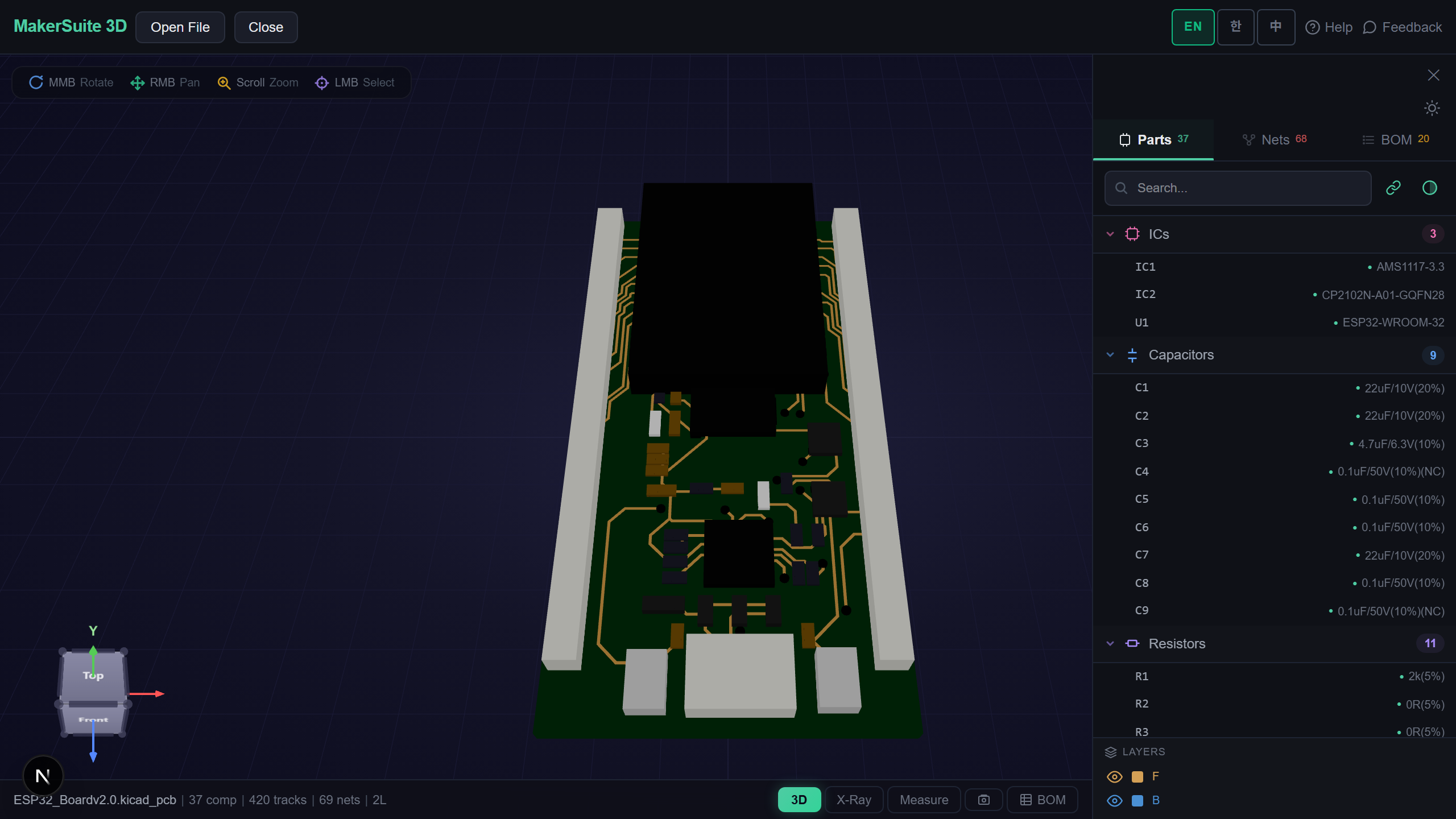
不用 MeshLab 也能看 3D 扫描输出
PLY(Polygon File Format,也叫 Stanford Triangle Format)是消费级和专业 3D 扫描仪(Artec、Polycam、Revopoint、Einstar)和摄影测量工具(Meshroom、RealityCapture、Metashape)的标准输出。该格式 1990 年代中期在 Stanford 开发,因原生支持每顶点颜色(对扫描数据至关重要)而保持流行。MakerSuite 3D 在浏览器里解析 ASCII 和二进制 PLY,所以不用装 MeshLab 或 CloudCompare 也能检查扫描输出。
PLY 格式内部
PLY 有声明数据布局的 ASCII 头,后面跟 ASCII 或二进制记录。头列出元素类型(vertex、face)和属性(x、y、z、nx、ny、nz、red、green、blue、alpha、s、t)。数据段精确按声明的 schema 走。ASCII PLY 人类可读但解析慢;二进制 PLY(小端或大端)是大型扫描的生产选择。头永远是 ASCII,所以 JavaScript 解析器能先读头再决定如何处理数据段。
查看器处理什么
- 网格 PLY — 顶点 + 面渲染为闭合网格,扫描数据里有每顶点颜色就显示。
- 点云 PLY — 仅顶点的文件渲染为点云;网格化前的原始扫描仪输出有用。
- 每顶点颜色 — RGB 属性保留并渲染,所以彩色扫描(Polycam、Revopoint)按捕获的纹理显示。
- 每顶点法线 — 存了法线就用于光照;否则按面几何计算。
- 二进制解析 — 小端和大端二进制 PLY 都按头里声明的格式正确解码。
- 大文件处理 — 数百万顶点的扫描通过 WebGL 用 LOD 渲染流畅交互。
五步看 PLY
- Open pcbviewer.app — 把 .ply 文件拖到 MakerSuite 3D 画布上。头立即解析,数据段对大文件异步读取。
- 点云文件(仅顶点)启用点云渲染模式。球体 splatting 和按高度上色选项帮助解读原始扫描数据。
- 网格文件用环绕/平移/缩放检查模型。扫描里有每顶点颜色就自动渲染。
- 用测量工具确认扫描缩放。检查器面板里显示包围盒尺寸 — 验证扫描仪输出毫米还是厘米有用。
- 从点云做网格重建:导出到 MeshLab 跑 Filters > Remeshing > Surface Reconstruction: Poisson。把网格化的 PLY 重新导入 MakerSuite 3D 验证结果。
立即检查 3D 扫描输出 — 在网格重建或下游使用之前用浏览器预览 PLY 文件。
免费试用 MakerSuite 3DPLY 为什么仍是扫描标准
PLY 的每顶点颜色支持是扫描数据的杀手特性。STL 没有颜色,OBJ 用材质文件(按面、不是按顶点),glTF 支持顶点颜色但不是扫描仪行业默认。在同时支持每顶点颜色和每顶点置信度/强度的扫描仪格式成为标准之前,PLY 仍是自然导出。Stanford 开放规范加 30 年通用工具意味着每个 CAD、可视化、图形工具都能读 — 没有供应商锁定风险。
PLY 在工作流里出现的时刻
- 3D 扫描仪导出 — Artec、Polycam、Revopoint、Einstar 都默认 PLY 用于彩色网格输出
- 摄影测量结果 — Meshroom、RealityCapture、Metashape 把 PLY 作为网格+颜色的标准结果
- 逆向工程 — 把物理零件扫成 PLY,再做网格化和 STEP 转换以做参数化 CAD 建模
- 文化遗产 — 博物馆和考古 3D 文档广泛用 PLY 做颜色忠实捕获
- 学术图形 — 教科书示例(Stanford Bunny、Dragon、Buddha)默认以 PLY 出货
浏览器端解析,零上传
3D 扫描数据经常代表专有零件、敏感文化遗产或量产前原型。MakerSuite 3D 的 PLY 查看器用 three.js PLYLoader 在浏览器里完整解析文件 — 不走服务器、不上传、不缓存。几何、颜色属性、元数据都留在你的机器上。NDA 扫描、博物馆文档、IP 敏感的逆向工程都安全。
常见问题
What is a PLY file?
PLY (Polygon File Format, also called Stanford Triangle Format) was developed at Stanford University in the mid-1990s by Greg Turk for storing 3D scan data from the Stanford 3D Scanning Repository (the source of the Stanford Bunny, Dragon, and Happy Buddha models still used in graphics research today). The format stores vertices, faces, and per-vertex attributes (color, normal, alpha, texture coordinates) in either ASCII text or binary little/big-endian. The header is always ASCII, declaring the data layout, followed by raw vertex/face records.
When would I get a PLY file?
Three common sources today: (1) 3D scanners — most consumer and professional scanners (Artec, Polycam, Revopoint, Einstar) export PLY because of its native point cloud and per-vertex color support, (2) photogrammetry pipelines — Meshroom, RealityCapture, and Agisoft Metashape output PLY as the canonical mesh+color result, (3) academic research — the format is still ubiquitous in graphics papers because the spec is simple, well-documented, and tooling is universal. Less common today for game/film pipelines, which favor FBX, glTF, USD.
PLY vs OBJ vs STL — which is right?
Pick by what your data has. PLY for point clouds, photogrammetry, or anything with per-vertex color/intensity. OBJ for general-purpose mesh exchange when you need separate material files. STL for 3D printing, where you only need triangles and don't care about color. PLY is the only one of the three that natively stores per-vertex RGB without external materials, which is why scanners use it. STL is geometry-only by definition. OBJ stores colors per material via .mtl, not per vertex, so a colored point cloud → OBJ loses precision.
Can I open binary PLY in a browser?
Yes. The PLY format's ASCII header self-describes the binary chunk that follows, including endianness, so JavaScript readers can parse both ASCII and binary variants without external configuration. three.js ships PLYLoader for this. MakerSuite 3D parses PLY in the browser — drop the file, the viewer reads the header, decodes vertices and faces, and renders. Per-vertex colors are preserved if present. No upload, no install. Works on Mac, Windows, Linux, ChromeOS, iPad, anywhere a modern browser runs.
Why is my PLY file just dots?
Because it has no faces — only vertices. PLY can store either a mesh (vertices + faces) or a point cloud (vertices only). Many 3D scanners output point cloud PLY initially, then a meshing step (Poisson reconstruction in MeshLab, ball-pivoting in Meshroom) converts the cloud to a closed mesh. If your viewer renders dots, you have a point cloud — open it in MeshLab (free, open source) and run Filters > Remeshing > Surface Reconstruction: Poisson to get a triangulated mesh. Then re-export as PLY (mesh) or OBJ for downstream use.
相关文章
拖入 .ply 文件 — 任何浏览器里预览 3D 扫描和摄影测量数据
打开 PLY 查看器