Eagle 转 KiCad 教程 — 2026 迁移指南
Autodesk EAGLE 结束了 — 现在怎么办
Autodesk 在 2023 年宣布 EAGLE 停服,最终日期定在 2026 年 6 月 7 日。新许可证停售、订阅停续,整个客户群被推向绑在 Fusion 360 里的付费 Fusion Electronics。很多团队对这套新捆绑不买账。EAGLE 项目最自然的归宿是 KiCad — 开源、永久免费、活跃开发,从 KiCad 6 起内置原生 EAGLE 导入器,开箱就能处理 .brd 板文件、.sch 原理图、.lbr 库。这篇讲清楚真正的迁移是什么样、哪里会翻车、结果怎么在信任它之前先验一遍。
迁移实际搬运的东西
EAGLE 文件是 XML — 板是 .brd,原理图是 .sch,库是 .lbr。KiCad 文件是 S-expression — .kicad_pcb、.kicad_sch、.kicad_sym、.kicad_mod。KiCad 导入器直接读 EAGLE XML 并输出对应的 S-expression。能搬过来的:板外框、铜层、走线、过孔、焊盘、铺铜、丝印、元件摆放、飞线、网络名、设计规则。需要二次处理的:封装库引用(EAGLE 封装 vs KiCad 封装)、3D 模型(EAGLE 不带,KiCad 要 .step 或 .wrl)、用 EAGLE ULP 脚本写的自定义 DRC。原理图符号能搬过来,但在你把它们重映射到真实符号库之前,会挂在 KiCad 的通用占位符上。
KiCad EAGLE 导入器能搞定的事
- 内置原生 — KiCad 8 的 File > Import > Non-KiCad Board/Schematic。不用插件、不用外部工具、不用订阅。默认安装就带。
- 网络保留 — 每一根线、每条飞线、每个网络名都原样过来。PCB 迁移里最难的一块,导入器处理得很干净。
- 层叠重映射 — EAGLE 的 16 个铜层自动映射到 KiCad 的 32 层叠层。丝印、锡膏、阻焊、禁布层全对得上。
- 元件摆放保留 — X/Y 坐标、旋转、面(顶/底)、封装名全部转移。但封装名到 KiCad 封装库路径的重映射还得你来做。
- 铺铜转换 — 铜区变成 KiCad 的 zone,网络归属和间距规则不变。热连接保留。
- 设计规则导入 — 间距、线宽、过孔尺寸从 EAGLE DRU 文件读出并填到 KiCad 的板设置里。出板前务必再核一遍。
五步完成迁移
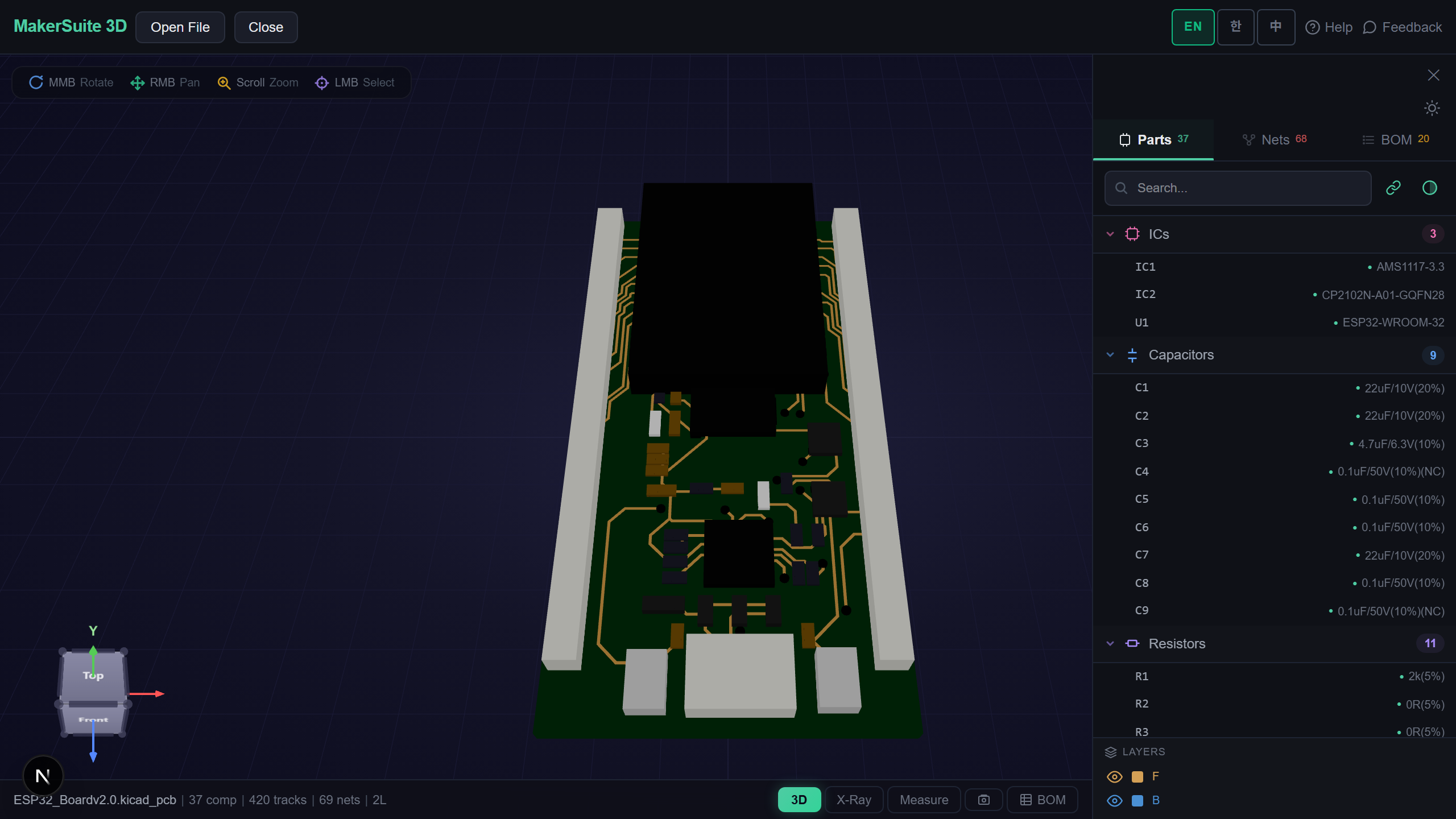
- Open pcbviewer.app — 先拖 .brd 文件,确认解析没毛病。MakerSuite 3D 能读,KiCad 就能读。
- 打开 KiCad 8.x,选 File > Import > Non-KiCad Board File,指定你的 .brd。KiCad 会在同目录生成对应的 .kicad_pcb。
- 原理图单独导入 — File > Import > Non-KiCad Schematic/Project 处理 .sch。两边都进来后跑一次 Tools > Update PCB from Schematic。
- 重映射封装库 — Tools > Footprint Editor > Global Library Nickname Substitution。EAGLE 的库名跟 KiCad 对不上,映射到 KiCad 官方库,或者映射到从 .lbr 转出来的 .kicad_sym。
- 把 KiCad 板导出成 Gerber,把结果 zip 重新拖回 MakerSuite 3D。跟原 EAGLE 板做视觉对比 — 层错位、铺铜丢失、元件转向立刻就看得出来。
在信任转换结果前,把原 .brd 和新 .kicad_pcb 一起拖到 MakerSuite 3D — 30 秒视觉 diff 就能抓住导入器的静默回归。
免费试用 MakerSuite 3D为什么这次迁移真有截止日期
2026 年 6 月 7 日停服不是营销话术 — 那天之后 EAGLE 不再激活新安装,老安装也失去对云端元件库的访问。离线 .exe 能继续跑,但新同事装不了、许可证没法转移、任何依赖云端库同步的团队工作流都崩。拖过截止日的团队会花时间维护死掉的工具链,而不是出板。正确做法是现在就转换活跃项目,留一台机器装个离线 EAGLE 当只读存档,新板从第一天起就在 KiCad 里做。
谁在迁、为什么
- Autodesk 停服 — 2026 年的头号驱动因素。赶在 6 月截止前迁完,避免工作流中断
- 许可证成本 — EAGLE Premium 订阅最后一年是每月 $65,KiCad 免费、席位数没上限
- 开源政策 — 内部要求可审计、不锁厂商 CAD 链的公司按政策切到 KiCad
- Linux 原生工作流 — KiCad 不用 Wine 就能在 Linux 上跑,Autodesk 从来没做过 Linux 版 EAGLE
- Git 友好的版本控制 — KiCad 的 S-expression 文件 git diff 起来很干净;EAGLE XML 也能 diff,但在代码评审里噪音大得多
在浏览器里验证转换结果
PCB 源文件装着你完整的设计 IP。把 .brd 或 .kicad_pcb 传到云端查看器在 NDA 项目里是风险。MakerSuite 3D 用 JavaScript 在浏览器里直接解析 EAGLE 和 KiCad 文件 — 不走服务器、不上传、不留缓存。一个标签页打开原 EAGLE .brd,另一个标签页打开转出来的 .kicad_pcb,并排对比。跟导入器作者内部用的是同一套解析逻辑,只是挪到客户端跑,板子不出你的机器。
EAGLE→KiCad 特有的迁移陷阱
库重映射是大多数团队烧掉一周的地方。EAGLE 库通过名字("R0805")把封装绑到零件上,导入器把名字带过来但不带几何 — KiCad 在库路径里要有同名的真实封装。如果您的 EAGLE 工作流用了 SparkFun、Adafruit 或自家库,第一次导入会看到几百条「footprint not found」警告。修复方法是在导入板子之前用开源 `eagle-to-kicad-libs` 脚本批量转换 .lbr 文件,让名字能解析。
ULP 脚本不会跟过来。EAGLE 的 User Language Programs 是处理网络重命名到 BOM 报告各种事情的自定义 C-like 脚本层。KiCad 用 Python 插件代替 — 不同语言、不同 API、不同 hook。如果团队为了发布版本依赖某个特定 ULP,要计划重写。最常见的 ULP(BOM 导出器、gerber 生成器)在默认安装里有 KiCad 直接等价物,所以重写常常不必要。
常见问题
Is Autodesk EAGLE really going away?
Yes. Autodesk officially announced EAGLE's discontinuation in 2023 and set the final sunset for June 7, 2026. New license sales stopped earlier, subscription renewals are ending, and cloud library services shut down on the sunset date. Existing installs continue to run offline indefinitely, but without updates or cloud sync. Autodesk directs the customer base toward Fusion Electronics (formerly Fusion 360 Electronics), which is a paid subscription bundled into Fusion 360 rather than a standalone EAGLE successor.
Does KiCad's EAGLE importer actually work on real boards?
Yes — it has been built into KiCad since version 6 (released 2022) and matured significantly in KiCad 7 and 8. The importer reads .brd, .sch, and .lbr XML files directly and produces native .kicad_pcb and .kicad_sch output. Nets, layers, component placements, zones, and design rules transfer reliably. The parts that need manual attention are footprint library remapping (EAGLE package names don't match KiCad footprint library paths) and 3D models (EAGLE doesn't ship models, you'll need to find KiCad-compatible .step or .wrl files). For a typical hobbyist or small-team board, expect to spend an afternoon on remapping after a clean import.
What about my EAGLE library files (.lbr)?
KiCad 8 can import .lbr files through File > Import > Non-KiCad Library. The importer splits the EAGLE library into KiCad's separated structure — .kicad_sym for schematic symbols and .pretty folders for footprints. This is useful if you've maintained custom EAGLE libraries for years. For parts covered by KiCad's official libraries (which are extensive), it's usually faster to remap to the official names than to maintain converted custom libraries. For truly custom packages (odd mechanicals, proprietary modules), converting the .lbr keeps your existing work intact.
Will my ULP scripts still work?
No — EAGLE's ULP (User Language Program) scripting is specific to EAGLE's C-like embedded interpreter and has no direct equivalent in KiCad. KiCad uses Python for scripting (via the pcbnew Python API). If you have ULP scripts for BOM generation, panelization, or custom DRC, you'll need to rewrite them in Python. The good news is KiCad's Python API is more powerful and has broader community support, so most ULP use cases have established Python equivalents or open-source plugins.
Can I verify the converted board without installing KiCad?
Yes — MakerSuite 3D opens both EAGLE .brd and KiCad .kicad_pcb files directly in the browser. Drop the original .brd in one tab and the converted .kicad_pcb in another, and visually compare layer by layer. Any silent regression from the importer (missing zones, flipped layers, rotated parts) shows up immediately in the 3D view. No KiCad install required for the verification step, which is useful if you're auditing converted boards on a machine that doesn't have CAD software installed.
相关文章
把 EAGLE .brd 或 KiCad .kicad_pcb 拖进来 — 视觉验证迁移结果
打开 PCB 查看器