KiCad 转 Altium 教程 — 老实迁移指南
Altium 没有原生 KiCad 导入器
这是没人想聊的转换方向。Altium Designer 出 EAGLE 导入器、Allegro 导入器、OrCAD 导入器 — 但没有 KiCad 导入器。反方向(Altium → KiCad)从 KiCad 7 起就内置。KiCad → Altium 要么走制造格式绕路(Gerber、IPC-2581、ODB++),要么用第三方翻译(Altium Vault Importer、翻译服务),要么手动重做。没有一条路能干净保留原理图到 PCB 的连接。本指南讲 2026 年三条真路径,每条保什么丢什么,什么时候付费第三方比手动重建划算。考虑迁移就先老实问一句:你真的需要 Altium,还是团队因为非技术原因强制?
每条转换路径实际做什么
路径 1:从 KiCad 导出 ODB++ → Altium 导入。KiCad 7+ 导出 ODB++(捆绑所有图层艺术加网络数据的制造格式)。Altium 把 ODB++ 当板子导入,但没有原理图。你拿到布局、铜、钻孔、元件、网络名 — 但丢原理图、设计规则、编辑历史。路径 2:IPC-2581 导出 → Altium 导入。跟 ODB++ 同样的取舍但更新格式、更广的厂商支持。路径 3:第三方工具 — Altium 专业服务或 Cadence/Mentor 这类厂商提供付费翻译。手动重建是路径 4 — 把 KiCad 设计当参考图打开,在 Altium 里重新做原理图、重新布线 PCB。慢但产出干净的 Altium 原生源。大多数团队低估路径 4,路径 1-3 出无法维护的输出后还是回到这条路。
每条路径保留什么
- ODB++ 导出 — 铜层、钻孔、板外形、元件位置、网络名、每层设计规则。没有原理图、没有库连接、没有可编辑历史。
- IPC-2581 — 跟 ODB++ 同样的范围,更新的 XML 格式。现代 Altium 版本里集成 bug 更少,但转换结果功能上一致。
- Gerber + Excellon — ODB++ 导入不干净时的备选。在 Altium 里要手动重建网表,因为 Gerber 不带网络数据。
- Altium Vault Importer — 付费 Altium 服务,跑转换并把可工作的 .PrjPcb 寄回。按项目报价,复杂度决定 $500-2K。
- 手动重建 — 最慢路径但产出干净 Altium 源。用 KiCad 原理图的 PDF 图作视觉参考,在 Altium 里重画原理图,然后摆元件布线。规划按小时算不是按分钟。
- 网络验证 — 不管哪条路径,把转出来的板子从 Altium 导回 Gerber 跟 KiCad 原始板子视觉对比。MakerSuite 3D 处理两种格式,并排检查很容易。
五步处理迁移
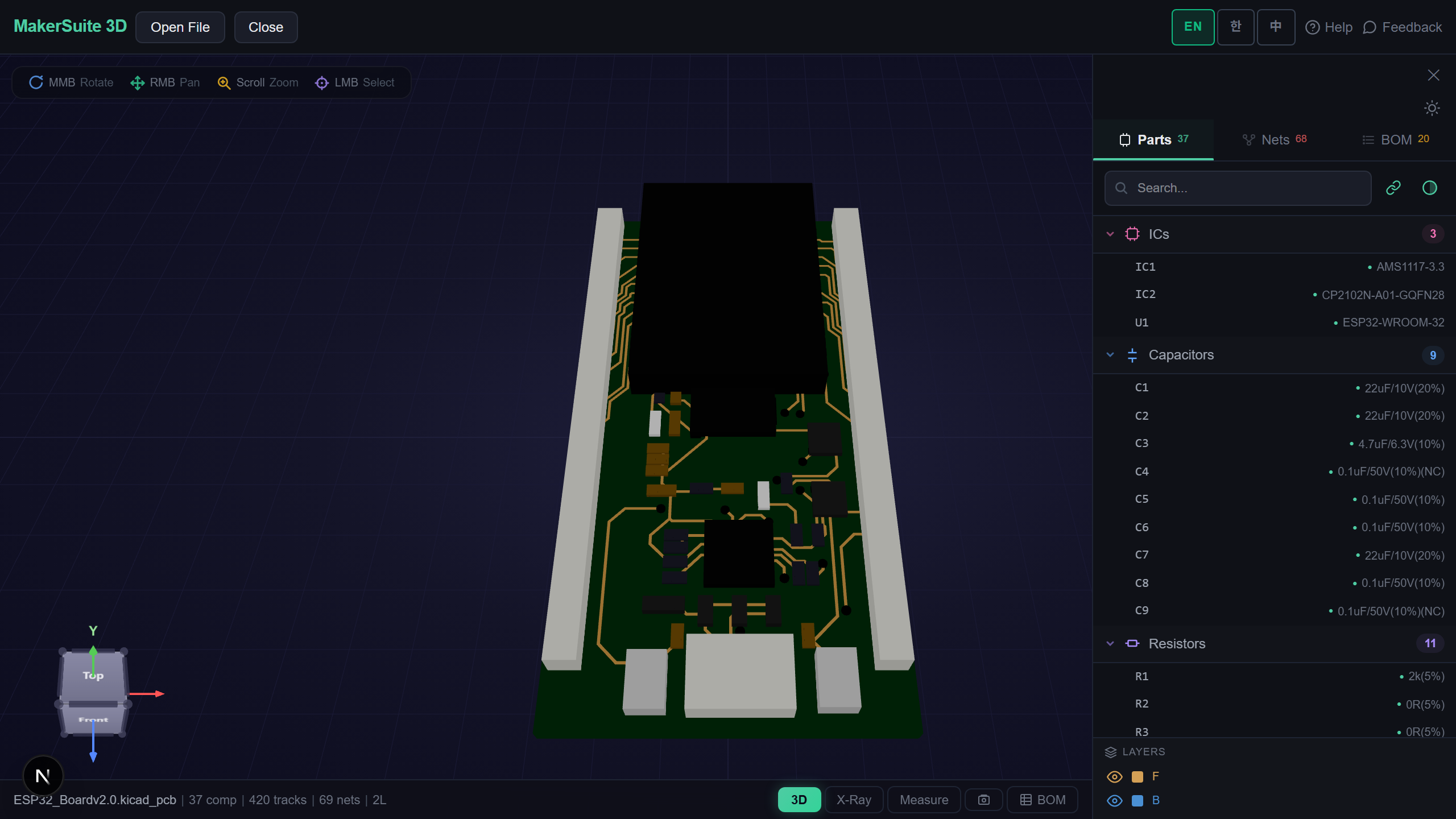
- Open pcbviewer.app — 先把 .kicad_pcb 拖到 MakerSuite 3D 确认源干净。源里的图层问题、元件旋转问题、网络数据缺口在转换里会复合放大。
- 先试 ODB++ — KiCad PCB Editor > File > Fabrication Outputs > ODB++。在 Altium 里 File > Import > ODB++ 打开结果 .tgz。检查:元件在不在对位置、网络名对不对、板外形正不正确。
- ODB++ 出问题就在 KiCad 里导出 IPC-2581 在 Altium 里导入。Altium 24+ 里更新格式,翻译 bug 更少。保留数据范围一样。
- 决定是接受转换板子(无可编辑原理图、仅制造交付)还是手动重建做真 Altium 原生工程。预算法则:在 Altium 里要编辑超 6 个月的板子值得手动重建。
- 验证转换 — 把 Altium 板子导出 Gerber,原始 KiCad 和转换后 Altium 的 Gerber 一起拖到 MakerSuite 3D。视觉 diff 抓出丢焊盘、图层漂移、静默翻译错误。
视觉对比原始 KiCad 板子和转出来的 Altium 输出 — 把两个 Gerber 导出都拖进 MakerSuite 3D,在签字前抓出静默翻译错误。
免费试用 MakerSuite 3D为什么这次迁移痛苦
KiCad 和 Altium 走了不同的架构路。KiCad 用 S-expression 文本文件,原理图/PCB/库分开。Altium 用二进制 OLE2/CFB 工程容器(.PrjPcb),里面嵌入原理图、PCB、库数据。根本表征差异意味着没有规范化的转换 — 要么通过仅制造的中间格式翻译(丢原理图),要么做自定义二进制格式重写(第三方翻译收的钱就是这个)。再加上 Altium 有商业动机不让 KiCad 迁移容易,结果就是 EDA 工具世界永久的摩擦点。老实建议:如果你有可工作的 KiCad 工程,留在 KiCad。如果团队为合规/PLM/客户要求强制 Altium,规划手动重建别想一锤子转换。
KiCad 转 Altium 发生的场景
- 客户要求 — 买家要 Altium 原生交付,KiCad 源得在 Altium 里重做
- PLM 集成 — 公司 PLM 系统(Windchill、Teamcenter)只为 Altium 配置,KiCad 不适配
- 团队强制 — 招聘 Altium 训练过的工程师,KiCad 工程为持续维护得转
- 仿真工具 — KiCad ngspice 集成处理不了的模拟工作需要 Altium 生态(SimTools、Mixed Signal)
- 多板工程 — Altium 里有现存工程系列,新 KiCad 设计的板子要跟现有舰队集成
在浏览器里验证转换
PCB 源文件含完整设计 IP。把 .kicad_pcb 或 .PcbDoc 上传到云端转换器或查看器对 NDA 工作是真风险。MakerSuite 3D 在浏览器里通过 JavaScript 完整解析 KiCad 和 Altium 文件 — 不走服务器、不上传、不缓存。一个标签开原 KiCad、另一个开转后 Altium,逐层对比。任何静默回归 — 翻图层、丢敷铜、转零件 — 都立即在 3D 视图里看到,几何不出本机。
手动重建胜过转换的时候
对于您积极维护并打算在 Altium 中修订几十次的板子,有损导入是每次修订都累积的税。每次导入的板子撞上一个未完全理解的 Altium 功能(rule-aware 多边形 pour、动态铜、带 sheet 符号的层级原理图),您手动打补丁。六次修订后,您的 Altium 工程是没人能审计的导入与重建几何的拼贴。对于设计时间值数百小时以上的活跃工程,把 KiCad 版本作为 reference 在 Altium 从头重建 — 前期慢,之后永远快。
诚实的第一个问题是您是否真的需要 Altium。如果团队因非技术原因(15 年前用过 Altium 的董事、未指明原因要求的客户)强制,用具体数字反驳。Altium 许可证每年每席位 $9,000+。KiCad 在生产中交付 PCIe Gen4 设计、RF 板、16 层混合信号叠层。迁移的唯一诚实理由是您实际使用的特定 Altium 功能(Draftsman、ActiveBOM、Variant Management)或真正的生态系统要求(Altium 365 Workspace 集成)。其他一切,转换成本超过收益。
常见问题
Why doesn't Altium have a KiCad importer?
Two reasons. First, Altium has commercial incentive — KiCad is free, growing fast, and removing migration friction would help users leave Altium more easily than join. Second, the conversion is genuinely hard: Altium's binary OLE2/CFB project format and KiCad's S-expression text format have different schematic-to-PCB linking semantics, library structures, and rule engines. EAGLE→Altium and OrCAD→Altium importers exist because Altium acquired commercial agreements; KiCad has no acquirer to negotiate with. The third-party translator market (Altium Translation Services, professional services firms) fills the gap for paying customers.
What does ODB++ from KiCad actually transfer to Altium?
Layout-only. ODB++ is a fabrication format from Mentor Graphics (Siemens) — it bundles all copper layer artwork, drill data, board outline, component placements, and net data into a single .tgz archive. Altium imports it as a board (.PcbDoc) but no schematic, no library connections, no editable schematic-to-PCB linkage. You get a working layout that can be modified in Altium and re-fabricated, but every component is a one-off footprint with no library backing. Suitable for fab-only handoff; not suitable for ongoing engineering changes.
Is IPC-2581 better than ODB++ for this conversion?
Functionally similar, but IPC-2581 has fewer translation bugs in modern Altium versions. IPC-2581 is the open IPC standard equivalent of ODB++ — XML-based, royalty-free, designed to be vendor-neutral. KiCad 7+ exports both. In Altium 24+, IPC-2581 import is more recently maintained and handles edge cases (split planes, thermal spokes, exotic via shapes) more reliably. ODB++ still works but is more likely to need cleanup. Try IPC-2581 first; fall back to ODB++ if your Altium version doesn't import it cleanly.
Should I pay for a third-party translator?
Maybe, depending on your timeline and budget. Altium Translation Services and similar vendors charge $500-2000 per project for a full conversion that includes schematic regeneration. Worth it if: (1) the project is large (>500 components) and rebuilding manually would take weeks, (2) you need editable schematic-to-PCB linkage in Altium for ongoing maintenance, (3) the customer or PLM system specifically requires Altium-native source. Skip it if: (1) the board is small and rebuilding takes hours, (2) you only need fabrication output (ODB++ does that for free), (3) the project is one-shot and won't see further changes.
What's the realistic time estimate for manual rebuild?
Rule of thumb: 30-60 minutes per 10 components for an experienced Altium user. A 100-component board takes a full day; a 500-component board takes a week. Schematic capture is faster than PCB layout because Altium's schematic editor is highly scriptable and the netlist comes from KiCad as a reference. PCB layout is the bottleneck — re-routing in Altium follows your judgment, not the original KiCad routes, so it's a real design effort. Plan accordingly. The honest cost-benefit: under 100 components, manual rebuild beats automated translation for quality. Over 500, automated translation wins on time but loses on cleanliness.
相关文章
拖入 KiCad 或 Altium 文件 — 视觉验证迁移
打开 PCB 查看器