DAE COLLADA Viewer Online — Free Browser Tool
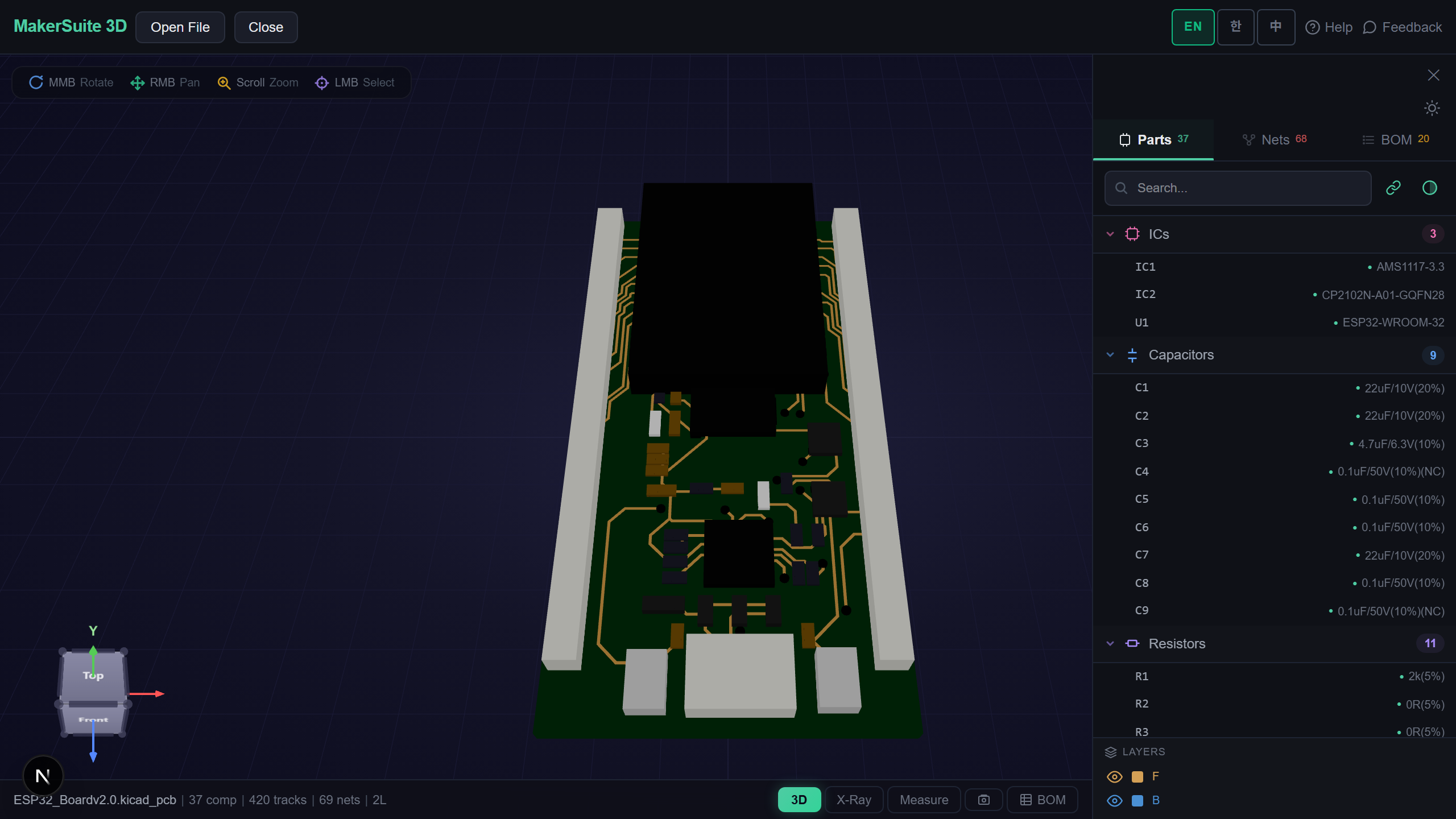
COLLADA Without Installing Blender
COLLADA (.dae) is the XML-based 3D asset interchange format developed by Sony for PlayStation 3 and now maintained by the Khronos Group. It became ISO/PAS 17506:2012 and was the industry exchange standard before glTF took over in 2015. You'll still encounter .dae files from older game pipelines, SketchUp exports, Google Earth models (KMZ archives use COLLADA inside), and academic/scientific visualization. MakerSuite 3D parses .dae in your browser — no install, no upload.
What COLLADA Is and Why It's Still Around
COLLADA's design goal in 2004 was vendor-neutral 3D asset exchange. The XML schema covers geometry, materials, animation, skeletons, physics, and even audio references. The format peaked between 2008-2012 when game studios used it as a Maya/Max ↔ engine pipeline format. Its decline started when game engines moved to FBX (Autodesk's binary format) and web 3D moved to glTF. Today COLLADA persists in three pockets: SketchUp's default export, Google Earth/Maps 3D models, and tools that haven't caught up yet (some scientific viz, some legacy CAD plugins).
What the Viewer Handles
- Geometry — vertex positions, normals, texture coordinates, and triangle topology decode from COLLADA's XML and render with full fidelity.
- Materials — Phong, Lambert, and Blinn shading from <library_effects> map onto three.js MeshPhongMaterial. Diffuse texture maps display correctly.
- Coordinate system — the viewer respects <up_axis> (X_UP, Y_UP, Z_UP) so SketchUp Z-up exports and Maya Y-up exports both render upright.
- Hierarchy — node transforms (translate, rotate, scale, matrix) compose correctly so multi-part assemblies preserve their structure.
- Texture references — the viewer reads embedded base64 textures and external file references; for external refs, drop both .dae and texture files together.
- Read-only inspection — for editing, export through Blender (free) to glTF or FBX; the viewer is for visual review and asset triage, not modification.
How to View .dae in Five Steps
- Open pcbviewer.app — drop your .dae file directly on MakerSuite 3D's canvas. Parser reads the XML header, decodes geometry, and renders within seconds for typical assets.
- For external texture references, drag the .dae alongside the texture files (PNG, JPG). The viewer matches references and decodes textures locally.
- Use the orbit/pan/zoom controls to inspect the model. ViewCube snaps to orthographic views; useful for confirming SketchUp exports came through with the right scale.
- Toggle the Layers panel to see hierarchy. Multi-object COLLADA files (typical from SketchUp) show as a tree you can hide or isolate.
- For modern workflows, convert to glTF using Blender (free): File > Import > COLLADA, then File > Export > glTF 2.0. The conversion is lossy on materials but preserves all geometry.
Inspect .dae files instantly — drop SketchUp or Google Earth exports for browser preview before converting.
Try MakerSuite 3D FreeWhy COLLADA Still Comes Up in 2026
Three reasons. SketchUp's default export remains COLLADA, so any architectural or design asset from SketchUp arrives as .dae unless someone re-exports. Google Earth's 3D model layer uses COLLADA inside KMZ archives, so geo-3D content trades in this format. Legacy game and visualization pipelines built around COLLADA in the late-2000s era still use it, especially in defense, scientific viz, and educational software. A browser viewer is the lowest-friction inspection tool when the source pipeline is opaque.
When You'll Open a .dae File
- SketchUp handoff — architect sends .dae for engineering or print review without expecting you to install SketchUp
- Google Earth 3D — extract a model from KMZ and inspect its geometry before reusing in another tool
- Legacy pipeline asset — pre-2015 game or visualization asset arrives as .dae and you need to triage before converting
- Scientific visualization — biology, chemistry, or geo-spatial models in academic papers shipped as .dae
- Format triage — confirm geometry integrity before committing engineering time to a Blender → glTF conversion run
Browser-Side Parsing, No Upload
COLLADA assets may represent proprietary architectural designs, unreleased products, or sensitive geo-spatial data. MakerSuite 3D's COLLADA viewer parses .dae files entirely in your browser using three.js's ColladaLoader — no server, no upload, no cached copy. Geometry, materials, and texture data all stay on your machine. Safe for NDA work and proprietary asset review.
Frequently Asked Questions
What is COLLADA and is it still relevant?
COLLADA (COLLAborative Design Activity) is an XML-based 3D asset interchange format from the Khronos Group, originally developed by Sony for PlayStation 3 asset pipelines (2004-2006). It became ISO/PAS 17506:2012. The .dae extension stands for Digital Asset Exchange. Today it's mostly legacy — Khronos shifted focus to glTF in 2015 and COLLADA's last spec update (1.5) was 2008. But you'll still encounter .dae files from older game pipelines, SketchUp exports, Google Earth (KML uses COLLADA models), and some scientific visualization tools. Read-only support remains in Blender, Maya, and major DCC tools.
Should I convert .dae files to glTF?
Yes, for any modern workflow. glTF 2.0 has better runtime performance (binary buffers vs XML parsing), broader tool support, and active maintenance. Conversion is straightforward: Blender (free, open-source) imports COLLADA and exports glTF/GLB cleanly. Command-line: collada2gltf (legacy, still works) or use Blender headless with a Python script for batch jobs. Material translation is the main lossy step — COLLADA's <effect> profiles don't always map 1:1 onto glTF PBR, so check your textures after conversion.
Why is my .dae file from SketchUp huge?
SketchUp exports verbose COLLADA. Every triangle gets its own <triangles> element with full attribute spec, every edge becomes a separate primitive, and the XML has no compression. A 50 MB SketchUp model can become a 200+ MB .dae export. Strip unused materials, decimate geometry before export, or export to .skp → import to Blender → re-export as .dae or .glb to get a cleaner file. For Google Earth specifically, the COLLADA spec inside KMZ has size limits (textures must be <2048px on a side, polygon count under 21,845 per <triangles>).
Does COLLADA support animation?
Yes — skeletal animation, morph targets, and joint hierarchies are all in the spec. <library_animations> stores keyframes; <library_controllers> handles skinning weights. Most DCC tools read these correctly. The catch is COLLADA's coordinate system: Y-up vs Z-up varies by exporter. SketchUp exports Z-up, Maya exports Y-up by default, Blender lets you choose. Animation transforms get applied in the file's declared coordinate space, so a Z-up animation imported into a Y-up tool will rotate 90° on import unless the importer respects <up_axis>.
Can I view .dae files without installing Blender?
Yes. Browser-based viewers like MakerSuite 3D parse COLLADA directly using JavaScript XML readers — no install, runs in any modern browser. three.js's ColladaLoader handles the format and is embedded in many web viewers. For quick visual checks before deciding whether to convert or rebuild, browser viewers are the lowest-friction path. The viewer reads geometry, materials, and basic transforms; complex animation rigs may need Blender's deeper importer for full fidelity.
Related Articles
Drop your .dae file — preview COLLADA assets in any browser
Launch DAE Viewer