How to Fix Non-Manifold STL Files — Free Browser Repair Tool
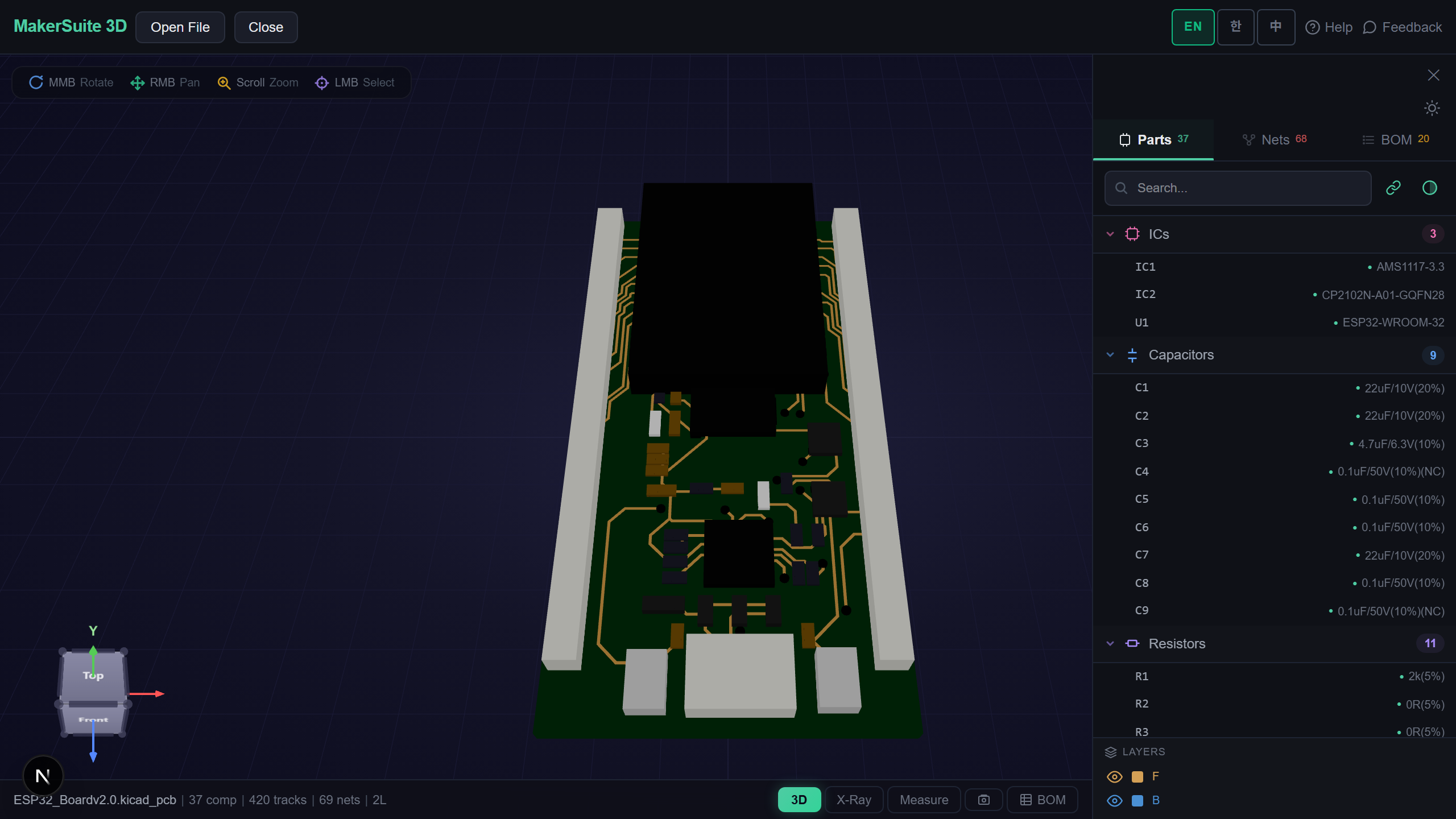
When Your STL Refuses to Slice
You drag your STL into PrusaSlicer or Cura and get a red warning: non-manifold edges, zero-thickness walls, flipped normals. The slice fails, the print fails, or worse — it silently prints garbage. MakerSuite 3D now repairs these problems in one click using Google's manifold-3d WASM library. No install, no account, no upload — the fix happens in your browser.
What "Non-Manifold" Actually Means
A manifold mesh is a watertight surface every slicer can turn into toolpaths: every edge is shared by exactly two triangles, every vertex has a well-defined neighbourhood, and the inside/outside is unambiguous. Non-manifold meshes break one of these rules — they have holes, T-junctions where three triangles meet an edge, duplicate vertices at seams, or inverted normals. STL exports from sketch-based CAD, voxel modelers, or old plugins often produce non-manifold geometry.
What the Repair Does
- Vertex welding — collapses coincident vertices within 1e-4 tolerance, closing seam gaps from duplicated verts
- Manifold enforcement — runs the mesh through manifold-3d which rejects any triangle configuration that can't form an oriented 2-manifold
- Degenerate triangle removal — drops zero-area and near-collinear triangles that cause slicer infinite loops
- Normal orientation — guarantees consistent outward-facing normals, fixing the "inside-out" black holes in your preview
- Graceful fallback — if the mesh can't be made fully manifold, you still get the welded-only result (which usually fixes shading seams)
- Undoable — the pristine original is cached so you can compare before/after or restore with one click
How to Repair an STL in Your Browser
- Open pcbviewer.app/tools/3d-viewer — No install, no MeshLab, no Blender
- Drag and drop your broken .stl file onto the drop zone
- Open the REPAIR panel in the sidebar — it shows current triangle and vertex count
- Click Repair mesh — the manifold-3d WASM (~480 KB) loads once, then repair completes in under a second for most prints
- Export the repaired mesh as STL or 3MF and send it straight to your slicer — the ✓ manifold badge confirms it's watertight
Drop a broken STL — one-click repair, ready for your slicer.
Try MakerSuite 3D FreeWhy Browser-Based Repair Beats Desktop Tools
MeshLab and Blender both repair non-manifold meshes, but they're heavy installs with steep learning curves. Meshmixer (Autodesk) was the go-to free option but Autodesk discontinued it in 2024 and downloads still float around the web on questionable mirrors. Online repair services upload your file to a server, which is slow and a deal-breaker for NDA-bound work. MakerSuite 3D runs the exact same manifold-3d library that Fusion 360 and Onshape use, right in your tab — nothing leaves your machine.
When You Need This
- Thingiverse downloads that fail in your slicer — usually bad exports from 10-year-old modelers
- 3D scans from photogrammetry (Polycam, RealityCapture) — dense meshes with scanner artifacts
- CAD exports from Tinkercad or legacy SketchUp plugins that skip normal orientation
- Boolean results from node-based modelers (Houdini, Grasshopper) that leave floating triangles
- Character models from sculpting apps (ZBrush decimation, Nomad Sculpt) before sending to a print farm
Privacy
Repair runs inside the WASM sandbox in your browser tab. No upload, no cloud processing, no account. Your STL stays on your machine — even the repair WASM binary is served from our CDN as a static file, not a server endpoint. Close the tab and there's no trace.
Frequently Asked Questions
What makes an STL file non-manifold?
A mesh is non-manifold when any edge is shared by more or fewer than exactly two triangles, when a vertex has no well-defined neighbourhood, or when normals flip direction. Duplicated vertices at seams, T-junctions, zero-area triangles, and holes are the common culprits — all of which our repair step handles.
Is this as good as Blender or MeshLab?
The repair uses manifold-3d, the same Google library that Autodesk Fusion 360 and Onshape use under the hood. For most common STL problems (vertex duplication, degenerate triangles, flipped normals) it matches Blender's 3D Print toolbox. Blender still wins for manual hole-filling on severely broken scans — where the mesh needs human judgement — but the one-click case covers ~90% of failed-to-slice STLs.
Does the repair change my model's geometry?
It welds coincident vertices within 1e-4 units and drops triangles that are either zero-area or near-collinear. For any mesh that was already clean, the output is geometrically identical. For broken meshes, the topological errors are fixed with minimal changes — no smoothing, no decimation, no hole-filling that invents new geometry.
What if the mesh can't be made manifold?
You still get a welded-only result as a fallback — duplicated vertices are merged and the mesh is re-indexed, which fixes shading seams and many slicer warnings even if the topology still has open edges. The UI shows a warning badge so you know the result isn't a full manifold.
Can I undo the repair?
Yes. The pristine original is cached in memory, so the Restore button swaps it back instantly. You can repair, compare, and restore without reloading the file.
Related Articles
Drop a broken STL — repair it in seconds
Launch 3D Viewer