PLY File Viewer Online — Free Stanford Format Viewer
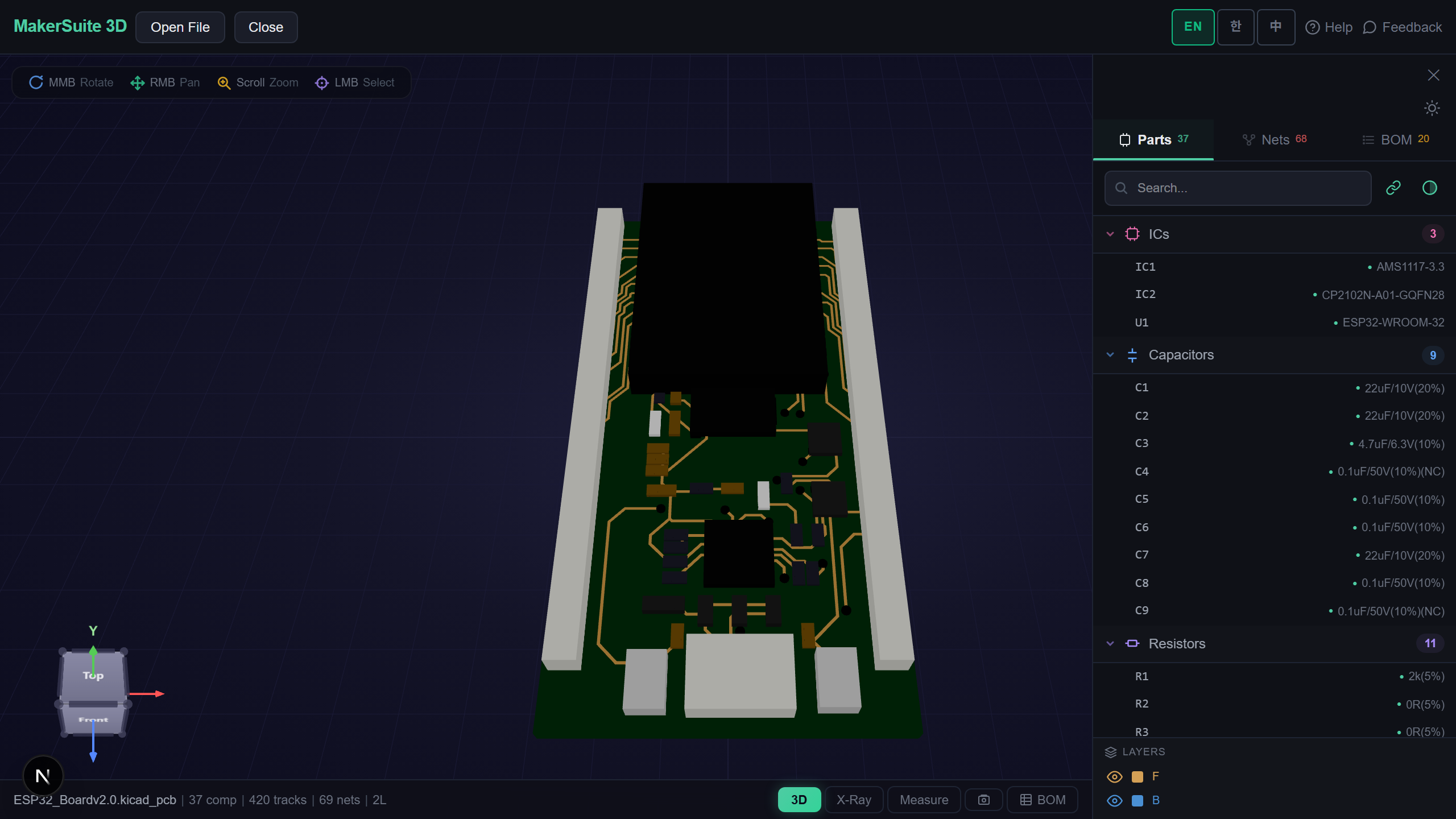
3D Scan Output Without MeshLab
PLY (Polygon File Format, also called Stanford Triangle Format) is the standard output of consumer and professional 3D scanners (Artec, Polycam, Revopoint, Einstar) and photogrammetry tools (Meshroom, RealityCapture, Metashape). The format was developed at Stanford in the mid-1990s and remains popular because it natively supports per-vertex color — critical for scan data. MakerSuite 3D parses both ASCII and binary PLY in your browser, so you can inspect scan output without installing MeshLab or CloudCompare.
PLY Format Internals
PLY has an ASCII header that declares the data layout, followed by either ASCII or binary records. The header lists element types (vertex, face) and properties (x, y, z, nx, ny, nz, red, green, blue, alpha, s, t). The data section follows the declared schema exactly. ASCII PLY is human-readable but slow to parse; binary PLY (little or big endian) is the production choice for large scans. The header is always ASCII regardless, so a JavaScript parser can read it first to decide how to handle the data section.
What the Viewer Handles
- Mesh PLY — vertices + faces render as a closed mesh with per-vertex colors if present in the scan data.
- Point cloud PLY — vertices-only files render as a point cloud; useful for raw scanner output before meshing.
- Per-vertex color — RGB attributes preserved and rendered, so colored scans (Polycam, Revopoint) show with their captured texture.
- Per-vertex normal — if normals are stored, they're used for lighting; otherwise computed from face geometry.
- Binary parsing — both little-endian and big-endian binary PLY decode correctly using the header's declared format.
- Large file handling — multi-million-vertex scans render via WebGL with level-of-detail rendering for smooth interaction.
How to View PLY in Five Steps
- Open pcbviewer.app — drop your .ply file on MakerSuite 3D's canvas. Header parses immediately; data section reads asynchronously for large files.
- For point cloud files (vertex-only), enable the Point Cloud rendering mode. Sphere splatting and color-by-height options help interpret raw scan data.
- For mesh files, use orbit/pan/zoom to inspect the model. Per-vertex colors render automatically if present in the scan.
- Use measurement tools to confirm scan scale. Bounding box dimensions appear in the inspector panel — useful for verifying scanner mm vs cm output.
- For mesh reconstruction from point clouds, export to MeshLab and run Filters > Remeshing > Surface Reconstruction: Poisson. Re-import the meshed PLY into MakerSuite 3D to verify the result.
Inspect 3D scan output instantly — drop PLY files for browser preview before mesh reconstruction or downstream use.
Try MakerSuite 3D FreeWhy PLY Is Still Standard for Scans
PLY's per-vertex color support is the killer feature for scan data. STL has no color, OBJ uses material files (per-face, not per-vertex), glTF supports vertex colors but isn't the scanner industry default. Until a scanner format with both per-vertex color and per-vertex confidence/intensity becomes standard, PLY remains the natural export. Stanford's open spec and 30 years of universal tooling means every CAD, viz, and graphics tool can read it — vendor lock-in isn't a risk.
When PLY Shows Up in Your Workflow
- 3D scanner export — Artec, Polycam, Revopoint, Einstar all default to PLY for colored mesh output
- Photogrammetry result — Meshroom, RealityCapture, Metashape produce PLY as the canonical mesh+color result
- Reverse engineering — scan a physical part to PLY, then mesh and convert to STEP for parametric CAD modeling
- Cultural heritage — museum and archaeological 3D documentation widely uses PLY for color-faithful captures
- Academic graphics — textbook examples (Stanford Bunny, Dragon, Buddha) ship as PLY by default
Browser-Side Parsing, No Upload
3D scan data often represents proprietary parts, sensitive cultural heritage, or pre-production prototypes. MakerSuite 3D's PLY viewer parses files entirely in your browser using three.js's PLYLoader — no server, no upload, no cached copy. Geometry, color attributes, and metadata all stay on your machine. Safe for NDA scans, museum documentation, and IP-sensitive reverse engineering.
Frequently Asked Questions
What is a PLY file?
PLY (Polygon File Format, also called Stanford Triangle Format) was developed at Stanford University in the mid-1990s by Greg Turk for storing 3D scan data from the Stanford 3D Scanning Repository (the source of the Stanford Bunny, Dragon, and Happy Buddha models still used in graphics research today). The format stores vertices, faces, and per-vertex attributes (color, normal, alpha, texture coordinates) in either ASCII text or binary little/big-endian. The header is always ASCII, declaring the data layout, followed by raw vertex/face records.
When would I get a PLY file?
Three common sources today: (1) 3D scanners — most consumer and professional scanners (Artec, Polycam, Revopoint, Einstar) export PLY because of its native point cloud and per-vertex color support, (2) photogrammetry pipelines — Meshroom, RealityCapture, and Agisoft Metashape output PLY as the canonical mesh+color result, (3) academic research — the format is still ubiquitous in graphics papers because the spec is simple, well-documented, and tooling is universal. Less common today for game/film pipelines, which favor FBX, glTF, USD.
PLY vs OBJ vs STL — which is right?
Pick by what your data has. PLY for point clouds, photogrammetry, or anything with per-vertex color/intensity. OBJ for general-purpose mesh exchange when you need separate material files. STL for 3D printing, where you only need triangles and don't care about color. PLY is the only one of the three that natively stores per-vertex RGB without external materials, which is why scanners use it. STL is geometry-only by definition. OBJ stores colors per material via .mtl, not per vertex, so a colored point cloud → OBJ loses precision.
Can I open binary PLY in a browser?
Yes. The PLY format's ASCII header self-describes the binary chunk that follows, including endianness, so JavaScript readers can parse both ASCII and binary variants without external configuration. three.js ships PLYLoader for this. MakerSuite 3D parses PLY in the browser — drop the file, the viewer reads the header, decodes vertices and faces, and renders. Per-vertex colors are preserved if present. No upload, no install. Works on Mac, Windows, Linux, ChromeOS, iPad, anywhere a modern browser runs.
Why is my PLY file just dots?
Because it has no faces — only vertices. PLY can store either a mesh (vertices + faces) or a point cloud (vertices only). Many 3D scanners output point cloud PLY initially, then a meshing step (Poisson reconstruction in MeshLab, ball-pivoting in Meshroom) converts the cloud to a closed mesh. If your viewer renders dots, you have a point cloud — open it in MeshLab (free, open source) and run Filters > Remeshing > Surface Reconstruction: Poisson to get a triangulated mesh. Then re-export as PLY (mesh) or OBJ for downstream use.
Related Articles
Drop your .ply file — preview 3D scan and photogrammetry data in any browser
Launch PLY Viewer