USDZ Viewer Online Free — Open Apple AR Files in Browser
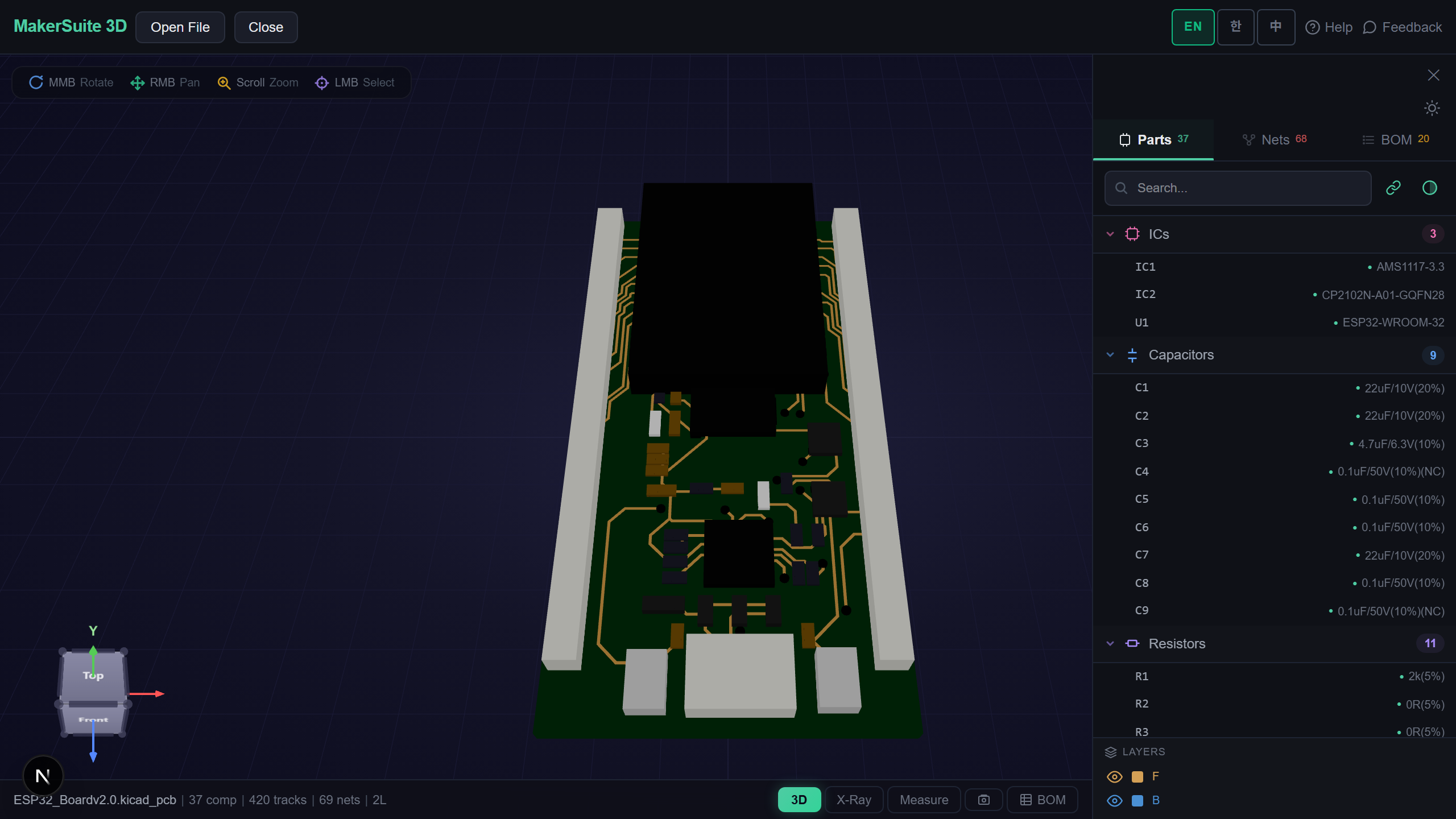
USDZ Without an iPhone or Mac
USDZ is Apple's AR Quick Look format — a ZIP archive of Pixar Universal Scene Description (USD) files plus textures. Apple's tooling assumes you're on macOS or iOS, but the format itself is open. MakerSuite 3D parses USDZ in the browser using JavaScript USD readers, so you can inspect AR assets on Windows, Linux, ChromeOS — anywhere a modern browser runs. Useful for QA, design review, and quick visual checks without provisioning Apple hardware.
What's Inside a USDZ File
USDZ is an uncompressed ZIP archive (rename .usdz to .zip and you can extract it). Inside: one .usdc (binary USD) or .usda (ASCII USD) scene file as the root, texture files (PNG, JPG, EXR), and optionally MaterialX shader graphs. The first file in the ZIP must be the root scene. File offsets must be aligned to 64-byte boundaries because Apple's runtime memory-maps the archive directly. USD itself is Pixar's open-source scene description (released 2016, used in film production) chosen for AR because of its composition and layering features.
What the Viewer Handles
- Geometry — meshes, points, basisCurves, and other USD primitive types render with full triangle data preserved.
- Materials — UsdPreviewSurface (PBR) materials display with base color, roughness, metallic, normal, and emission maps.
- Hierarchy — USD's prim hierarchy (composition, references, payloads) flattens correctly so what you see matches what AR Quick Look would show.
- Coordinate system — USD's Y-up convention is preserved; rotations and transforms render in the file's declared space.
- Texture decoding — embedded PNG/JPG textures decode in the browser without external requests, so the preview is faithful to the packaged asset.
- Browser parity — the viewer runs on Chrome, Firefox, Edge, Safari across desktop and mobile, so cross-platform reviewers see the same thing.
How to Inspect USDZ in Five Steps
- Open pcbviewer.app — drop your .usdz file directly on the viewer canvas. Reading starts immediately; large scenes may take a few seconds for texture decode.
- Use mouse drag to orbit, middle-click drag to pan, scroll to zoom. The 3D ViewCube in the corner snaps to standard orthographic views (front, top, side).
- Use the Layers panel to toggle parts of the prim hierarchy. Useful for multi-object scenes like furniture or product configurations.
- Take a screenshot for documentation or design review feedback. Useful when sharing AR feedback with non-Apple stakeholders.
- For final AR validation, transfer the same .usdz to an iOS device and open in Safari to confirm AR Quick Look rendering matches the browser preview.
Inspect USDZ assets without an Apple device — drop the file in MakerSuite 3D for instant browser preview.
Try MakerSuite 3D FreeWhy Browser-Based USDZ Matters
AR content production teams are usually mixed-platform. Designers on macOS export USDZ; reviewers on Windows or Linux can't natively open it; iOS device testing happens at the end of the pipeline. A browser viewer fills the middle gap — anyone with a URL or local file can inspect the asset before it gets to device QA. Cuts iteration time on AR projects from days to minutes per feedback cycle.
When You'll Want a USDZ Viewer
- Design review — Windows-based PM reviews AR assets without buying an iPad for previewing
- E-commerce AR — verify product USDZ before publishing to AR Quick Look-enabled product pages
- Asset QA — check texture mapping, scale, and hierarchy before handoff to iOS development
- Format conversion check — confirm Reality Converter or usd-from-gltf output before final pipeline integration
- Educational — inspect USDZ scenes to learn USD's composition and layering structure visually
Inspection Without Upload
USDZ assets often represent unreleased products or proprietary designs. MakerSuite 3D's USDZ viewer parses the archive entirely in your browser using JavaScript ZIP and USD readers — no server, no upload, no cached copy on our infrastructure. Texture data, scene graph, and material parameters all stay on your machine. Safe for NDA work and pre-launch product previews.
Frequently Asked Questions
What is USDZ and how is it different from USD?
USDZ is Apple's zero-compression ZIP archive containing Pixar Universal Scene Description (USD) files. USD itself is the open-source 3D scene description format Pixar developed for film production (released 2016). Apple chose it as the AR Quick Look format in 2018 because USD's composition and layering features map naturally to AR scene assembly. The .usdz extension is an uncompressed ZIP — rename it to .zip and you can extract the .usdc (binary USD), .usda (ASCII USD), and texture files inside. The 'z' stands for ZIP, not compression.
Why does Apple use USDZ instead of glTF for AR?
USD has features glTF doesn't: composition (layered scene overrides), variants (alternative looks/materials), and a richer scene-graph model better suited to large production pipelines. Apple bet that USD's industry weight from film and VFX would translate to AR. glTF 2.0 is simpler and dominates web 3D, but lacks USD's composition. Both work — Safari's AR Quick Look uses USDZ, Android's Scene Viewer uses glTF, and most AR pipelines now generate both formats from the same source.
Can I view USDZ on Windows or Linux?
Yes, but tooling is thinner than on macOS. Pixar's open-source USD toolkit (github.com/PixarAnimationStudios/OpenUSD) ships usdview for Linux and Windows, but it's a developer tool with a learning curve. Browser-based viewers like MakerSuite 3D parse USDZ directly using JavaScript USD readers — no install, runs anywhere a modern browser runs (Chrome, Firefox, Edge, Safari). For quick visual checks before sending to an iOS device, browser viewers are the lowest-friction path.
What's inside a USDZ file?
A USDZ archive contains: one .usdc or .usda file (the scene graph), texture files (PNG, JPG, EXR), and optionally MaterialX shader graphs. The first file in the ZIP must be the root scene; this is enforced by the USDZ spec. File offsets within the ZIP must be aligned to 64-byte boundaries (Apple's runtime maps the ZIP directly into memory and reads the assets without decompression). If you build a USDZ with standard ZIP tools and don't enforce alignment, AR Quick Look will reject it with a silent failure.
How do I convert from STEP/STL/OBJ to USDZ?
Direct converters: Apple's Reality Converter (macOS, free) handles OBJ, glTF, FBX, USD, and Pixar's USD Python toolkit can script conversions on any platform. From CAD STEP, the workflow is usually two steps: STEP → glTF (via OpenCASCADE-based browser converter or FreeCAD) → glTF → USDZ (via Reality Converter or usd-from-gltf). MakerSuite 3D handles the STEP-to-glTF half in the browser, then the glTF goes into Reality Converter for the final USDZ packaging.
Related Articles
Drop your USDZ file — inspect AR assets in any browser
Launch USDZ Viewer