PLY 파일 뷰어 온라인 — 무료 Stanford 포맷 뷰어
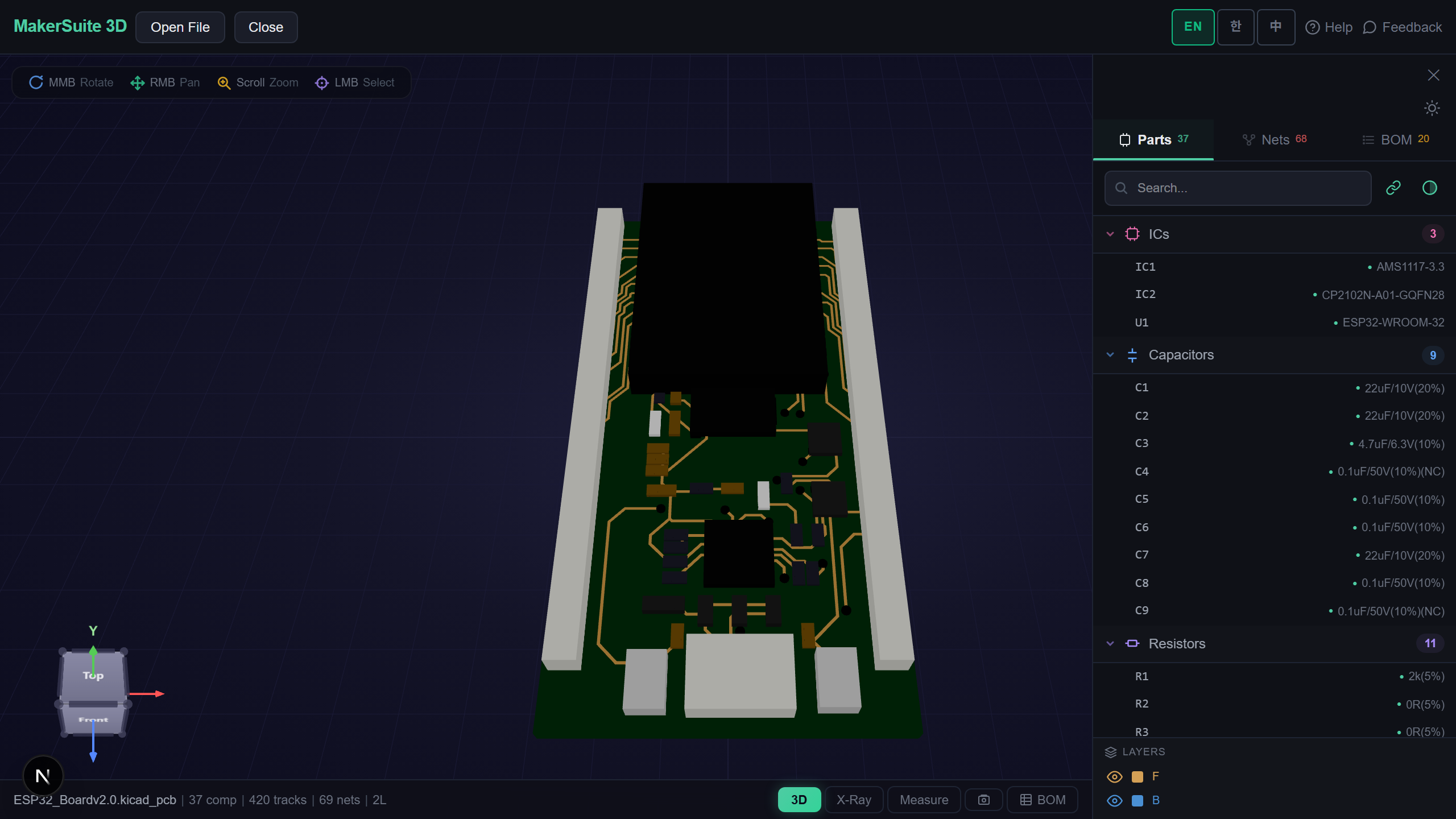
MeshLab 없이 3D 스캔 출력
PLY(Polygon File Format, Stanford Triangle Format)는 컨슈머·프로페셔널 3D 스캐너(Artec·Polycam·Revopoint·Einstar)와 포토그래메트리 도구(Meshroom·RealityCapture·Metashape)의 표준 출력. 1990년대 중반 Stanford에서 개발, 정점별 컬러 네이티브 지원 — 스캔 데이터에 결정적 — 으로 인기 유지. MakerSuite 3D는 ASCII와 바이너리 PLY 둘 다 브라우저에서 파싱, MeshLab이나 CloudCompare 설치 없이 스캔 출력 검사 가능.
PLY 포맷 내부
PLY는 데이터 레이아웃 선언하는 ASCII 헤더, 그 다음 ASCII 또는 바이너리 레코드. 헤더가 엘리먼트 타입(vertex·face)과 프로퍼티(x·y·z·nx·ny·nz·red·green·blue·alpha·s·t) 나열. 데이터 섹션이 선언된 스키마 정확히 따름. ASCII PLY는 사람이 읽을 수 있지만 파싱 느림. 바이너리 PLY(little 또는 big endian)가 큰 스캔 프로덕션 선택. 헤더는 항상 ASCII라서 JS 파서가 먼저 읽어 데이터 섹션 처리 결정.
뷰어가 처리하는 것
- 메시 PLY — 정점 + 면이 닫힌 메시로 렌더링, 스캔 데이터에 정점별 컬러 있으면 표시.
- 포인트 클라우드 PLY — 정점만 파일이 포인트 클라우드로 렌더링, 메싱 전 원시 스캐너 출력에 유용.
- 정점별 컬러 — RGB 속성 보존되고 렌더링, 컬러 스캔(Polycam·Revopoint)이 캡처된 텍스처와 함께 표시.
- 정점별 노멀 — 노멀 저장됐으면 라이팅에 사용, 아니면 면 지오메트리에서 계산.
- 바이너리 파싱 — little-endian과 big-endian 바이너리 PLY 둘 다 헤더 선언 포맷 사용해 올바르게 디코드.
- 큰 파일 처리 — 수백만 정점 스캔이 WebGL로 LOD 렌더링 통해 매끈한 인터랙션으로 렌더링.
다섯 단계로 PLY 보기
- Open pcbviewer.app — .ply 파일을 MakerSuite 3D 캔버스에 드롭. 헤더 즉시 파싱, 데이터 섹션은 큰 파일에서 비동기 읽기.
- 포인트 클라우드 파일(정점만)은 포인트 클라우드 렌더링 모드 활성화. 스피어 스플래팅과 높이별 컬러 옵션이 원시 스캔 데이터 해석에 도움.
- 메시 파일은 오빗·팬·줌으로 모델 검사. 스캔에 정점별 컬러 있으면 자동 렌더링.
- 측정 도구로 스캔 스케일 확인. 인스펙터 패널에 바운딩 박스 치수 — 스캐너 mm vs cm 출력 검증에 유용.
- 포인트 클라우드 메시 재구성은 MeshLab으로 익스포트하고 Filters > Remeshing > Surface Reconstruction: Poisson 실행. 메시된 PLY를 MakerSuite 3D에 재임포트로 결과 검증.
3D 스캔 출력 즉시 검사 — 메시 재구성이나 다운스트림 사용 전 PLY 파일 브라우저 프리뷰.
MakerSuite 3D 무료로 써보기왜 PLY가 스캔 표준인가
PLY 정점별 컬러 지원이 스캔 데이터의 킬러 피처. STL은 컬러 없음, OBJ는 머티리얼 파일 사용(면별, 정점별 아님), glTF는 정점 컬러 지원하나 스캐너 산업 기본 아님. 정점별 컬러와 정점별 신뢰도/강도 둘 다 있는 스캐너 포맷 표준 될 때까지 PLY가 자연스러운 익스포트. Stanford 오픈 스펙과 30년 보편 툴링 의미: 모든 CAD·시각화·그래픽 도구가 읽음 — 벤더 락인 리스크 없음.
PLY가 워크플로우에 등장할 때
- 3D 스캐너 익스포트 — Artec·Polycam·Revopoint·Einstar 모두 컬러 메시 출력에 PLY 기본
- 포토그래메트리 결과 — Meshroom·RealityCapture·Metashape가 메시+컬러 정규 결과로 PLY 생산
- 리버스 엔지니어링 — 물리 부품을 PLY로 스캔 후 메싱·STEP 변환으로 파라메트릭 CAD 모델링
- 문화 유산 — 박물관·고고학 3D 문서화가 컬러 충실 캡처에 PLY 광범위 사용
- 학술 그래픽 — 교과서 예시(Stanford Bunny·Dragon·Buddha)가 기본 PLY로 출하
브라우저 측 파싱, 업로드 없음
3D 스캔 데이터는 종종 독점 부품·민감 문화 유산·프리프로덕션 프로토타입 표현. MakerSuite 3D PLY 뷰어는 three.js PLYLoader로 파일을 브라우저에서 완전 파싱 — 서버·업로드·캐시 사본 없음. 지오메트리·컬러 속성·메타데이터 모두 머신에 남음. NDA 스캔·박물관 문서화·IP 민감 리버스 엔지니어링에 안전.
자주 묻는 질문
What is a PLY file?
PLY (Polygon File Format, also called Stanford Triangle Format) was developed at Stanford University in the mid-1990s by Greg Turk for storing 3D scan data from the Stanford 3D Scanning Repository (the source of the Stanford Bunny, Dragon, and Happy Buddha models still used in graphics research today). The format stores vertices, faces, and per-vertex attributes (color, normal, alpha, texture coordinates) in either ASCII text or binary little/big-endian. The header is always ASCII, declaring the data layout, followed by raw vertex/face records.
When would I get a PLY file?
Three common sources today: (1) 3D scanners — most consumer and professional scanners (Artec, Polycam, Revopoint, Einstar) export PLY because of its native point cloud and per-vertex color support, (2) photogrammetry pipelines — Meshroom, RealityCapture, and Agisoft Metashape output PLY as the canonical mesh+color result, (3) academic research — the format is still ubiquitous in graphics papers because the spec is simple, well-documented, and tooling is universal. Less common today for game/film pipelines, which favor FBX, glTF, USD.
PLY vs OBJ vs STL — which is right?
Pick by what your data has. PLY for point clouds, photogrammetry, or anything with per-vertex color/intensity. OBJ for general-purpose mesh exchange when you need separate material files. STL for 3D printing, where you only need triangles and don't care about color. PLY is the only one of the three that natively stores per-vertex RGB without external materials, which is why scanners use it. STL is geometry-only by definition. OBJ stores colors per material via .mtl, not per vertex, so a colored point cloud → OBJ loses precision.
Can I open binary PLY in a browser?
Yes. The PLY format's ASCII header self-describes the binary chunk that follows, including endianness, so JavaScript readers can parse both ASCII and binary variants without external configuration. three.js ships PLYLoader for this. MakerSuite 3D parses PLY in the browser — drop the file, the viewer reads the header, decodes vertices and faces, and renders. Per-vertex colors are preserved if present. No upload, no install. Works on Mac, Windows, Linux, ChromeOS, iPad, anywhere a modern browser runs.
Why is my PLY file just dots?
Because it has no faces — only vertices. PLY can store either a mesh (vertices + faces) or a point cloud (vertices only). Many 3D scanners output point cloud PLY initially, then a meshing step (Poisson reconstruction in MeshLab, ball-pivoting in Meshroom) converts the cloud to a closed mesh. If your viewer renders dots, you have a point cloud — open it in MeshLab (free, open source) and run Filters > Remeshing > Surface Reconstruction: Poisson to get a triangulated mesh. Then re-export as PLY (mesh) or OBJ for downstream use.
관련 글
.ply 파일 드롭 — 어떤 브라우저에서나 3D 스캔·포토그래메트리 데이터 프리뷰
PLY 뷰어 열기