STEP vs IGES — 모던 vs 레거시 CAD 교환
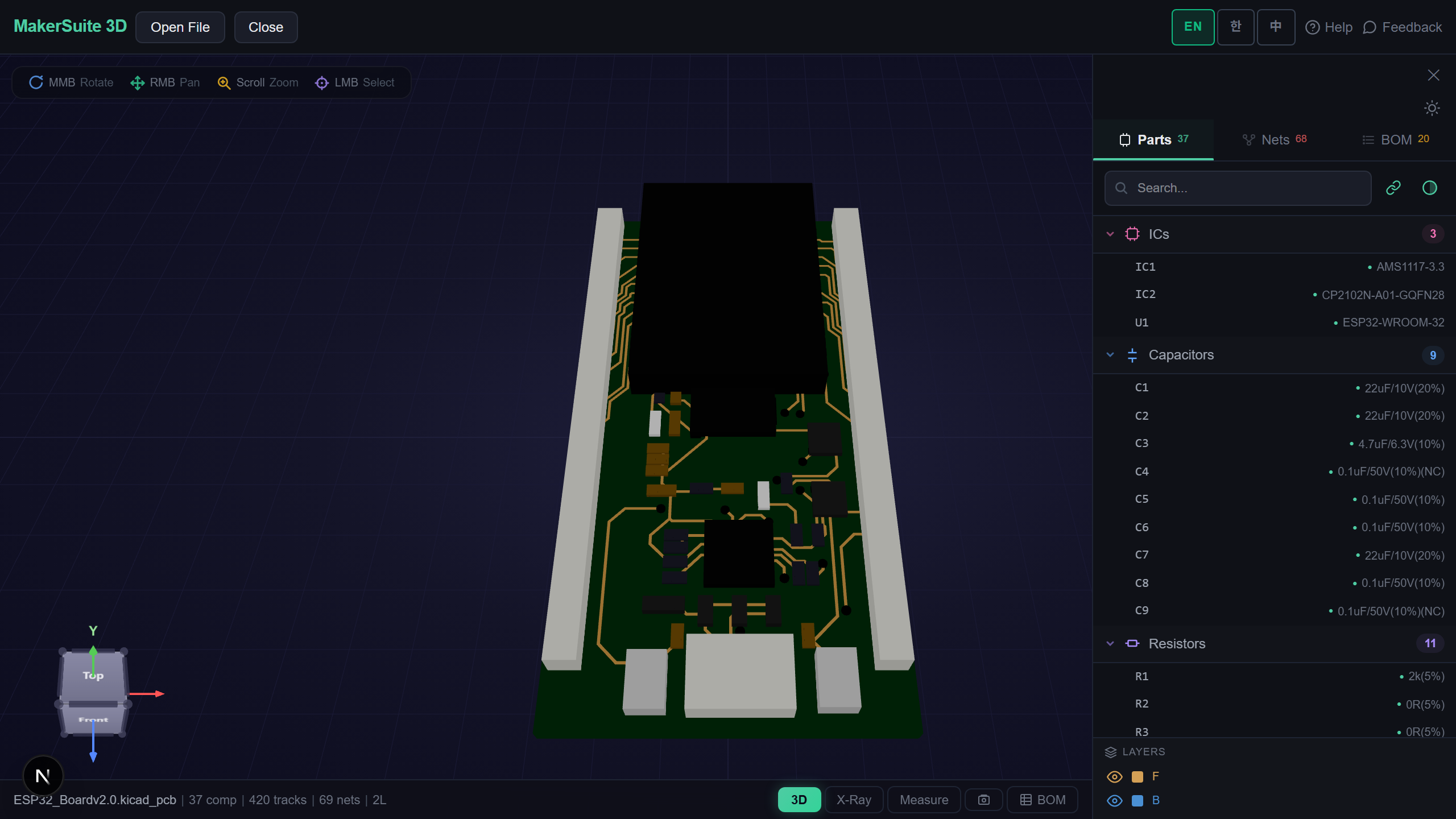
두 중립 CAD 포맷
CAD-CAD 데이터 교환에 두 중립 포맷 지배: STEP(ISO 10303·모던)과 IGES(ANSI Y14.26M·레거시). 둘 다 모든 주요 CAD 패키지 지원, 둘 다 ASCII 텍스트, 둘 다 3D 솔리드 지오메트리 표현. 그러나 거기서 유사성 끝 — STEP이 IGES가 안 하는 모던 엔지니어링 메타데이터 지원, 둘 사이 선택이 파일 크기에서 도면 없는 제조 워크플로우까지 모든 것에 영향.
포맷 역사와 표준
IGES가 1980 거슬러 올라감, 1996년 IGES 5.3로 마지막 업데이트, 지금 동결 — 새 개정 개발 중 없음. STEP은 1984 개발 시작, 1994 ISO 10303으로 처음 비준, Application Protocol(구성 관리 AP203·자동차 AP214·제품 제조 정보 AP242) 통해 활발 개발 지속. STEP AP242가 PMI(GD&T 톨러런스·표면 마감·datum) 포함, 모든 프로덕션 의도가 3D 모델에 있는 '도면 없는' 제조 가능. IGES 동등 없음.
이 비교 다루는 것
- 지오메트리 지원 — 둘 다 솔리드·서피스·커브·포인트 동등 처리.
- 어셈블리 계층 — STEP이 중첩 어셈블리 지원; IGES는 평탄.
- 메타데이터 — STEP AP242가 PMI(GD&T·표면 마감) 포함; IGES는 없음.
- 파일 크기 — STEP이 일반 동등 IGES보다 20~40% 작음.
- 활발 유지보수 — STEP이 현재 ISO 표준; IGES는 1996년 이래 동결.
- 툴링 지원 — 모든 모던 CAD가 둘 다 읽기/쓰기; 레거시 CAM은 IGES만 지원할 수도.
STEP과 IGES 사이 결정 방법
- Open pcbviewer.app 하고 STEP 파일 드롭. 뷰어가 OpenCASCADE WebAssembly로 STEP 파싱.
- IGES는 FreeCAD 또는 CAD 도구로 먼저 STEP 변환, 그 다음 STEP을 MakerSuite 3D에 드롭.
- 지오메트리 무결성 검증 — 두 포맷이 파싱 후 동일 3D 생산해야.
- 해당 시 어셈블리 구조 검사 — STEP이 계층 보임, IGES는 평탄.
- 신규 교환은 IGES보다 STEP AP214(자동차) 또는 AP242(풀 PMI) 매번 선택.
STEP vs IGES 출력 비교 — 둘 다 드롭하고 다운스트림 사용 전 지오메트리 일치 검증.
MakerSuite 3D 무료로 써보기왜 STEP이 모던 기본인가
항공우주·자동차·의료 디바이스 산업이 도면 없는 제조로 마이그레이션 — 프로덕션 의도가 2D 도면 아닌 3D 모델에 인코드. STEP AP242가 이를 가능하게 하는 포맷; IGES는 못 함. 주요 OEM(Boeing·Airbus·Toyota·GM·Siemens Medical)이 공급사 데이터 교환에 STEP AP242 의무화, 2D 도면이 3D PMI가 제거하는 해석 모호성 가짐. PCB-CAD 인터랙션(PCB 인클로저 인터페이스 기계 설계)에 STEP도 표준 — KiCad·Altium·Eagle·EasyEDA 모두 보드-인클로저 핸드오프에 STEP 임포트/익스포트.
각 포맷 승리 시기
- STEP — 모던 CAD-CAD 교환·도면 없는 제조·PMI 전송
- STEP — PCB-인클로저 설계 핸드오프(보드 아웃라인 + 부품 in 3D)
- IGES — 2000년 이전 포맷만 읽는 레거시 CNC 머신
- IGES — 하위 호환 위해 여전히 의무화하는 항공우주 국방 워크플로우
- 둘 다 — 표준화 안 한 패브리케이터; STEP 먼저 제공, 요청 시 IGES
브라우저 측 파싱, 업로드 없음
STEP 파일은 종종 독점 기계 설계와 프리릴리스 제품 지오메트리 포함. MakerSuite 3D는 occt-import-js(OpenCASCADE WebAssembly)로 STEP을 브라우저에서 완전 파싱; 서버 업로드 없음, 캐시 사본 없음. 어셈블리 계층·부품 메타데이터·PMI 어노테이션 모두 머신에 남음. NDA 리뷰·공급사 핸드오프에 안전.
자주 묻는 질문
What's the actual difference between STEP and IGES?
STEP (ISO 10303) is a modern (1994 onward, AP214 in 1998, AP242 in 2014) standard with explicit support for product data: assemblies, hierarchy, materials, color, kinematic, GD&T, PMI annotations. IGES (Initial Graphics Exchange Specification, ANSI Y14.26M, last updated 1996 as IGES 5.3) is older and primarily geometry-only — surfaces, curves, points, with limited support for assemblies and metadata. STEP is actively maintained; IGES is frozen. STEP is the modern default, IGES is the legacy fallback when STEP isn't supported.
Why does IGES still exist?
Two reasons. First, legacy CAD systems (some industrial CNC machines, older CAM software, very old CATIA versions) still only read IGES. Second, IGES tolerates ambiguity better — when CAD systems disagree on geometry interpretation, IGES sometimes succeeds where STEP fails because IGES has fewer strict rules. For new work, always export STEP. For sending data to a customer with a 1990s-vintage CAD system or specific aerospace defense workflows, IGES may be the only working option. The conversion is one-way: STEP-to-IGES loses metadata, IGES-to-STEP recovers nothing that wasn't there.
Which one preserves more design intent?
STEP, especially STEP AP242. AP242 includes PMI (Product Manufacturing Information): GD&T tolerances, surface finish callouts, weld symbols, datum identifiers — the same engineering metadata that appears on a 2D drawing. Aerospace and automotive workflows leverage AP242 to ship 'drawingless' designs where all manufacturing intent is in the 3D model. IGES has no equivalent — annotations are at best loose text labels with no machine-readable semantics. For modern design intent transfer, STEP AP242 is the standard.
What about file size?
STEP files are typically 20-40% smaller than equivalent IGES files for the same geometry, partly because STEP's data structure is more efficient and partly because STEP allows compression-friendly representations. For a typical mechanical part, STEP is 1-5 MB vs IGES at 1.5-7 MB. For large assemblies (thousands of parts), STEP's hierarchical assembly structure means even bigger savings — IGES has to flatten everything into a single file. Both formats are ASCII (human-readable) by default, which inflates size 3-5× compared to a binary equivalent. STEP has a binary variant (Part 28, XML-based) but it's rarely used in practice.
Can MakerSuite 3D open IGES?
MakerSuite 3D currently uses occt-import-js (OpenCASCADE WebAssembly build) which supports STEP natively but not IGES out of the box. To view IGES in our viewer, convert it to STEP first using FreeCAD (File > Open .iges, then File > Export .step) or any CAD with IGES read + STEP write capability. The conversion is lossless for geometry. For mechanical CAD work, exporting STEP from your design tool directly is recommended — avoid IGES as an intermediate format because it loses metadata that other workflows depend on.
관련 글
STEP과 IGES 지오메트리 비교 — 파일 드롭하고 다운스트림 사용 전 검증
MakerSuite 3D 열기