Free Circuit Analysis Tool Online — Analyze Schematics in Your Browser
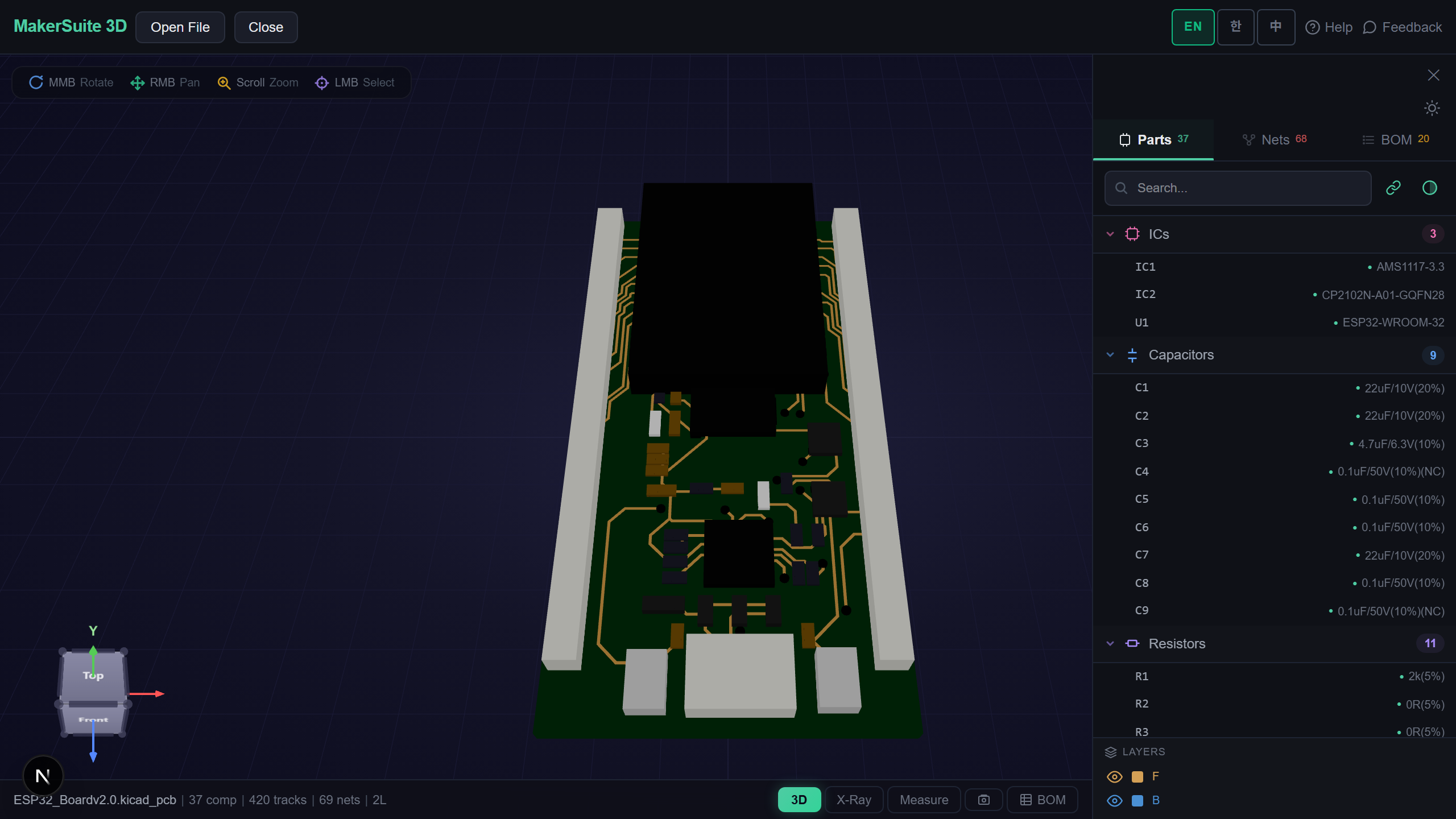
Analyze Your Circuits Without Installing Any Software
Understanding a circuit design usually requires manual calculation or expensive simulation software like SPICE. MakerSuite 3D now includes a browser-based circuit analysis tool that automatically detects common circuit patterns in your KiCad schematic and calculates key electrical parameters. No installation, no signup, no file uploads to any server.
What Is a Circuit Analysis Tool?
A circuit analysis tool examines the netlist and component values in your schematic to identify common circuit topologies and compute their electrical characteristics. Instead of manually tracing nets and plugging values into formulas, the analyzer does it automatically. It detects voltage dividers and computes output voltages, identifies RC and LC filter networks and calculates cutoff frequencies, finds series and parallel resistor combinations and computes equivalent resistance, calculates power dissipation for resistors, and determines the correct current-limiting resistor for LEDs.
Circuit Analysis Features
- Voltage Divider Detection — Automatically identifies resistor voltage divider networks and calculates the output voltage ratio for any input voltage
- RC/LC Filter Analysis — Detects resistor-capacitor and inductor-capacitor filter networks, calculates cutoff frequency, and identifies low-pass, high-pass, and band-pass configurations
- Series/Parallel Combination — Finds resistors connected in series or parallel and computes the equivalent resistance, simplifying complex networks
- Power Dissipation Calculation — Calculates the power dissipated by each resistor based on the voltage across it and current through it, helping you select appropriate wattage ratings
- LED Current Calculation — Identifies LED circuits with current-limiting resistors and computes the forward current based on supply voltage, forward voltage drop, and resistor value
How to Analyze a Circuit Online
- Open pcbviewer.app — Open pcbviewer.app in your browser
- Drag and drop your .kicad_sch schematic file onto the drop zone
- The schematic renders on the canvas and the circuit analyzer runs automatically
- View detected circuit patterns in the analysis panel — voltage dividers, filters, and component combinations
- Click any detected pattern to highlight the relevant components and nets on the schematic
Analyze your circuit online — no installation needed.
Try MakerSuite 3D FreeExample Analysis Results
- A 10k/4.7k voltage divider on a 5V rail shows an output of 1.60V — useful for level shifting between 5V and 3.3V logic
- A 10k resistor with a 100nF capacitor forms a low-pass RC filter with a cutoff frequency of 159.15 Hz
- Three 1k resistors in parallel yield an equivalent resistance of 333.3 ohms
- An LED with a 330-ohm current-limiting resistor on a 3.3V supply draws approximately 5.6 mA (assuming 1.8V forward voltage)
Who Needs a Circuit Analysis Tool?
- Hardware engineers verifying voltage levels and filter characteristics before prototyping
- Students learning circuit theory who want to check their manual calculations against automated analysis
- Makers building Arduino and Raspberry Pi projects who need to calculate LED resistor values or voltage dividers
- Design reviewers checking power dissipation and thermal limits across all resistors in a design
- Hobbyists exploring open-source hardware projects and understanding how the circuits work
Privacy and Security
The circuit analysis tool processes everything locally in your browser. Your schematic files are never uploaded to any server. Component values and netlist data stay on your device, making it safe for proprietary and confidential designs.
What the Analyzer Detects, and What It Cannot
Circuit analysis is a much harder problem than it looks. Full SPICE simulation needs every component model, every parasitic, and a numerical solver that handles nonlinear devices like transistors and op-amps. That's the heavyweight option, and it's what tools like LTspice and KiCad's Eeschema-with-ngspice provide. MakerSuite's analyzer takes a different approach: pattern recognition over the netlist. It looks for topologies that match well-known canonical circuits — voltage dividers, RC and LC filters, series and parallel resistor networks, LED current limiters — and computes the closed-form formulas for those specific circuits. It does not simulate.
The pattern-matcher works by walking the netlist graph from each component and matching against a small library of topology templates. A voltage divider is two resistors in series between a supply rail and ground, with the output net taken from the junction. An RC low-pass filter is a resistor in series with a capacitor to ground. An LED current limiter is a resistor in series with an LED, both connected between a supply and ground. When the topology matches and the component values are present, the calculation is deterministic.
What the analyzer can't do is anything that requires simulation. AC analysis with frequency-dependent gain, transient response, op-amp feedback networks, switching regulator stability — all of those need a real simulator. The analyzer also can't help with circuits that have unusual topologies the pattern library doesn't know about. For those, the right tool is LTspice or ngspice, and the analyzer's role is to handle the cases where you don't need to spin up a simulation just to check that your voltage divider produces 3.3 V.
Sanity-Checking Designs Before You Solder
The most common circuit-design failure on hobbyist projects is an LED that burns out within seconds because the current-limiting resistor was sized assuming the wrong forward voltage. The analyzer catches this: drop in your KiCad schematic, and any LED-plus-resistor combination is flagged with the calculated forward current and a comparison against the LED's expected drive current. Resistors that produce currents above 30 mA on standard indicator LEDs get a warning.
Power dissipation is the other underrated check. A 1k resistor across a 12 V rail dissipates 144 mW, which is fine on a 1/4 W resistor but borderline on a 1/8 W. The analyzer surfaces dissipation per resistor so you can scan for any value that runs hot — those are the ones that change value over time and silently break designs that worked at the bench.
Frequently Asked Questions
What circuit analysis features are available?
MakerSuite 3D can detect voltage dividers, analyze RC/LC filters, identify series/parallel resistor combinations, calculate power dissipation, and compute LED current limiting resistor values.
Do I need to install any software?
No. The circuit analysis tool runs entirely in your browser. Just drag and drop your KiCad schematic file and the analysis happens automatically.
Is the circuit analysis tool free?
Yes. The circuit analysis tool is completely free with no signup, no installation, and no file limits. Your files are processed locally in your browser.
What file formats are supported?
Currently KiCad .kicad_sch schematic files are supported. The analyzer parses the netlist and component values directly from the schematic data.
How accurate are the calculations?
The calculations use standard electrical engineering formulas. Voltage divider ratios, RC/LC cutoff frequencies, and power dissipation values are computed from the component values in your schematic.
Related Articles
Analyze your circuit online right now
Open MakerSuite 3D