How to Convert STL to STEP — Mesh-to-BRep Reality Check
STL to STEP Is Not a Conversion — It's a Reconstruction
STL files store triangle meshes. STEP files store boundary representation — exact mathematical surfaces. Going from STL to STEP means looking at thousands of flat triangles and trying to recover the original cylinders, planes, and NURBS that produced them. It's a reverse-engineering problem, not a file format conversion. There is no lossless STL→STEP because the original surface information was already thrown away when the mesh was generated. That said, there are practical workflows that get you a usable STEP file for assembly with other CAD parts or handoff to a CNC shop. This guide walks through the four real options — FreeCAD, Fusion 360 Mesh-to-BRep, Geomagic Design X, and a clean re-CAD — plus when each one is actually the right call.
What STL and STEP Actually Store
An STL file is a flat list of triangles, each triangle defined by three vertices and a normal. ASCII STL is human-readable text; binary STL is a 50-byte record per triangle. There is no surface continuity, no parametric history, no concept of 'this is a cylinder' — just a bag of triangles. STEP (ISO 10303-21) stores B-rep geometry: the exact mathematical equation for every face (plane, cylinder, cone, torus, NURBS surface), the curves that bound each face, and the topology connecting it all. A STEP cylinder is one face with one equation; an STL cylinder is two hundred triangles approximating that face. Converting STL to STEP requires inferring the original equations from the triangle cloud — possible for simple primitives, hard for organic shapes, impossible for noisy scan data without manual cleanup.
What Each Tool Actually Does
- FreeCAD — Free, open-source. Mesh > Convert to Solid creates a single STEP face from the entire STL with no surface decomposition. Result: one giant unedited body, useful for CAM but not for parametric editing. Works on any STL, even messy ones.
- Fusion 360 Mesh-to-BRep — Free Personal license. Mesh workspace > Modify > Convert Mesh, then choose Faceted (one face per triangle, useless), Prismatic (detects flats and primitives, best for engineered parts), or Organic (T-spline fit, good for sculpts). Triangle limit ~50,000 for prismatic mode.
- Geomagic Design X — Paid (~$15K license). Industry-standard reverse-engineering tool. Region detection, primitive fitting, surface lofting — produces clean parametric STEP from scan data. Used by aerospace and medical device shops to digitize physical parts.
- OpenSCAD / Blender — Not designed for this. OpenSCAD only writes STL; Blender's CAD addons are mesh-modifier wrappers that don't produce real B-rep. Skip these for STL→STEP work.
- MeshLab + custom workflow — Open-source mesh repair (smoothing, decimation, hole filling) before sending to FreeCAD or Fusion. Useful for scan data with noise, but doesn't change the fundamental mesh-to-BRep problem.
- Online converters (MakeXYZ, Convertio, AnyConv) — All wrap FreeCAD or OpenCASCADE server-side. Identical results to running FreeCAD locally, except your geometry uploads to a third party. Avoid for NDA work.
How to Approach STL to STEP in Five Steps
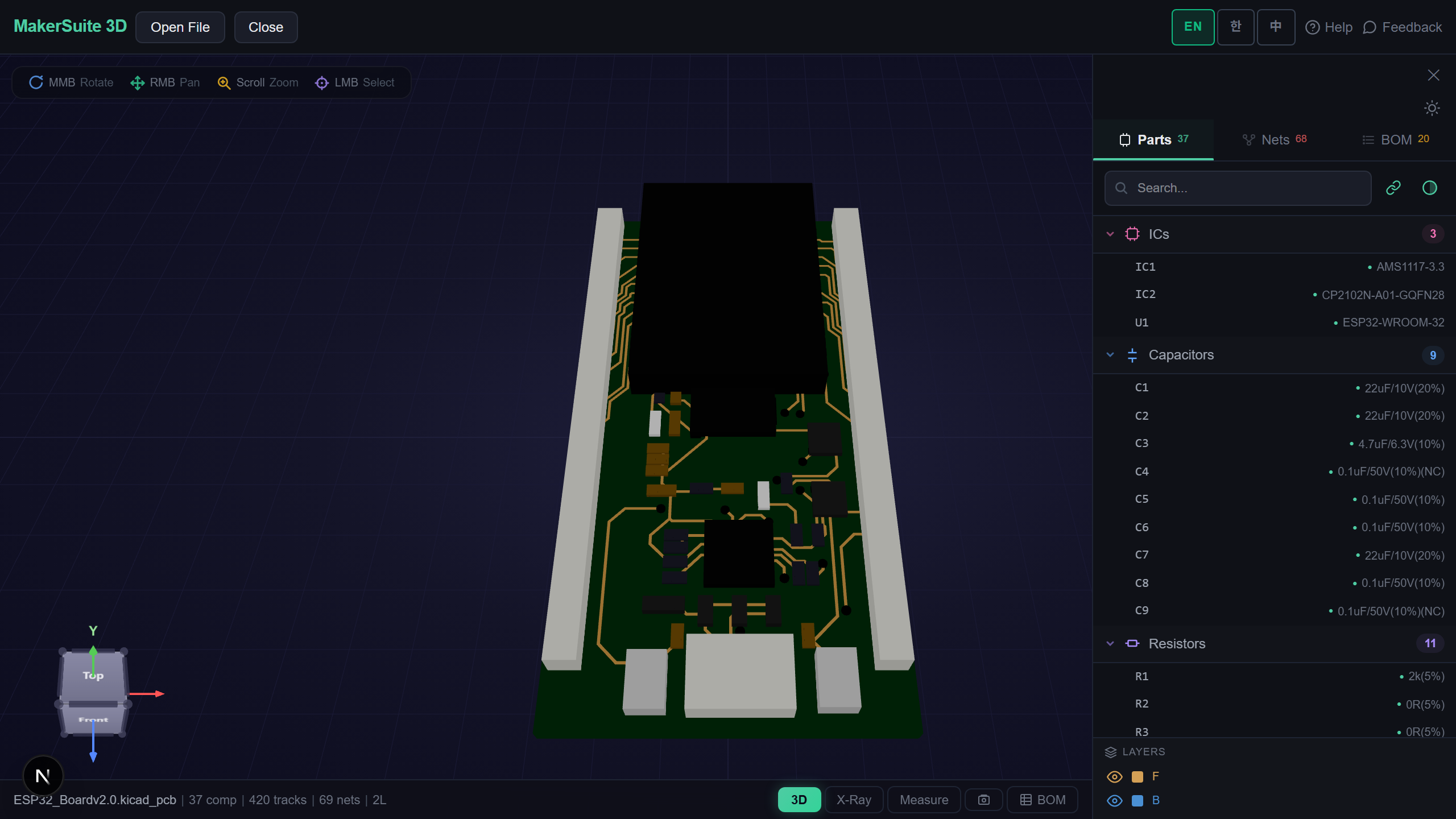
- Open pcbviewer.app — drop the STL on MakerSuite 3D first to inspect it. Triangle count under 5K and clear flat surfaces means prismatic conversion will work; over 100K triangles or organic shapes means Fusion 360 organic mode or skip the conversion entirely.
- Try the easiest path first — FreeCAD's Mesh > Convert to Solid. If you only need a closed STEP for CAM/CNC handoff (not for parametric editing), this finishes in seconds. The output is one shape with no editable features, but the geometry is correct.
- For editable CAD geometry, open the STL in Fusion 360, switch to Mesh workspace, and run Convert Mesh. Pick Prismatic for engineered parts (brackets, enclosures), Organic for sculpted shapes. Adjust face count tolerance — too low loses detail, too high produces unmanageable surface count.
- Verify the result by exporting STEP back out and dropping it on MakerSuite 3D alongside the original STL. Visual diff catches missing features, lost holes, or surface artifacts before you ship it to the CNC shop.
- If the converted STEP isn't editable enough, the right move is to recreate the part in CAD using the STL as a visual underlay. Fusion, SolidWorks, and Onshape all support this — import STL, lock it as a reference body, sketch over the geometry. Slower than conversion but produces real parametric CAD with edit history.
Before sending the converted STEP to manufacturing, drop both the original STL and the new STEP on MakerSuite 3D — visual diff catches surface artifacts and missing features that mesh-to-BRep tools introduce silently.
Try MakerSuite 3D FreeWhy STL to STEP Matters for Manufacturing
Most CNC shops, sheet metal vendors, and injection molders require STEP or IGES files, not STL. STL works for 3D printing because slicers handle triangle meshes natively, but a CAM operator running a CNC mill needs continuous surfaces to generate clean toolpaths. Submitting an STL to a CNC shop usually triggers a back-and-forth where the shop charges extra to convert it, the conversion is approximate, and the final part doesn't match expectations. Doing the STL→STEP conversion yourself — even imperfectly — keeps you in control of the geometry and saves the shop's reverse-engineering fee. The honest workflow is to do the best conversion you can, then verify the STEP visually against the original STL before signing the manufacturing PO.
When STL to STEP Is the Right Move
- 3D-printed prototype to CNC production — bracket worked in PLA, now you need it in aluminum, only have the STL
- Open-source hardware integration — Thingiverse model needs to assemble with your CAD design, source files unavailable
- Legacy archive recovery — old project lost the source, only the STL remains in version control
- Scanned part digitization — physical part scanned to STL, needs CAD model for redesign or reverse engineering
- Cross-tool collaboration — partner sends STL, your team works in SolidWorks/Inventor and needs B-rep input
Verify in the Browser Without Uploading
Mechanical designs in STL or STEP usually contain proprietary geometry — product enclosures, mounting brackets, internal mechanisms. Online STL→STEP converters require uploading the file to their servers, which is a non-starter for NDA work. MakerSuite 3D parses both formats entirely in the browser via JavaScript and OCCT WASM — no server, no upload, no cached copy. Drop the original STL in one tab, the converted STEP in another, and visually compare. Your geometry never leaves the machine, and the conversion happens in your tool of choice (FreeCAD, Fusion) under your control.
When STL→STEP Just Won't Happen
Organic, sculpted, or scanned meshes are the worst case. A 500,000-triangle mesh of a hand-sculpted character or a 3D-scanned bone has no canonical surfaces — every triangle is part of a freeform shape that no boundary representation can capture exactly. FreeCAD and Fusion 360 will produce a STEP, but it'll be a STEP containing thousands of tiny tessellated faces, which is technically a B-rep but useless for parametric editing. If your downstream needs to dimension or modify the shape, the right move is rebuilding it from scratch in your CAD tool, not converting.
The other STL→STEP failure mode is non-watertight or self-intersecting meshes. Slicers tolerate small defects (overlapping triangles, near-zero-thickness edges), but mesh-to-BRep conversion fails outright on them. The Manifold-3D mesh-repair pass in MakerSuite catches most of these — drop the STL in the 3D viewer, run the repair, then export the cleaned STL before sending it to FreeCAD. The repair-then-convert pipeline succeeds where direct conversion silently produces broken STEP files.
Frequently Asked Questions
Can you really convert STL to STEP?
Not losslessly. STL stores triangulated surfaces — a mesh of flat triangles approximating the original geometry. STEP stores boundary representation (B-rep) — exact mathematical surfaces (planes, cylinders, NURBS) and their topology. Going mesh → B-rep requires reconstructing the surfaces from triangles, which is genuinely hard and always lossy. Tools like FreeCAD's 'Convert to solid' or Fusion 360's 'Mesh to BRep' work for clean primitive shapes (boxes, cylinders, simple revolutions), but freeform organic STLs (sculpts, scans, complex 3D prints) come out as one giant unedited shape with thousands of triangle facets baked in. The honest answer is: STL→STEP is a workaround, not a real conversion. If you need editable CAD geometry, recreate the part in CAD using the STL as visual reference.
When does STL to STEP actually work well?
When the STL was generated from CAD primitives in the first place. If someone exported a simple bracket, mounting plate, or enclosure as STL and you need it back in STEP for assembly with other CAD parts, mesh-to-BRep tools can usually reconstruct it cleanly. Look for these signs: low triangle count (under 5,000), flat or single-curvature surfaces, sharp edges between faces. STLs from MRI scans, photogrammetry, or sculpting tools (ZBrush, Blender) will not convert into useful STEP — the surface complexity is in millions of triangles with no underlying primitives to recover.
Is there an online STL to STEP converter that works?
Yes, several exist (MakeXYZ, Convertio, AnyConv) but they all run the same FreeCAD or OpenCASCADE algorithms server-side. The result is identical to running FreeCAD locally — and you upload your geometry to a third party. For sensitive designs, install FreeCAD (free, open-source) or use Fusion 360's free Personal license and run the conversion locally. For viewing and verifying, MakerSuite 3D opens both .stl and .step files in the browser without uploading — useful for previewing the input STL and the converted STEP side by side before committing to a manufacturing handoff.
Why is mesh-to-BRep so hard?
B-rep surfaces are continuous mathematical equations — a cylinder is one equation, a plane is one equation. A triangle mesh approximates these with thousands of tiny flat polygons. Reverse-engineering means looking at a cloud of triangles and inferring 'these 200 triangles are actually one cylinder of radius R centered at (x,y,z)'. Algorithms (RANSAC primitive detection, region growing, NURBS fitting) work but require clean input and produce 'best fit' surfaces, not the original. Fusion 360's parametric Mesh-to-BRep uses prismatic/organic mode flags to bias toward primitives or freeform — neither is perfect. Industry tools like Geomagic Design X exist specifically for this problem and cost thousands of dollars.
What's the right workflow if I need to edit a 3D print model in CAD?
Best to worst: (1) Get the original CAD source — ask the designer, check Thingiverse for source files, look for .step or .f3d files. (2) Recreate in CAD using the STL as a visual underlay — Fusion 360, SolidWorks, and Onshape all let you import an STL as a reference body and sketch over it. (3) Use Fusion 360 Mesh workspace to remesh, simplify, then convert prismatic regions to BRep. (4) Last resort: STL → STEP via FreeCAD as a single shape (one closed body, no editable features, no parametric history). Manufacturing handoff to CNC shops still works because the geometry is closed, but you can't change anything without going back to mesh editing.
Related Articles
Drop your STL or STEP file — verify the conversion visually, no upload
Launch 3D Viewer