Excellon 드릴 파일이란? — PCB 드릴 포맷 완전 정리
제조사에게 '어디를 뚫어라'라고 알려주는 파일
PCB 발주용 zip을 열면 구리 레이어 Gerber 옆에 .drl, .txt, .nc, .drd 같은 확장자 파일이 하나둘 들어있습니다. 그게 Excellon 드릴 파일입니다. Gerber와 함께 살지만 언어는 완전히 달라 — 2D 모양이 아니라 회전하는 드릴 비트의 기계 좌표입니다. Gerber가 포토플로터에게 구리를 어디에 에칭할지 알려준다면, Excellon은 CNC 드릴에게 어디에 구멍을 뚫을지 알려줍니다. 50년 된 이 포맷의 속을 들여다보고, 왜 여기서 실수하면 보드가 망하는지 정리합니다.
Excellon 파일 속
Excellon은 Gerber처럼 평문 ASCII — 하지만 문법은 완전히 다른 시대의 것. 헤더에서 단위(INCH 또는 METRIC), 0 억제(leading·trailing), 툴 테이블 선언: T1C0.3은 툴 1 직경 0.3mm, T2C0.8은 툴 2는 0.8mm, 식으로. 본문은 T1으로 툴 선택 → X12500Y8750으로 그 좌표에 구멍 뚫기 → 다음 툴 체인지나 M30(프로그램 종료)까지 반복. 파일 전체가 세 가지뿐: 단위 선언, 툴 테이블, (툴·X·Y) 드릴 히트 나열. Gerber 애퍼처 스탬프보다 훨씬 단순한 이유는 드릴 비트는 할 일이 하나뿐이라서입니다.
Excellon이 잘 한 것
- 평문·편집 가능 — 어떤 에디터로도 열리고, 어떤 CNC도 읽을 수 있음. 독점 바이너리 없음, 라이선스 필요한 벤더 확장 없음.
- 툴 직경이 명시적 — 모든 드릴 히트가 툴 번호에 묶여 있고, 툴 테이블이 정확한 직경 제공. 추론이나 문맥 의존 없음.
- 단위는 헤더 선언 — INCH·METRIC 지시어가 파서에게 좌표 해석법을 알려줌. 이걸 틀리면 스케일 에러 1위.
- 0 억제 처리 — 옛 Excellon은 펀치 테이프 절약 위해 앞/뒤 0을 생략. 현대 내보내기는 정밀도 유지하지만 레거시 파일은 여전히 주의 필요.
- 도금(PTH)·비도금(NPTH) 분리 — 대부분 EDA 툴이 두 파일로 내보냄(예: -PTH.drl·-NPTH.drl). 맨 금속이어야 할 마운팅 홀을 실수로 도금하는 사고 방지.
- 슬롯용 라우트 명령 — 라우트된 슬롯(사각 컷아웃·긴 마운팅 홀)은 드릴 히트와 함께 G00/G01 경로 명령 사용. 같은 파일, 두 가지 동작 모드.
발주 전 Excellon 검증하는 법
- Open pcbviewer.app — Gerber zip 전체를 드롭하면 뷰어가 내부 드릴 파일을 자동 감지.
- 드릴 히트가 구리 패드 위에 떨어지는지 확인 — 모든 PTH 히트는 패드나 비아 중앙에 와야 함. 어긋난 드릴은 트레이스를 뚫고 나옴.
- 도금·비도금 분류 검증 — 나사용 마운팅 홀은 NPTH, 부품 핀 홀과 비아는 PTH. 뷰어가 색상으로 구분해 표시.
- 툴 테이블 교차 확인 — 스키매틱의 모든 드릴 직경이 툴 정의와 맞는지. 크기 빠지면 제조사가 대체하고 부품 핀이 안 들어감.
- zip을 제조사에 전송 — .drl 두 파일(PTH·NPTH)을 Gerber 레이어와 함께. NPTH 파일 확장자가 특이하면 README 동봉.
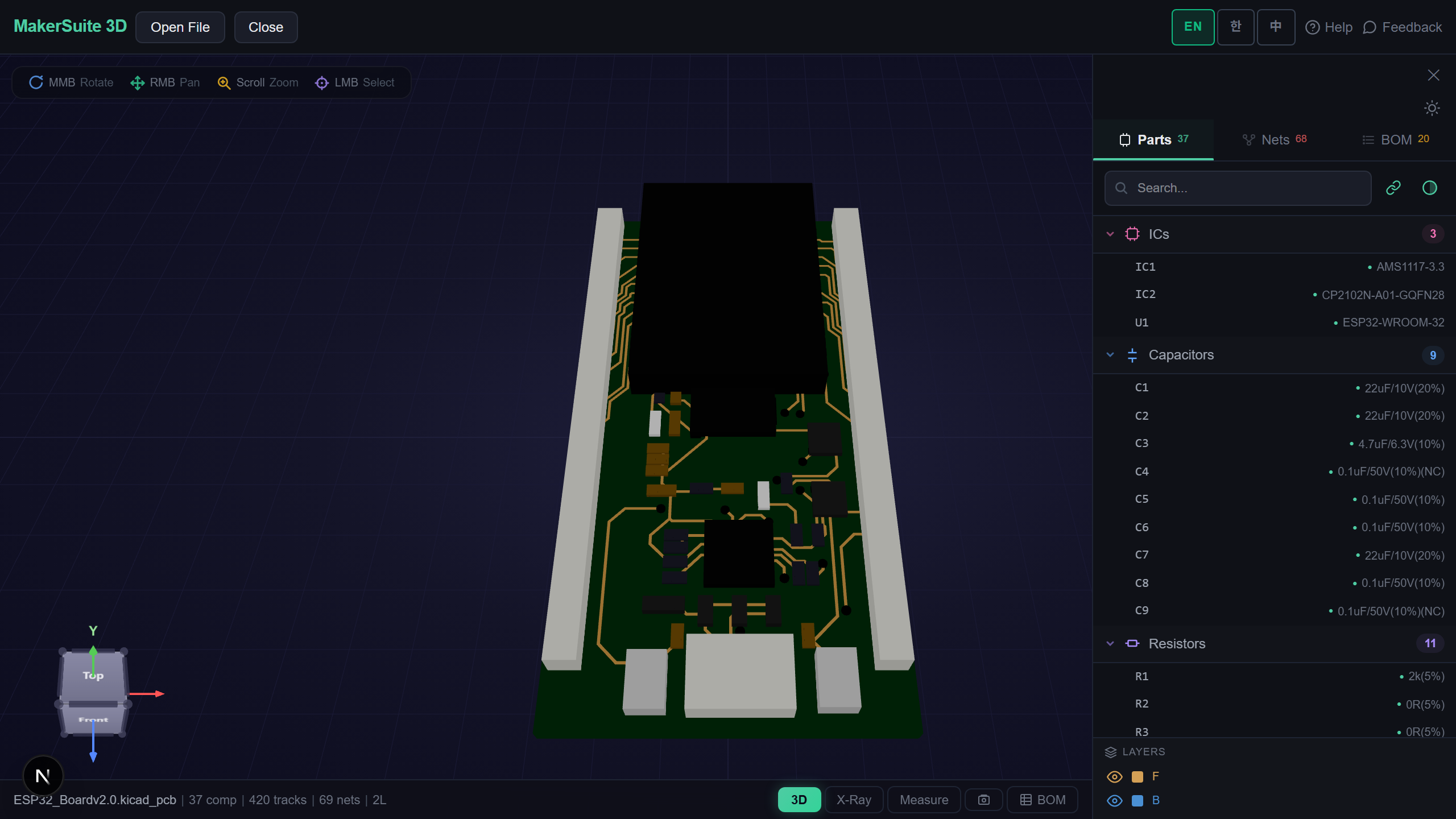
Excellon 드릴이 든 Gerber zip 드롭 — 제조사보다 먼저 모든 히트가 패드에 떨어지는지 확인.
MakerSuite 3D 무료로 써보기Excellon 실수가 비싼 이유
Gerber 레이어 실수는 포토플롯 프리뷰에서 눈에 보이고 누군가 잡습니다. Excellon 실수는 제조사의 드릴 프레스가 $3/장짜리 양산 주문에 돌아갈 때까지 안 보입니다. 단위 틀림? 모든 홀이 25배 어긋남. 0 억제 틀림? 모든 홀이 잘못된 구역에. 툴 빠짐? 제조사가 대충 사이즈로 대체, BGA 패키지가 안 앉음. Submit 누르기 전 10초 Excellon 뷰어 돌리는 게 다른 어떤 단일 체크보다 많은 보드를 살려왔습니다.
Excellon이 등장하는 순간
- 모든 PCB 발주 — JLCPCB·PCBWay·OSH Park 전부 Gerber와 함께 Excellon 요구
- 멀티 드릴 작업 — HDI 보드의 레이저 드릴 마이크로비아는 한 Excellon, 기계 드릴은 다른 Excellon
- 패널라이징 — 브레이크오프 탭·마우스바이트 천공용 드릴이 세 번째 Excellon 파일로
- CNC 밀로 프로토타이핑 — LPKF·Bantam 밀이 Excellon을 직접 읽어 집에서 프로토 컷
- 제조사 입고 검사 — 제조사 QA가 양산 전 Excellon을 CAM에 태워 히트 수 세고 툴 크기 검증
브라우저 전용 Excellon 파싱
드릴 파일에는 보드의 모든 부품 핀 패턴이 담깁니다 — 하드웨어 구성의 독점 정보. NDA 작업이나 출시 전 설계에서 클라우드 뷰어 업로드는 리스크. MakerSuite 3D는 JS로 브라우저에서 Excellon을 직접 파싱 — 서버·업로드·캐시 사본 없음. 제조사가 내부적으로 쓰는 것과 같은 파싱 로직을 클라이언트 사이드로 옮긴 것.
자주 묻는 질문
Why is Excellon a separate file from Gerber?
Gerber describes 2D shapes that get stamped onto copper layers — pads, traces, silkscreen. Drilling is a different operation: a spinning bit plunging through the board at a specific coordinate with a specific diameter. That's not a 2D shape, it's a machine instruction. Excellon was designed in the 1970s for CNC drill presses and evolved alongside Gerber as the companion format. Every fab machine treats them separately, so keeping them separate files matches the physical workflow.
What's the difference between plated (PTH) and non-plated (NPTH) drills?
PTH (plated through-hole) drills are for electrical connections — via holes, component pin holes. The fab plates the hole walls with copper so signals can cross layers. NPTH (non-plated through-hole) drills are mechanical — mounting screws, alignment pins, logo cutouts. They have no copper plating inside. Most EDA tools export them as two separate Excellon files (e.g., .DRL and .NPTH) so the fab doesn't accidentally plate a mounting hole.
Can I open an Excellon file in a text editor?
Yes — it's plain ASCII. You'll see a header with tool definitions (T1C0.3 means tool 1 is 0.3 mm diameter), then a sequence of tool changes and X/Y coordinates (X12500Y8750 drills a hit at those coordinates). The coordinate format depends on the header directives (INCH vs METRIC, leading-zero vs trailing-zero suppression). This is why Excellon parsers have to read the header carefully — the same number string means different things under different directives.
What units does Excellon use?
Either inches or millimeters, declared in the header via INCH or METRIC directives. Inches are historical (1970s US machinery); millimeters are more common in modern exports. Units have leading-zero or trailing-zero suppression, declared separately. Getting the units or zero-suppression wrong is the #2 cause of bad boards (after layer flip) — a drill hit meant for 12.500 mm can land at 1.2500 mm if the parser guesses wrong.
Does MakerSuite 3D support Excellon drills?
Yes — drop your Gerber zip and the viewer automatically detects any .drl, .txt, .nc, or .drd files inside and renders drill hits as 3D holes through the board. Plated and non-plated are distinguished by file name conventions (DRL vs NPTH). Same browser-only parsing as Gerber — no upload, no server round-trip.
관련 글
Gerber zip 드롭 — 드릴이 자동으로 3D 렌더
Gerber 뷰어 열기