Share PCB Design Review Notes — Annotation Links in Your Browser
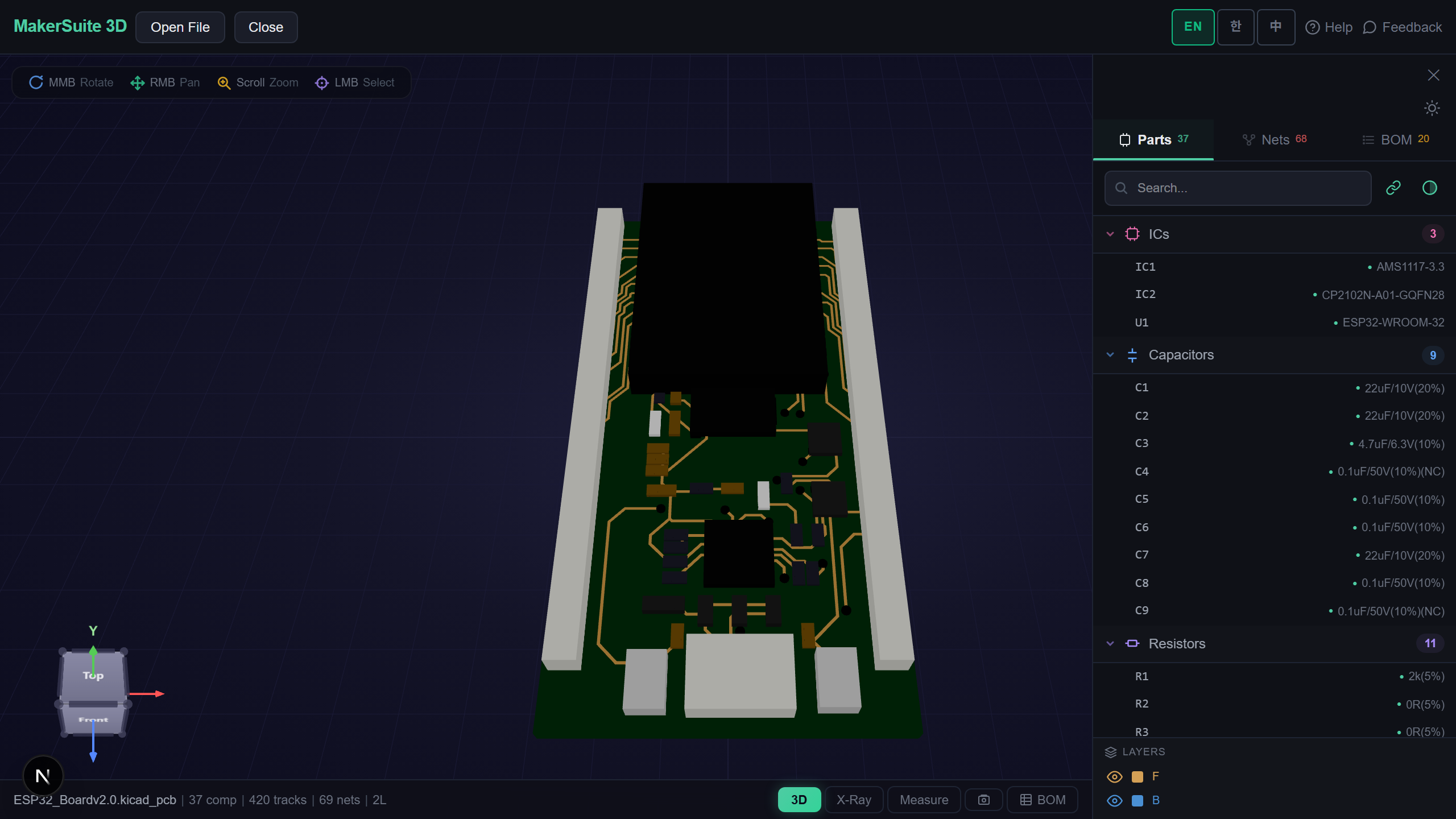
Design Review Without the Upload Dance
Most PCB design review tools force an awkward workflow: upload your board to a vendor cloud, create accounts for every reviewer, configure permissions, and hope the file stays confidential. MakerSuite 3D flips that upside down — your PCB file never leaves your browser, and your review notes travel through nothing more than a plain URL.
What Are Annotation Share Links?
Annotation sharing encodes every pin you've dropped on your PCB — the 3D coordinates, text, and color — directly into the URL's hash fragment. The result is a link like pcbviewer.app/en#ann=W1sxLjIzLC4uLiJdXQ that opens the viewer with your annotations already placed. Because the encoding happens client-side, there's no backend, no database, and no account system between you and your reviewers.
Key Features
- Zero Server Infrastructure — Annotations live in the URL hash, so the viewer needs no database. Your links work forever as long as pcbviewer.app is online
- Privacy by Default — Your PCB file stays in your browser. The URL carries only annotation metadata (position, text, color) — never the board itself
- Instant Sharing — Click the Link button in the toolbar to copy the share URL to your clipboard. Paste into Slack, email, or a GitHub issue
- Auto-Restore on Load — When a reviewer opens the link, the viewer automatically parses the hash and places every pin. No extra clicks required
- Works Across All Formats — Annotation pins use 3D world coordinates, so they align correctly on KiCad, Gerber, Eagle, Altium, and EasyEDA boards
- Unicode-Safe — Review notes in Korean, Japanese, Chinese, or any language encode correctly via base64url + UTF-8
How to Share Annotations
- Open pcbviewer.app — No installation or signup required
- Drop your PCB file onto the viewer, then press the Note (pin) button in the toolbar to enter annotation mode
- Click any point on the 3D board to drop a pin. Type your review note, choose a color, and press Enter
- When done, click the new Link button (appears next to Note when annotations exist) — the share URL is copied to your clipboard
- Send the URL to your reviewer. When they open it, annotations appear automatically in place
Try annotation sharing — drop a PCB, add notes, copy link.
Try MakerSuite 3D FreeWhy URL-Based Sharing Beats Cloud Review
Cloud-based review platforms add friction at every step: account creation, license seats, file upload limits, and the constant anxiety that proprietary designs are sitting on someone else's servers. URL-fragment sharing removes every one of those problems. The recipient doesn't need an account. The vendor doesn't store your IP. The link is as easy to share as any other web page — and as easy to revoke (just don't resend it).
Use Cases
- Quick reviewer feedback: Drop 3–4 pins pointing out placement issues, send the link, get comments back in minutes
- GitHub PR reviews: Paste the annotation URL in a PR description to show exactly which footprints need changes
- Remote team walkthroughs: Pre-annotate a board with discussion points before a video call — no screen-share fumbling
- Student-teacher feedback: Professors mark up student PCB assignments with pins, send a single link back
- Open-source hardware: Attach annotation links to GitHub issues so maintainers can quickly understand layout concerns
Privacy
Annotation share links never transmit your PCB file. The browser encodes only coordinate/text/color data into the URL fragment, and fragments are, by HTTP convention, never sent to servers — they stay entirely client-side. Even pcbviewer.app's analytics can't see what your annotations say.
Frequently Asked Questions
How do annotation share links work?
When you pin notes on your PCB in MakerSuite 3D, the coordinates, text, and color of every pin are encoded directly into the URL hash (#ann=...). Anyone who opens that URL sees the same PCB file with all your annotations already placed — no server, no upload, no account required.
Do my PCB files get uploaded somewhere?
No. Your PCB file never leaves your browser. Only the annotation metadata (position, text, color) is encoded into the URL. Recipients still need the same PCB file open to see the pins — annotations alone without the file are meaningless.
Is there a limit to how many annotations I can share?
URLs can hold roughly 50–80 annotations before becoming awkwardly long (most browsers accept URLs up to 2000 characters). For typical design review with 5–20 review comments, annotation sharing works perfectly.
Can I share annotations on any PCB format?
Yes. Annotation pins work on KiCad, Gerber, Eagle, Altium, and EasyEDA boards — any file the viewer can open. The coordinates are in 3D world space, so they stay aligned regardless of format.
How is this different from traditional PCB review tools?
Traditional tools (Altium 365, upverter, etc.) require uploading your PCB to their cloud, creating accounts, and managing permissions. MakerSuite 3D annotation sharing is zero-friction — paste a link, see the notes. Your IP stays on your machine.
Related Articles
Try annotation sharing now — drop a PCB, add notes, copy the link
Open MakerSuite 3D