PCB Design Review Tool — Inspect Any Board in 3D
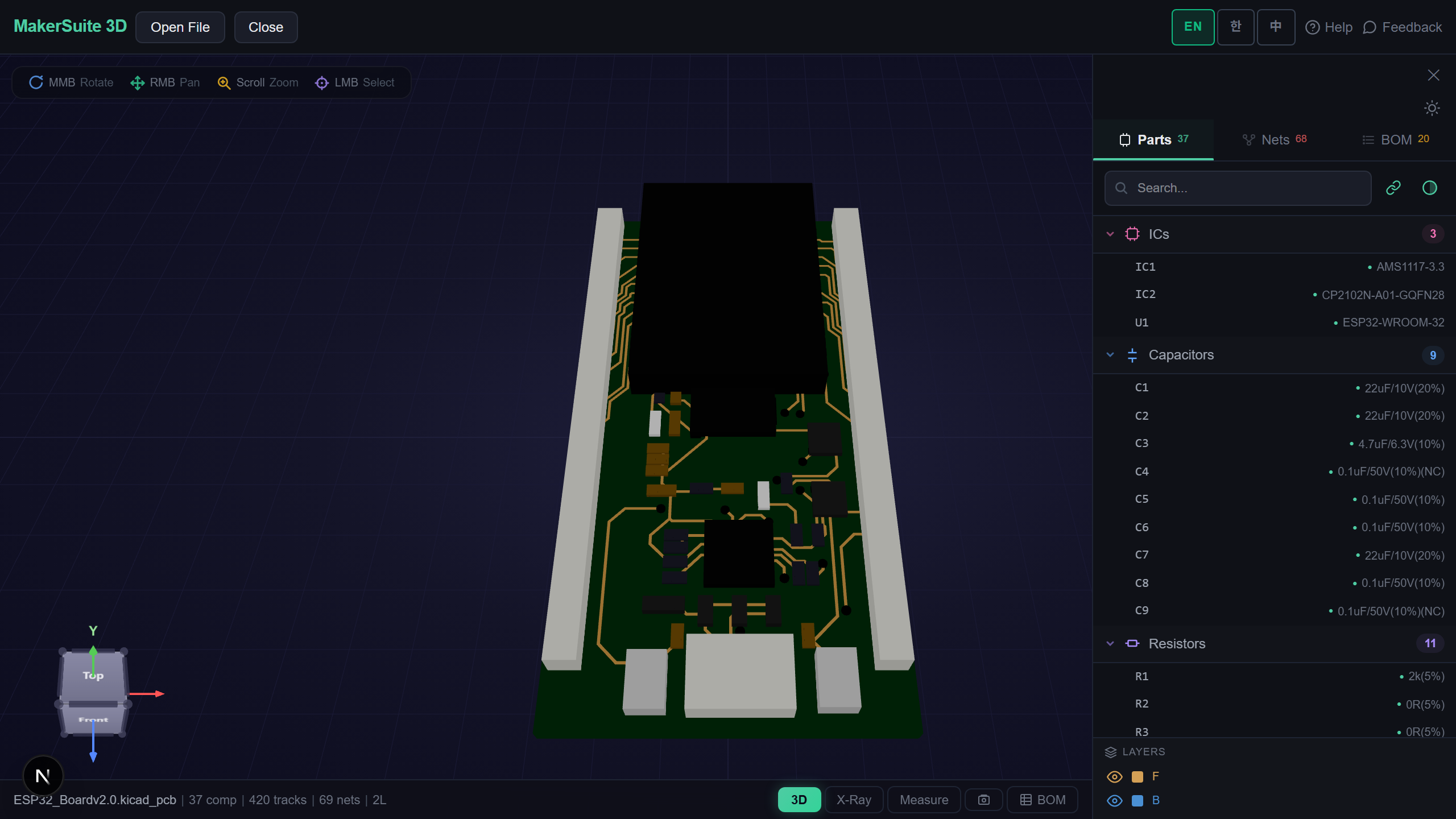
Interactive PCB Design Reviews in Your Browser
Design reviews are essential for catching errors before manufacturing. MakerSuite 3D gives you a complete 3D inspection environment — upload any PCB file and review component placement, routing, connectivity, and layer stackup interactively.
How to Conduct a Design Review
Share your PCB file with reviewers and have them open pcbviewer.app. They can drag the file into their browser to get the same 3D view — no PCB software needed. Everyone can inspect the board independently.
Review Capabilities
- 3D visualization — See your board from any angle with realistic component models
- Component inspection — Click any component to see its value, footprint, nets, and pads
- Net tracing — Highlight entire signal paths to verify connectivity
- Layer toggle — Show/hide individual copper, silk, and mask layers
- Measurement tool — Press M and click two points to measure distances in mm
- X-Ray mode — See through the board to inspect inner layers and buried traces
- DRC (Design Rule Check) — Automated checks for min track width, clearance, drill size, and unconnected nets with click-to-focus navigation
- PCB Compare (Diff) — Upload two revisions to see added, removed, and changed components and nets at a glance
Start your PCB design review — upload your board file now.
Try MakerSuite 3D FreeEasy Sharing for Teams
No need for expensive CAD licenses for every reviewer. MakerSuite 3D runs in any modern browser. Share your PCB file via email, Slack, or cloud storage, and reviewers can inspect it in full 3D instantly.
Design Review Checklist
- Verify component placement and orientation in 3D
- Trace critical signal paths with net highlighting
- Check via placement and layer transitions
- Inspect silkscreen text for correct labeling
- Review BOM for correct values and footprints
- Measure clearances between components
- Run DRC to catch minimum track width and clearance violations
- Compare with previous revision to verify intended changes
What a Good Design Review Actually Catches
The cheap errors a design review catches are well known: a flipped diode, a swapped capacitor footprint, a connector pinout that mirrors the mechanical drawing. Those matter, but they're not where good reviews earn their keep. The expensive errors are the ones nobody sees on a flat schematic — a USB connector positioned 0.4 mm too close to the enclosure rib, a heatsink fin that interferes with a tantalum cap, a mounting hole that lines up with a high-speed differential pair on the inner layer. Those errors get caught only when reviewers can rotate the board, switch on inner layers, and feel for the physical relationships.
The asynchronous part is also undervalued. Most design reviews collapse into a 90-minute video call where the lead designer drives a screen share and reviewers shout out notes. That format misses the careful reviewer who wants 20 minutes alone with the layout, and it amplifies whoever talks fastest. Sharing a MakerSuite link in advance lets each reviewer inspect the board on their schedule, write detailed notes, and come to the meeting with specific concerns instead of generalities.
There's a privacy angle too. Sharing a .kicad_pcb or .PcbDoc with an external consultant or a customer often runs into NDA constraints — "we'd love to review, but we can't accept the source files." MakerSuite's share-link flow exports a snapshot that has no editable source attached, so reviewers see the geometry and BOM but can't modify or extract the original CAD. That's enough for most third-party reviews and avoids the lawyer round-trip.
A Reviewer's Checklist Worth Running Every Time
Start with a layer-by-layer sweep. Top copper, then top silk, then top mask. Confirm reference designators are visible and not crashing into pads, that the silkscreen polarity dots match the components, and that the solder mask openings are sized correctly. Repeat for the bottom. Then turn on inner copper layers one at a time and look for routing that crosses sensitive analog regions.
End with the BOM panel open. The first thing to spot is whether any line lacks an MPN — those become procurement headaches later. The second thing is stock and EOL flags. A board that passes electrical review but fails because a key part is end-of-life is the least visible failure mode in PCB engineering.
Frequently Asked Questions
Can I use MakerSuite 3D for design reviews?
Yes. Upload any PCB file to get instant 3D visualization, component inspection, net highlighting, and layer-by-layer analysis — perfect for team design reviews.
Do reviewers need PCB software installed?
No. Share a link to pcbviewer.app and reviewers can view the board by simply dragging the file into the browser. No installation needed.
What can I inspect during a review?
Component placement, track routing, via locations, layer stackup, net connectivity, silkscreen text, and BOM data — all in interactive 3D.
Can I measure distances on the PCB?
Yes. Press M to activate the measurement tool and click two points to measure the distance between them.
Does it include a DRC (Design Rule Check)?
Yes. Press D to open the DRC panel. It automatically checks for minimum track width, clearance violations, drill size issues, and unconnected nets. Click any violation to zoom the 3D camera to its location.
Can I compare two PCB revisions?
Yes. Click the Diff button to open the compare panel, then drop a second PCB file. It shows added, removed, and changed components and nets side by side.
Related Articles
Start your design review now
Open MakerSuite 3D