STEP vs IGES — Modern vs Legacy CAD Exchange
The Two Neutral CAD Formats
For CAD-to-CAD data exchange, two neutral formats dominate: STEP (ISO 10303, modern) and IGES (ANSI Y14.26M, legacy). Both are supported by every major CAD package, both are ASCII text, and both can represent 3D solid geometry. But the similarities end there — STEP supports modern engineering metadata that IGES doesn't, and the choice between them affects everything from file size to drawing-less manufacturing workflows.
Format History and Standards
IGES dates to 1980, was last updated as IGES 5.3 in 1996, and is now frozen — no new revisions are in development. STEP began development in 1984, was first ratified as ISO 10303 in 1994, and continues active development through Application Protocols (AP203 for configuration management, AP214 for automotive, AP242 for product manufacturing information). STEP AP242 includes PMI (GD&T tolerances, surface finish, datums) that enables 'drawingless' manufacturing where all production intent is in the 3D model. IGES has no equivalent.
What This Comparison Covers
- Geometry support — both formats handle solids, surfaces, curves, points equivalently.
- Assembly hierarchy — STEP supports nested assemblies; IGES is flat.
- Metadata — STEP AP242 includes PMI (GD&T, surface finish); IGES has none.
- File size — STEP typically 20-40% smaller than equivalent IGES.
- Active maintenance — STEP is current ISO standard; IGES is frozen since 1996.
- Tooling support — every modern CAD reads/writes both; legacy CAM may only support IGES.
How to Decide Between STEP and IGES
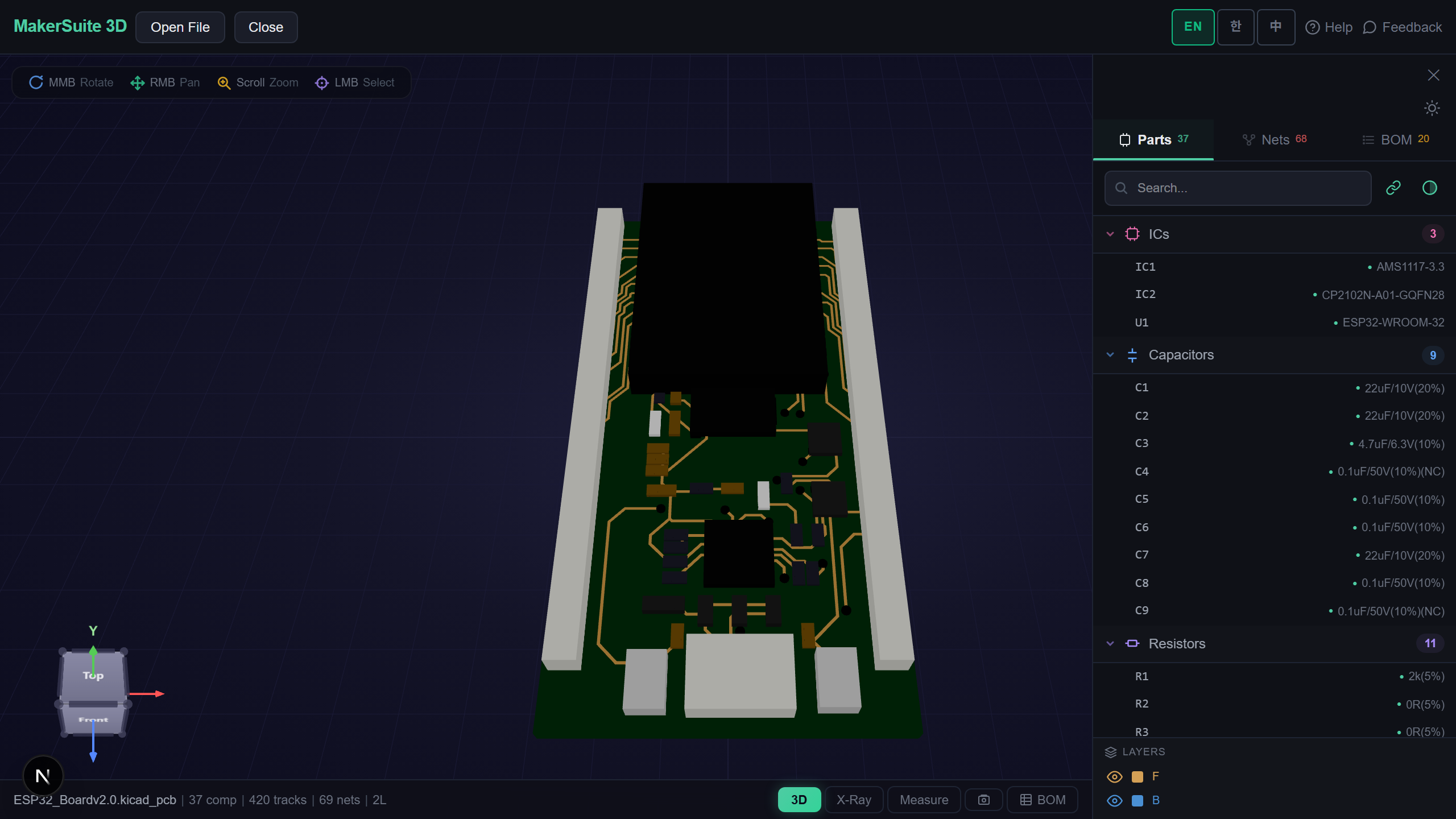
- Open pcbviewer.app and drop your STEP file. The viewer parses STEP via OpenCASCADE WebAssembly.
- For IGES, convert to STEP first using FreeCAD or your CAD tool, then drop the STEP into MakerSuite 3D.
- Verify geometry integrity — both formats should produce identical 3D after parsing.
- Inspect assembly structure if applicable — STEP shows hierarchy, IGES is flat.
- For new exchanges, choose STEP AP214 (automotive) or AP242 (full PMI) over IGES every time.
Compare STEP vs IGES outputs — drop both versions and verify geometry matches before downstream use.
Try MakerSuite 3D FreeWhy STEP Is the Modern Default
Aerospace, automotive, and medical device industries are migrating to drawingless manufacturing — production intent encoded in 3D models, not 2D drawings. STEP AP242 is the format that enables this; IGES cannot. Major OEMs (Boeing, Airbus, Toyota, GM, Siemens Medical) are mandating STEP AP242 for supplier data exchange because 2D drawings carry interpretation ambiguity that 3D PMI eliminates. For PCB-CAD interaction (mechanical designs interfacing with PCB enclosures), STEP is also standard — KiCad, Altium, Eagle, and EasyEDA all import/export STEP for board-to-enclosure handoff.
When Each Format Wins
- STEP — modern CAD-to-CAD exchange, drawingless manufacturing, PMI transfer
- STEP — PCB to enclosure design handoff (board outline + components in 3D)
- IGES — legacy CNC machine that only reads pre-2000 formats
- IGES — aerospace defense workflows still mandating it for backward compatibility
- Both — fabricator who hasn't standardized; provide STEP first, IGES on request
Browser-Side Parsing, No Upload
STEP files often contain proprietary mechanical designs and pre-release product geometry. MakerSuite 3D parses STEP entirely in your browser via occt-import-js (OpenCASCADE WebAssembly); no server upload, no cached copy. Assembly hierarchy, part metadata, and PMI annotations all stay on your machine. Safe for NDA reviews and supplier handoff.
Frequently Asked Questions
What's the actual difference between STEP and IGES?
STEP (ISO 10303) is a modern (1994 onward, AP214 in 1998, AP242 in 2014) standard with explicit support for product data: assemblies, hierarchy, materials, color, kinematic, GD&T, PMI annotations. IGES (Initial Graphics Exchange Specification, ANSI Y14.26M, last updated 1996 as IGES 5.3) is older and primarily geometry-only — surfaces, curves, points, with limited support for assemblies and metadata. STEP is actively maintained; IGES is frozen. STEP is the modern default, IGES is the legacy fallback when STEP isn't supported.
Why does IGES still exist?
Two reasons. First, legacy CAD systems (some industrial CNC machines, older CAM software, very old CATIA versions) still only read IGES. Second, IGES tolerates ambiguity better — when CAD systems disagree on geometry interpretation, IGES sometimes succeeds where STEP fails because IGES has fewer strict rules. For new work, always export STEP. For sending data to a customer with a 1990s-vintage CAD system or specific aerospace defense workflows, IGES may be the only working option. The conversion is one-way: STEP-to-IGES loses metadata, IGES-to-STEP recovers nothing that wasn't there.
Which one preserves more design intent?
STEP, especially STEP AP242. AP242 includes PMI (Product Manufacturing Information): GD&T tolerances, surface finish callouts, weld symbols, datum identifiers — the same engineering metadata that appears on a 2D drawing. Aerospace and automotive workflows leverage AP242 to ship 'drawingless' designs where all manufacturing intent is in the 3D model. IGES has no equivalent — annotations are at best loose text labels with no machine-readable semantics. For modern design intent transfer, STEP AP242 is the standard.
What about file size?
STEP files are typically 20-40% smaller than equivalent IGES files for the same geometry, partly because STEP's data structure is more efficient and partly because STEP allows compression-friendly representations. For a typical mechanical part, STEP is 1-5 MB vs IGES at 1.5-7 MB. For large assemblies (thousands of parts), STEP's hierarchical assembly structure means even bigger savings — IGES has to flatten everything into a single file. Both formats are ASCII (human-readable) by default, which inflates size 3-5× compared to a binary equivalent. STEP has a binary variant (Part 28, XML-based) but it's rarely used in practice.
Can MakerSuite 3D open IGES?
MakerSuite 3D currently uses occt-import-js (OpenCASCADE WebAssembly build) which supports STEP natively but not IGES out of the box. To view IGES in our viewer, convert it to STEP first using FreeCAD (File > Open .iges, then File > Export .step) or any CAD with IGES read + STEP write capability. The conversion is lossless for geometry. For mechanical CAD work, exporting STEP from your design tool directly is recommended — avoid IGES as an intermediate format because it loses metadata that other workflows depend on.
Related Articles
Compare STEP and IGES geometry — drop your file and verify before downstream use
Open MakerSuite 3D