What is an Excellon Drill File? — PCB Drill Format Explained
The File That Tells the Fab Where to Drill
Open any PCB manufacturing zip and you'll find Gerber files for the copper layers plus one or two files with extensions like .drl, .txt, .nc, or .drd. Those are Excellon drill files. They live alongside Gerber but speak a completely different language — not 2D shapes, but machine coordinates for a spinning drill bit. If Gerber tells the photoplotter where to etch copper, Excellon tells the CNC drill where to punch holes. Here's what's inside, why the format is 50 years old, and why getting it wrong ships bad boards.
What's Inside an Excellon File
Excellon is plain ASCII, like Gerber — but the syntax is from a different era. The header declares units (INCH or METRIC), zero-suppression (leading or trailing), and a tool table: T1C0.3 means tool 1 has a 0.3 mm diameter, T2C0.8 means tool 2 is 0.8 mm, and so on. Then comes the body: T1 selects a tool, X12500Y8750 drills a hit at those coordinates, and the machine keeps going until another tool change or M30 (program end). The entire file is just three things: unit declarations, a tool table, and a long list of (tool, X, Y) drill hits. Compare this to Gerber's aperture stamps — Excellon is much simpler because a drill bit only has one job.
What Excellon Gets Right
- Plain text, editable — any text editor can open it, any CNC can read it. There's no proprietary binary, no vendor-specific extensions you need to license.
- Tool diameter is explicit — every drill hit is tied to a tool number, and the tool table gives its exact diameter. No guessing, no inference from context.
- Units are declared in the header — INCH or METRIC directives tell the parser how to interpret coordinates. Getting this wrong is the #1 cause of scale errors.
- Zero-suppression handling — historical Excellon suppressed leading or trailing zeros to save punch-tape characters. Modern exports keep full precision, but legacy files still need careful parsing.
- Plated vs non-plated split — most EDA tools export two files (e.g., -PTH.drl and -NPTH.drl) so the fab doesn't accidentally plate mounting holes that should stay bare metal.
- Route commands for slots — routed slots (rectangular cutouts, long mounting holes) use G00/G01 path commands alongside drill hits. Same file, two modes of operation.
How to Verify Your Excellon Before Shipping
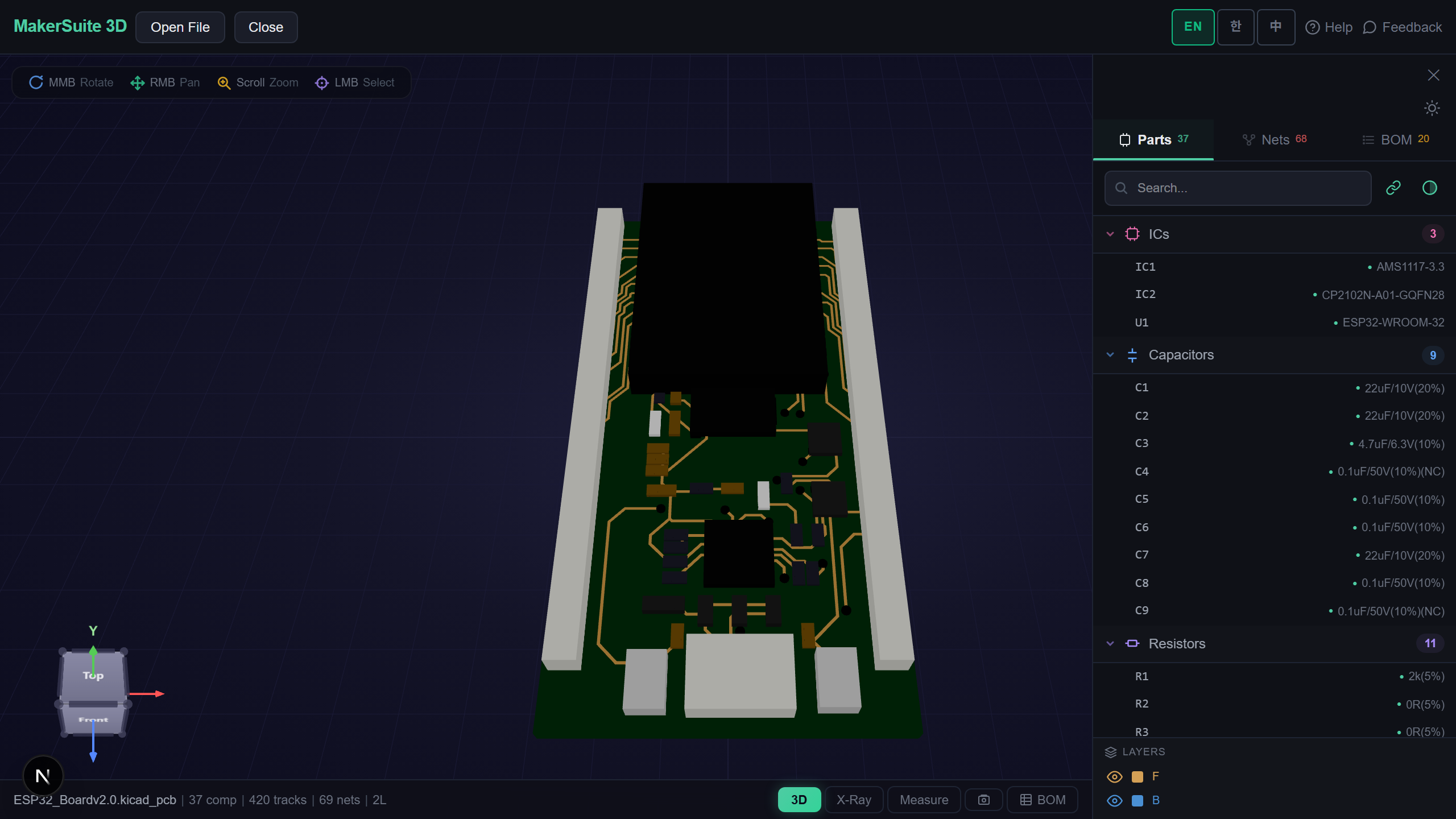
- Open pcbviewer.app — drop the full Gerber zip and the viewer auto-detects drill files inside.
- Check drill hits land on copper pads — every PTH hit should be centered on a pad or via. Offset drills come back as holes punched through traces.
- Verify plated vs non-plated classification — mounting holes for screws should be NPTH, component pin holes and vias should be PTH. The viewer colors them differently.
- Cross-check the tool table — every drill diameter in your schematic should match a tool definition. Missing sizes mean the fab will substitute and your part pins won't fit.
- Send the zip to the fab — include both .drl files (PTH and NPTH) alongside the Gerber layers. Leave a README if your NPTH file has an unusual extension.
Drop a Gerber zip with Excellon drills — see every hit land on a pad (or not) before the fab does.
Try MakerSuite 3D FreeWhy Excellon Errors Are Expensive
A Gerber layer mistake shows up in the photoplot preview and someone catches it. An Excellon mistake doesn't show up until drill press runs on your $3/piece production order. Wrong units? Every hole is 25× off. Wrong zero-suppression? Every hole is in the wrong octant. Missing tool? Fab substitutes a generic size and your BGA package won't seat. Running an Excellon viewer in 10 seconds before you click Submit has saved more boards than any other single check.
When Excellon Shows Up
- Every PCB fab order — JLCPCB, PCBWay, OSH Park all require Excellon alongside Gerber
- Multi-drill jobs — laser-drilled microvias on HDI boards use one Excellon, mechanical drills use another
- Panelization — drills for break-off tabs and mouse-bite perforations go in a third Excellon file
- Prototyping with a CNC mill — LPKF or Bantam mills read Excellon directly to cut prototypes at home
- Incoming inspection — QA at the fab runs your Excellon through CAM to count hits and verify tool sizes before production
Browser-Only Excellon Parsing
Drill files contain the exact pin pattern of every component on your board — proprietary hardware configuration. Uploading to a cloud viewer is a risk for NDA work or pre-launch designs. MakerSuite 3D parses Excellon directly in your browser via JavaScript — no server, no upload, no cached copy. Same parsing logic the fabs use internally, just ported to run client-side.
Frequently Asked Questions
Why is Excellon a separate file from Gerber?
Gerber describes 2D shapes that get stamped onto copper layers — pads, traces, silkscreen. Drilling is a different operation: a spinning bit plunging through the board at a specific coordinate with a specific diameter. That's not a 2D shape, it's a machine instruction. Excellon was designed in the 1970s for CNC drill presses and evolved alongside Gerber as the companion format. Every fab machine treats them separately, so keeping them separate files matches the physical workflow.
What's the difference between plated (PTH) and non-plated (NPTH) drills?
PTH (plated through-hole) drills are for electrical connections — via holes, component pin holes. The fab plates the hole walls with copper so signals can cross layers. NPTH (non-plated through-hole) drills are mechanical — mounting screws, alignment pins, logo cutouts. They have no copper plating inside. Most EDA tools export them as two separate Excellon files (e.g., .DRL and .NPTH) so the fab doesn't accidentally plate a mounting hole.
Can I open an Excellon file in a text editor?
Yes — it's plain ASCII. You'll see a header with tool definitions (T1C0.3 means tool 1 is 0.3 mm diameter), then a sequence of tool changes and X/Y coordinates (X12500Y8750 drills a hit at those coordinates). The coordinate format depends on the header directives (INCH vs METRIC, leading-zero vs trailing-zero suppression). This is why Excellon parsers have to read the header carefully — the same number string means different things under different directives.
What units does Excellon use?
Either inches or millimeters, declared in the header via INCH or METRIC directives. Inches are historical (1970s US machinery); millimeters are more common in modern exports. Units have leading-zero or trailing-zero suppression, declared separately. Getting the units or zero-suppression wrong is the #2 cause of bad boards (after layer flip) — a drill hit meant for 12.500 mm can land at 1.2500 mm if the parser guesses wrong.
Does MakerSuite 3D support Excellon drills?
Yes — drop your Gerber zip and the viewer automatically detects any .drl, .txt, .nc, or .drd files inside and renders drill hits as 3D holes through the board. Plated and non-plated are distinguished by file name conventions (DRL vs NPTH). Same browser-only parsing as Gerber — no upload, no server round-trip.
Related Articles
Drop your Gerber zip — drills render automatically in 3D
Launch Gerber Viewer