Free Online Gerber Viewer with 3D Rendering
Why View Gerber Files in 3D?
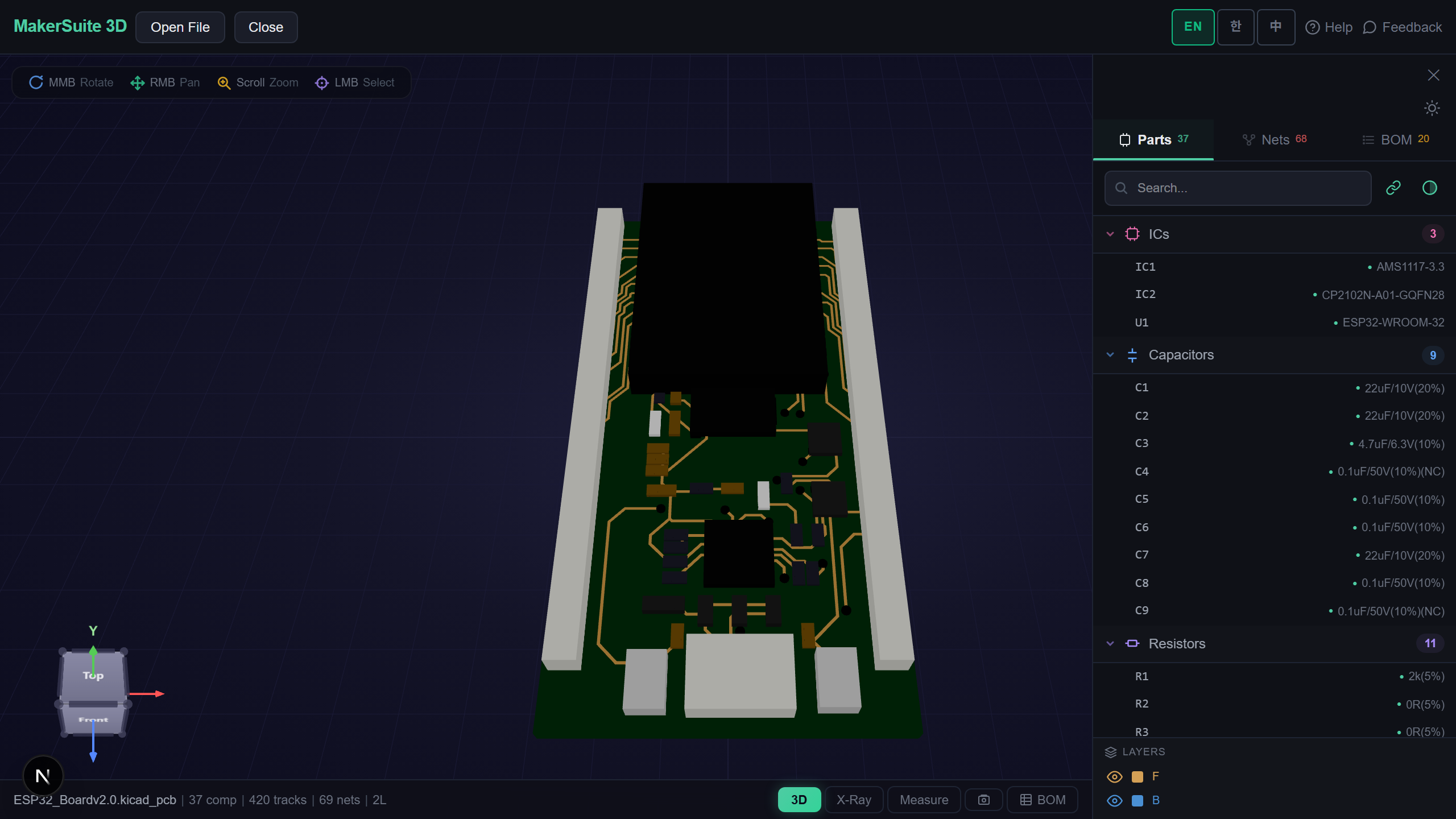
Gerber files are the industry standard for PCB manufacturing, but they're hard to inspect without specialized software. MakerSuite 3D renders your Gerber files in full 3D — helping you catch errors before sending boards to fabrication.
How to View Gerber Files
- Export Gerbers from your PCB tool (KiCad, Eagle, Altium, etc.)
- ZIP all files together (.gbr, .gbl, .gtl, .drl, .pos, etc.)
- Drop the ZIP on MakerSuite 3D
- Verify layers in the Layer Mapping dialog (auto-detected)
- Click Apply — your board appears in 3D
Supported Gerber Features
- RS-274X format — D01/D02/D03 commands, aperture definitions, regions (G36/G37)
- Excellon drill — .drl files parsed for vias and mounting holes
- Pick & Place — .pos files for component placement in 3D
- BOM integration — .csv BOM files for component values
- Auto layer detection — KiCad, Eagle, Altium, and generic naming patterns
- Layer mapping UI — Manual override for unrecognized files
Automatic Net Analysis
Unlike most Gerber viewers, MakerSuite 3D automatically analyzes copper trace connectivity to infer electrical nets. Click any net in the sidebar to highlight all connected traces, vias, and pads — even though Gerber files don't contain net data.
Try viewing your Gerber files in 3D — no software needed.
Try MakerSuite 3D FreeTips for Best Results
- Include Edge.Cuts / board outline file for accurate board shape
- Include drill files (.drl) for via and hole rendering
- Add Pick & Place (.pos) for 3D component placement
- ZIP everything together for one-click upload
RS-274X, Older RS-274D, and Why Gerber Survived
Gerber RS-274X has been the universal PCB manufacturing handoff since 1998. The format started as a Joseph Gerber Scientific photoplotter control language in the 1960s — literally instructions for moving a light source across photographic film. The X variant added embedded apertures and image polarity, eliminating the separate aperture lists that made earlier RS-274D files painful to interpret. Most boards ordered today ship as RS-274X, but legacy archives, defense contractors, and a few stubborn fabrication houses still hold onto RS-274D files where aperture definitions live in a separate text document.
MakerSuite parses both. The RS-274X tokenizer handles D01 (interpolate), D02 (move), D03 (flash), G36/G37 region fills, aperture macros, and step-and-repeat blocks. Excellon drill files — usually .drl, .txt, .nc, or .drd extensions — are parsed alongside, with automatic unit detection for the historical inch-vs-millimeter ambiguity that has bricked more PCB orders than any other format issue. When the layer mapping is ambiguous (no extension, no header), the layer mapping dialog lets you manually assign top copper, bottom copper, silk, mask, and edge-cuts before rendering.
The other Gerber-adjacent formats — IPC-2581 and ODB++ — are technically more capable, carrying net names, design rules, and intelligent layer metadata. They have not won. Every fabrication house on earth still accepts RS-274X first, and the IPC-2581 ecosystem remains a niche. If you're handing off a board for manufacturing in 2026, Gerber is the safe answer.
Gotchas When Reviewing Manufacturing Gerbers
Always include the edge-cuts (board outline) layer in your ZIP — without it, the viewer has to infer the board shape from the largest copper polygon, which goes wrong on boards with cutouts or non-rectangular outlines. Verify drill counts match your design: a missing .drl file shows the board with no vias and no mounting holes, which can look almost-right but ships unfunded boards if you skip the inspection.
Solder mask polarity catches new designers. Gerber mask layers describe where mask is removed, not where it's present. If your board renders with green covering every pad, the mask file is inverted — most fabricators handle this silently, but a few will produce boards with no exposed copper. Run a final mask-versus-pad sanity check before approving the fab order.
Frequently Asked Questions
How do I upload Gerber files?
ZIP all your Gerber (.gbr) and Excellon drill files together, then drag and drop the ZIP file onto MakerSuite 3D. Layer mapping is automatic.
Does it support RS-274X format?
Yes. RS-274X (extended Gerber) format is fully supported with automatic aperture and layer detection.
Can I see component placement from Gerber files?
Yes, if you include a Pick & Place (centroid) file in your ZIP, components will be placed on the 3D board with correct positions and rotations.
How is net analysis done without netlist data?
MakerSuite analyzes copper trace connectivity to automatically detect and highlight electrical nets, even without explicit netlist files.
Related Articles
Check your Gerber files before ordering
Open MakerSuite 3D