Free Online Altium PCB Viewer — View .PcbDoc Files in 3D
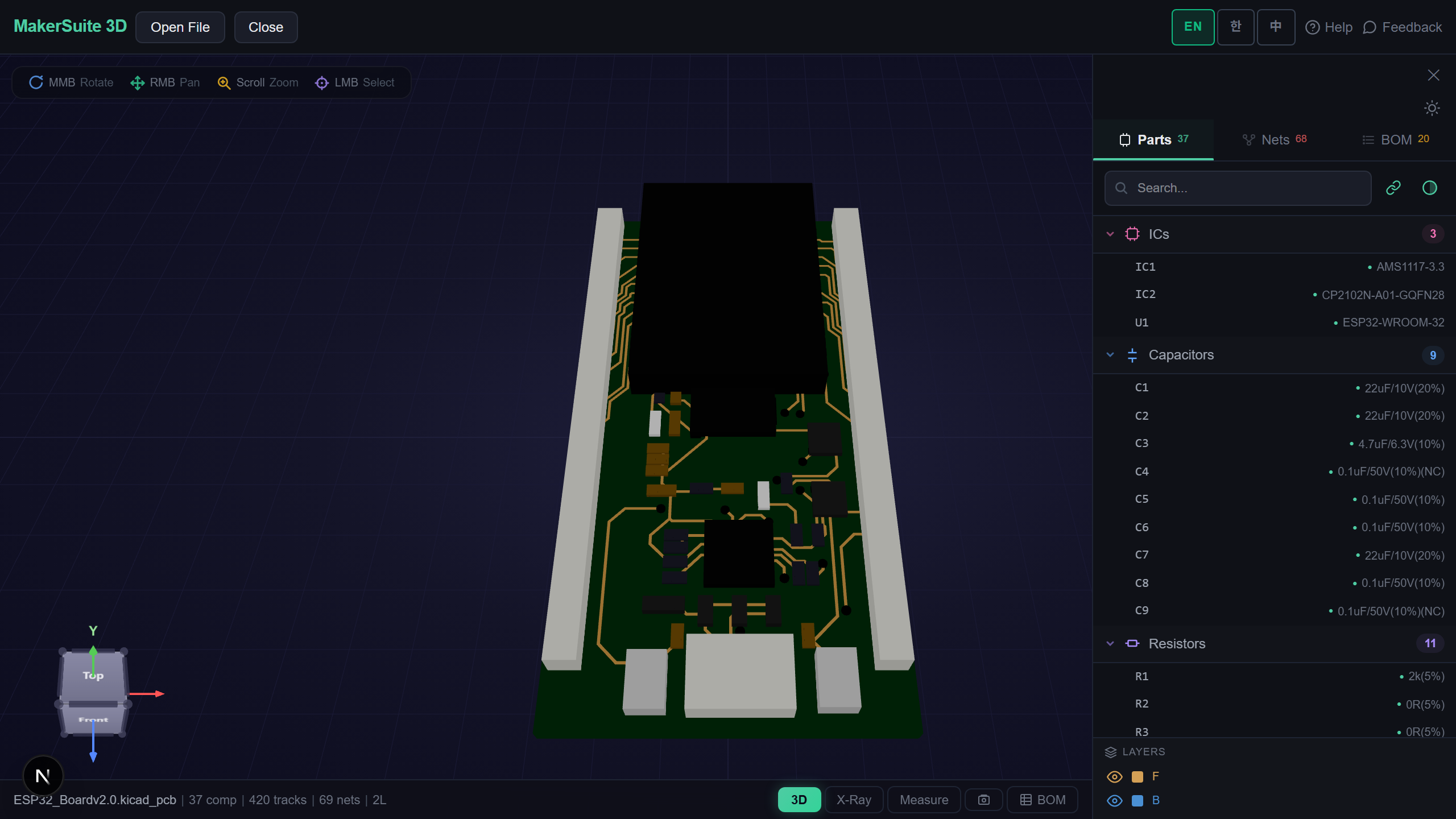
View Altium Boards Without a License
Altium Designer is powerful but expensive. Sharing .PcbDoc files with teammates or clients who don't have Altium can be frustrating. MakerSuite 3D opens Altium .PcbDoc files directly in your browser — no license, no installation, no signup. Just drag and drop.
How to View Altium .PcbDoc Files
- Open MakerSuite 3D — no login or installation needed
- Drag and drop your .PcbDoc file onto the drop zone
- The binary OLE2/CFB file is parsed entirely in your browser — nothing is uploaded
- Explore your board in 3D with net highlighting, X-Ray mode, and measurements
View your Altium .PcbDoc board in 3D — no license needed.
Try MakerSuite 3D FreeAltium-Specific Features
- OLE2/CFB binary parsing — Board6, Nets6, Tracks6, Pads6, Arcs6, Fills6, Texts6, ComponentBodies6 streams
- Multi-layer support — 2/4/6/8-layer boards with blind and buried vias
- 3D STEP models — 100+ component models loaded from CDN with priority queue
- Net highlighting — Click any net to highlight connected tracks, vias, and pads with Bloom glow
- Silk text rendering — Designator and Comment fields with rotation normalization
- X-Ray mode — See through layers to inspect inner copper and component placement
Also Supports Other Formats
MakerSuite 3D isn't just for Altium. It also supports KiCad (.kicad_pcb), Gerber (.zip/.gbr), Eagle (.brd), and EasyEDA (.json) — all in one tool.
What's Actually Inside a .PcbDoc File
An Altium .PcbDoc is not a single document — it is an OLE2 Compound File Binary container, the same Microsoft format that backs old Office documents. Inside, dozens of named sub-streams hold the board: Board6 carries the layer stackup and design rules, Components6 lists every footprint placement, Tracks6 stores the copper routing, Pads6 and Vias6 hold the holes, Polygons6 describes copper fills, and Texts6 keeps the silkscreen labels. Each stream is a packed array of fixed-width binary records, byte-aligned and Altium-version-dependent.
MakerSuite parses 12 of those sub-streams independently, with try/catch isolation per stream so a corrupt silkscreen entry never blocks the rest of the board from rendering. That matters when you receive a .PcbDoc from a third party and have no way to know which Altium version it came from. The viewer reports per-stream parse counts to the console, so if Tracks6 reports 0 records on a board you know has routing, you can spot the problem before trusting the visual.
Why isn't there a free official reader? Altium's own Free Viewer ships only for Windows, requires a 700 MB install, and has not had a meaningful update in years. The Altium 365 web viewer requires a paid Workspace and uploads your design. The MakerSuite parser was reverse-engineered from public CFB documentation and the OpenAltium project — it isn't endorsed by Altium Inc., but it doesn't need to be.
Reviewing an Altium Board You Didn't Design
When opening a board from a client or contractor, start with layer counts and net counts in the sidebar — those numbers tell you whether you're looking at a four-layer prototype or a twelve-layer high-density design. Toggle the silkscreen layer on, then off, to confirm reference designators are present (some Altium exports strip silk before sharing). Click any net to see all connected pads — if a power net like VCC has only two connections, somebody forgot to copy a polygon pour.
For migrations, MakerSuite's BOM panel exports the placement list as XLSX with reference, footprint, value, and X/Y/rotation columns. That spreadsheet is the safest handoff to KiCad if a team is moving away from Altium — better than the lossy .PcbDoc importer in KiCad 8, because component values stay verbatim instead of being normalized.
Frequently Asked Questions
Do I need an Altium Designer license to view .PcbDoc files?
No. MakerSuite 3D parses .PcbDoc binary files directly in the browser without Altium software. It's completely free.
How does it parse Altium's binary format?
It uses an OLE2/CFB compound binary parser written in TypeScript, running entirely in your browser with no server-side processing.
What Altium features are supported?
Multi-layer boards, 3D STEP models with 97.8% auto-match rate, net highlighting, silkscreen text rendering, and full BOM extraction with supplier search.
Can I view Altium boards on Mac or Linux?
Yes. Since MakerSuite 3D runs in the browser, it works on any operating system — Windows, Mac, Linux, and even mobile devices.
Related Articles
Open your Altium board in 3D — no license needed
Open MakerSuite 3D