3D STEP Model Viewer for PCB Components
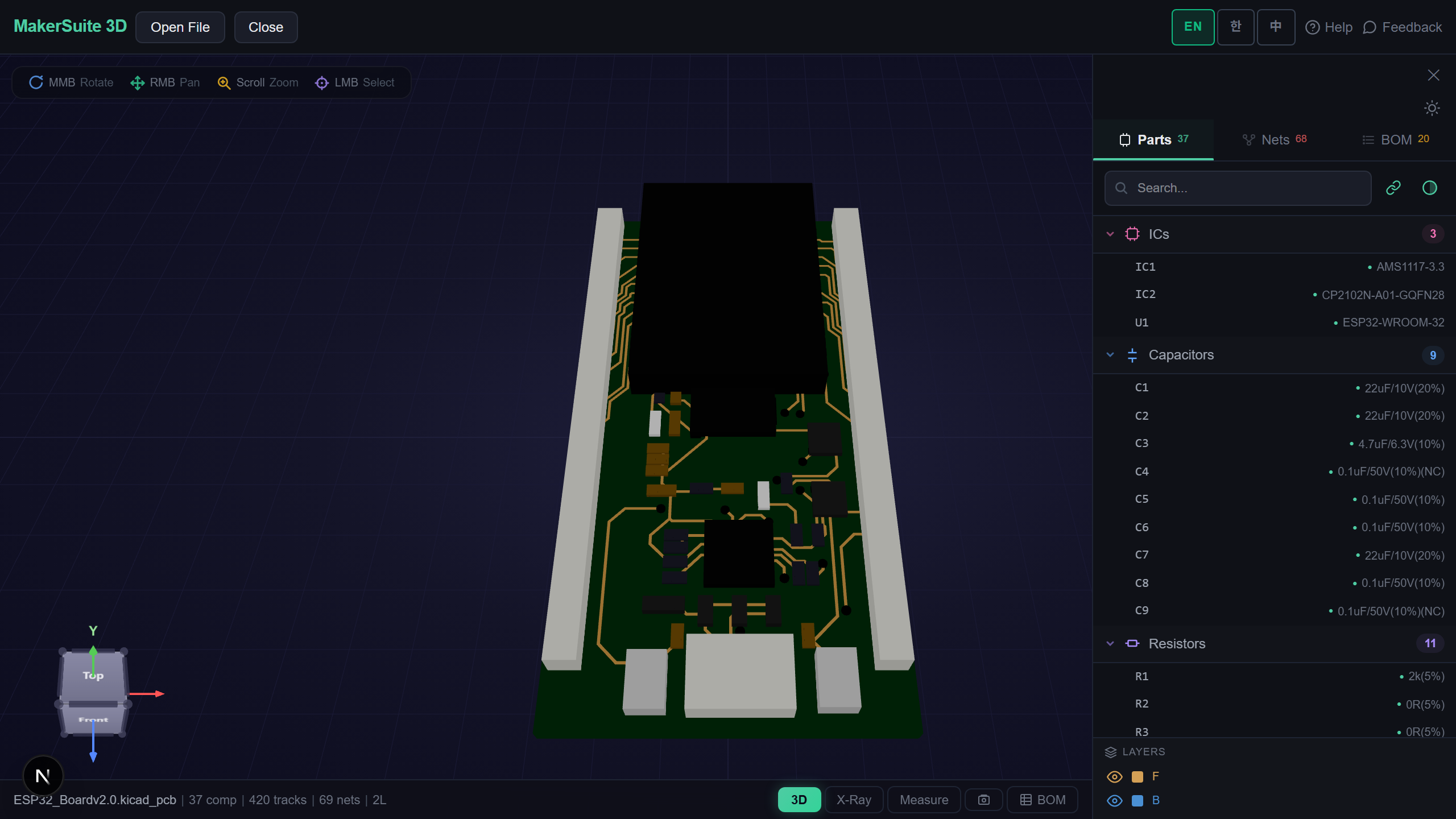
Realistic 3D Components on Your PCB
MakerSuite 3D loads real STEP 3D models for your PCB components, replacing simple boxes with photorealistic shapes that match the actual parts on your board.
How STEP Model Loading Works
When you load a PCB file, MakerSuite 3D matches each component's footprint to our library of 116+ STEP models hosted on a Cloudflare R2 CDN. Models are loaded progressively — components closest to the camera load first.
Component Library Coverage
- Resistors — 0402, 0603, 0805, 1206, 1210, 2512 packages
- Capacitors — MLCC, electrolytic, tantalum in common sizes
- ICs — QFN, QFP, LQFP, TSSOP, SOT-23, SOT-223, SOIC packages
- Connectors — USB-C, USB Micro-B, pin headers, JST
- Passives — inductors, diodes, LEDs, crystals, switches
- Modules — ESP32-WROOM, popular development board components
Custom STEP Model Upload
Missing a component? Upload your own STEP (.step/.stp) or STL files directly in the detail panel. Custom models are saved to your browser's IndexedDB and persist across sessions.
See realistic 3D components on your PCB — upload your board now.
Try MakerSuite 3D FreePerformance Optimization
- Priority queue — camera-nearest components load first
- CDN delivery — models cached globally via Cloudflare R2
- IndexedDB cache — downloaded models are stored locally
- Fallback boxes — components show placeholder geometry while loading
Where the 116+ STEP Models Come From
The component library is sourced from KiCad's official 3D shapes repository, the de-facto open standard for board-level 3D parts. Each STEP file in that library was authored by a community contributor who measured a physical part, modeled it in FreeCAD or built it from a manufacturer datasheet, then submitted a pull request that was reviewed and merged. MakerSuite hosts a mirror of the most-used 116 models on Cloudflare R2 so they load fast from anywhere in the world, but the upstream files are the same ones KiCad ships, with no modifications.
When a footprint isn't in the curated 116, the viewer falls back to two layers of geometry inference. Layer one is the IPC-7351 footprint convention: package codes like CAPC2012X130 or RESC1608X40 encode width × height × thickness in tenths of a millimeter, which the viewer reads to generate a correctly-sized box. Layer two is a lookup table for IC packages (SOIC-8, QFN-32, TQFP-100, etc.) that emits the right body height and pin geometry. Together they cover the long tail — almost no component renders as a generic cube unless its footprint name is genuinely unparseable.
Auto-rotation is the trickiest part. STEP models are authored in a canonical orientation that doesn't always match what your PCB designer chose. The viewer compares the footprint's pad spans to the model's expected pad layout and rotates 90° if the long axis is reversed. This catches the common SOT-23 / SOT-23-3 / SOT-23-5 confusion and most rotated SSOP packages. When it gets it wrong, the detail panel has a manual rotation override.
Custom STEP for Parts You Designed
If you've designed a custom enclosure piece, a connector with unusual mounting, or a module that nobody has modeled yet, you can upload your own STEP file from the component detail panel. The model is stored in your browser's IndexedDB and persists across sessions on the same machine — but it isn't synced to other devices, by design, since your CAD belongs to you.
For a team-wide custom library, the practical pattern is hosting your STEP files on your own static host (S3 bucket, GitHub raw, Cloudflare R2) and constructing the URL with the inferModelUrl pattern. Then the URL maps deterministically to a footprint reference and every team member sees the same custom geometry without re-uploading.
Frequently Asked Questions
How many 3D STEP models are available?
Over 116 component models are available via Cloudflare R2 CDN, covering resistors, capacitors, ICs, connectors, modules, and more.
Can I upload custom STEP models?
Yes. You can upload your own .step or .stp files and they'll be cached in IndexedDB for instant loading on future visits.
How are components matched to 3D models?
An IPC-7351 footprint matcher combined with manufacturer MPN lookup automatically finds the correct 3D model with up to 97.8% match rate.
What happens if a 3D model isn't available?
A proportionally-sized fallback box is rendered based on the component's pad dimensions, so you still see accurate board layout.
Related Articles
See your PCB components in realistic 3D
Open MakerSuite 3D