How to Convert Eagle to KiCad — 2026 Migration Guide
Autodesk EAGLE Is Done — What Now
Autodesk announced EAGLE's discontinuation in 2023 and the final sunset lands June 7, 2026. New licenses are gone, subscription renewals are gone, and Autodesk is nudging everyone toward Fusion Electronics — a paid subscription bolted into Fusion 360. A lot of teams aren't happy with that pivot. The natural home for EAGLE projects is KiCad: open-source, free forever, actively developed, and since KiCad 6 it ships a native EAGLE importer that handles .brd boards, .sch schematics, and .lbr libraries out of the box. Here's what the migration actually looks like, where it breaks, and how to verify the result before trusting it.
What the Migration Actually Moves
EAGLE files are XML — .brd for the board, .sch for the schematic, .lbr for libraries. KiCad files are S-expressions — .kicad_pcb, .kicad_sch, .kicad_sym, .kicad_mod. KiCad's importer reads the EAGLE XML directly and emits the S-expression equivalents. What comes across: board outline, copper layers, tracks, vias, pads, zones (polygon pours), silkscreen, component placements, ratsnest, net names, and design rules. What needs a second pass: footprint library references (EAGLE packages vs KiCad footprints), 3D models (EAGLE doesn't ship them, KiCad expects .step or .wrl), and custom design-rule checks written in EAGLE's ULP scripting. Schematic symbols transfer but may land on KiCad's generic placeholders until you remap to real symbol libraries.
What KiCad's EAGLE Importer Handles
- Native built-in — File > Import > Non-KiCad Board/Schematic in KiCad 8. No plugin, no external tool, no subscription. Ships in the default install.
- Nets preserved — every wire, ratsnest connection, and net name carries over. This is the hard part of any PCB migration and the importer nails it.
- Layer stackup remapped — EAGLE's 16 copper layers map onto KiCad's 32-layer stackup automatically. Silkscreen, paste, mask, and keepout layers line up.
- Component placements kept — X/Y coordinates, rotation, side (top/bottom), and package name all transfer. You'll still need to remap package names to KiCad footprint library paths.
- Polygon pours converted — copper zones become KiCad zones with the same net assignment and clearance rules. Thermal connections preserved.
- Design rules imported — clearance, trace width, via sizes read from the EAGLE DRU file and populated in KiCad's board setup. Verify before fabricating.
How to Migrate in Five Steps
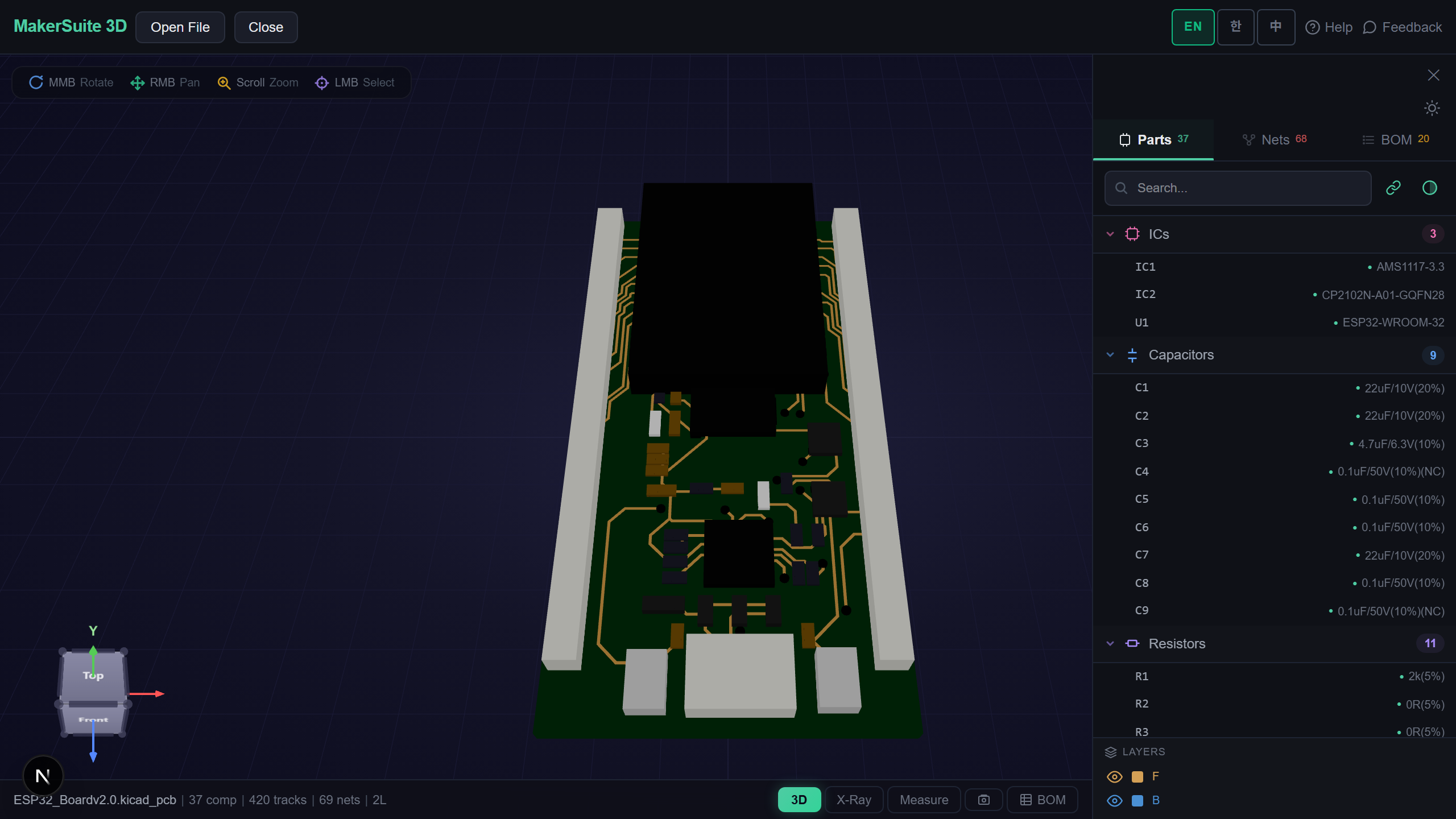
- Open pcbviewer.app — drag your .brd file first to confirm it parses cleanly. If MakerSuite 3D reads it, KiCad will too.
- Open KiCad 8.x, pick File > Import > Non-KiCad Board File, select your .brd. KiCad creates a matching .kicad_pcb in the same folder.
- Import the schematic separately — File > Import > Non-KiCad Schematic/Project for the .sch. Run Tools > Update PCB from Schematic once both are in.
- Remap footprint libraries — Tools > Footprint Editor > Global Library Nickname Substitution. EAGLE's library names won't match KiCad's; map them to the KiCad official libraries or to a converted .kicad_sym generated from the .lbr file.
- Export the KiCad board to Gerber and drop the resulting zip back on MakerSuite 3D. Compare visually with the original EAGLE board — any layer drift, missing zones, or rotated parts show up immediately.
Before you trust the converted board, drop both the original .brd and the new .kicad_pcb on MakerSuite 3D — a 30-second visual diff catches silent importer regressions.
Try MakerSuite 3D FreeWhy This Migration Has a Real Deadline
The June 7, 2026 sunset isn't marketing — after that date EAGLE stops activating new installs and existing installs lose access to the component library cloud service. You can keep the .exe running offline indefinitely, but new hires can't install, license transfers fail, and any team workflow that assumed cloud library sync breaks. Teams that delay past the sunset end up maintaining dead tooling instead of shipping boards. The right move is to convert the active projects now, pin one machine with an offline EAGLE install as a read-only archive, and spin up all new boards in KiCad from day one.
Who's Migrating and Why
- Autodesk sunset — primary driver for 2026; teams migrating before the June deadline to avoid workflow disruption
- License cost — EAGLE's Premium subscription was $65/month in its final year; KiCad is free with zero seat limits
- Open-source policy — companies with internal requirements for auditable, vendor-neutral CAD stacks switching to KiCad as policy
- Linux-native workflow — KiCad runs natively on Linux without Wine; Autodesk never shipped a Linux EAGLE build
- Git-friendly source control — KiCad's S-expression files diff in git cleanly; EAGLE XML works but is more verbose and noisier in code review
Verify the Conversion in Your Browser
PCB source files contain your full design IP. Uploading .brd or .kicad_pcb to a cloud viewer is a risk for NDA work. MakerSuite 3D parses both EAGLE and KiCad files entirely in your browser via JavaScript — no server, no upload, no cached copy. Drop the original EAGLE .brd on one tab, the converted .kicad_pcb on another, and compare side by side. Same parsing logic used internally by the importer developers, just ported to run client-side so your board never leaves the machine.
Migration Pitfalls Specific to EAGLE→KiCad
Library remap is where most teams burn a week. EAGLE libraries pin a footprint to a part by name ("R0805"), and the importer brings the name across but not the geometry — KiCad needs an actual footprint with the same name in its library path. If your EAGLE workflow used the SparkFun, Adafruit, or in-house libraries, you'll see hundreds of "footprint not found" warnings on first import. The fix is converting the .lbr files in batch using the open-source `eagle-to-kicad-libs` script before importing the board, so the names resolve.
ULP scripts don't transfer. EAGLE's User Language Programs are a custom C-like scripting layer that handles everything from net renaming to bill-of-materials reports. KiCad has Python plugins instead — different language, different API, different hooks. If your team relies on a specific ULP for production releases, plan for a rewrite. Most common ULPs (BOM exporters, gerber generators) have direct KiCad equivalents in the default install, so the rewrite is often unnecessary.
Frequently Asked Questions
Is Autodesk EAGLE really going away?
Yes. Autodesk officially announced EAGLE's discontinuation in 2023 and set the final sunset for June 7, 2026. New license sales stopped earlier, subscription renewals are ending, and cloud library services shut down on the sunset date. Existing installs continue to run offline indefinitely, but without updates or cloud sync. Autodesk directs the customer base toward Fusion Electronics (formerly Fusion 360 Electronics), which is a paid subscription bundled into Fusion 360 rather than a standalone EAGLE successor.
Does KiCad's EAGLE importer actually work on real boards?
Yes — it has been built into KiCad since version 6 (released 2022) and matured significantly in KiCad 7 and 8. The importer reads .brd, .sch, and .lbr XML files directly and produces native .kicad_pcb and .kicad_sch output. Nets, layers, component placements, zones, and design rules transfer reliably. The parts that need manual attention are footprint library remapping (EAGLE package names don't match KiCad footprint library paths) and 3D models (EAGLE doesn't ship models, you'll need to find KiCad-compatible .step or .wrl files). For a typical hobbyist or small-team board, expect to spend an afternoon on remapping after a clean import.
What about my EAGLE library files (.lbr)?
KiCad 8 can import .lbr files through File > Import > Non-KiCad Library. The importer splits the EAGLE library into KiCad's separated structure — .kicad_sym for schematic symbols and .pretty folders for footprints. This is useful if you've maintained custom EAGLE libraries for years. For parts covered by KiCad's official libraries (which are extensive), it's usually faster to remap to the official names than to maintain converted custom libraries. For truly custom packages (odd mechanicals, proprietary modules), converting the .lbr keeps your existing work intact.
Will my ULP scripts still work?
No — EAGLE's ULP (User Language Program) scripting is specific to EAGLE's C-like embedded interpreter and has no direct equivalent in KiCad. KiCad uses Python for scripting (via the pcbnew Python API). If you have ULP scripts for BOM generation, panelization, or custom DRC, you'll need to rewrite them in Python. The good news is KiCad's Python API is more powerful and has broader community support, so most ULP use cases have established Python equivalents or open-source plugins.
Can I verify the converted board without installing KiCad?
Yes — MakerSuite 3D opens both EAGLE .brd and KiCad .kicad_pcb files directly in the browser. Drop the original .brd in one tab and the converted .kicad_pcb in another, and visually compare layer by layer. Any silent regression from the importer (missing zones, flipped layers, rotated parts) shows up immediately in the 3D view. No KiCad install required for the verification step, which is useful if you're auditing converted boards on a machine that doesn't have CAD software installed.
Related Articles
Drop your EAGLE .brd or KiCad .kicad_pcb — verify the migration visually
Launch PCB Viewer