Free Online Eagle PCB Viewer — View .brd Files in 3D
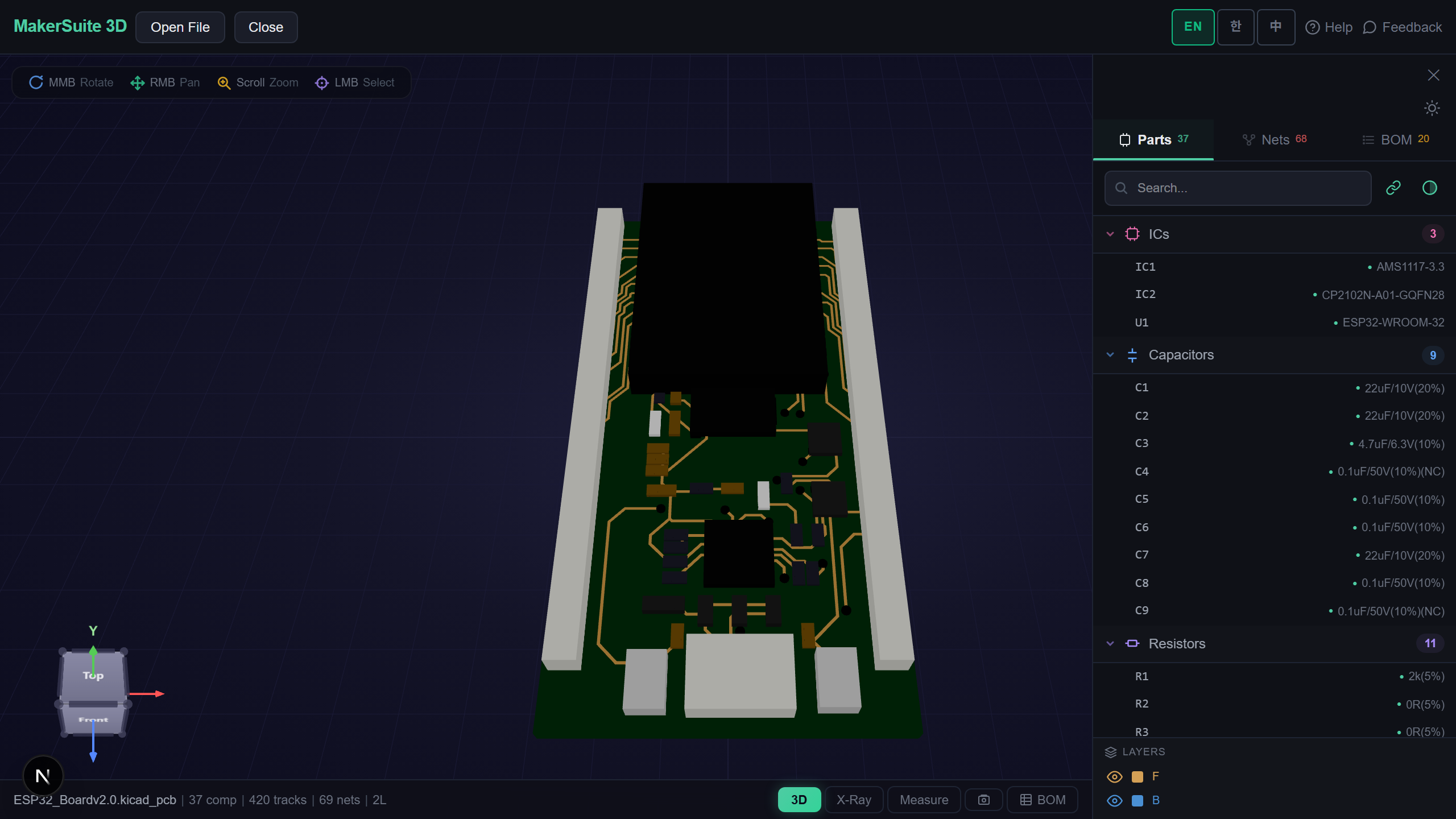
View Eagle Boards Without Autodesk Eagle
Autodesk Eagle is a popular PCB design tool, but opening .brd files usually requires the full Eagle installation and an Autodesk account. MakerSuite 3D parses Eagle XML-based .brd files directly in your browser — no installation, no login, completely free.
How to View Eagle .brd Files in 3D
- Open MakerSuite 3D — no installation or Autodesk account needed
- Drag and drop your .brd file onto the drop zone
- The Eagle XML is parsed entirely in your browser — nothing is uploaded
- Explore your board in 3D with components, nets, and layer controls
Eagle-Specific Features
- XML parsing — Full Eagle .brd XML structure with libraries, packages, and signals
- Rotation & mirroring — Component rotation and mirroring data applied correctly
- Net highlighting — Click any net to see all connected traces, vias, and pads
- Silkscreen text — Reference designators and component values rendered on the board
- BOM extraction — Automatic component extraction with values and footprints
- Multi-layer — Front and back copper, silkscreen, and mask layers with toggle
View your Eagle .brd board in 3D — no Autodesk account needed.
Try MakerSuite 3D FreeSupported Eagle Versions
Both kinds of Eagle board open: the XML .brd files of Eagle 6.x through the final Autodesk release, and the older binary .brd files of Eagle 3, 4 and 5. Schematics open both ways too: XML .sch files, and binary .sch files from Eagle 4 and 5.
After June 2026: Eagle's End of Life
Autodesk announced Eagle's discontinuation in 2023, and the final sunset landed on June 7, 2026. New licenses are gone. Renewals are gone. Existing perpetual seats keep working but receive no updates, no security patches, and no library refreshes. Autodesk's official replacement is Fusion Electronics — a paid Fusion 360 add-on with an entirely different schematic environment and a workflow many Eagle veterans have rejected. The result is a long tail of orphaned .brd files at hobbyist forums, OSH Park projects, and small companies that built designs in Eagle 9 and now need to keep them readable for the next decade.
MakerSuite parses Eagle's XML schema directly, so it doesn't depend on the Autodesk client surviving. Eagle 6 introduced the XML format; everything from Eagle 6.0 through the final Autodesk release uses the same basic structure (libraries → packages → signals → wires → vias). Boards from Eagle 5 and earlier are binary — a tree of fixed-size records with a string table — and MakerSuite reads those too, by rebuilding the same XML structure from the records. It was checked against the Gerber and drill files Eagle itself produced from such boards.
For projects that need an active future, the most direct migration path is Eagle → KiCad. KiCad 6 and later ship a built-in Eagle importer that handles .brd, .sch, and .lbr files. The conversion is not lossless — some library hierarchy is flattened, polygon priorities are sometimes inverted — but it's the cleanest open-source path. Use MakerSuite to spot-check both versions before deleting your Eagle source.
Reading a .brd File After Autodesk Cuts Off Support
If you receive an Eagle file from a colleague who can no longer install Eagle, MakerSuite is often the only viable reader. Drop the .brd, verify the layer count and signal count match what was expected, and export the BOM if you need a procurement record. The XML is human-readable, so in a pinch you can also open it in a text editor to confirm the design name, date, and software version stamped in the header.
Library compatibility is the main migration trap. Eagle libraries (.lbr) reference parts by name, and KiCad's importer can resolve standard footprints, but custom in-house libraries need manual reconstruction. Before migrating, use MakerSuite to capture screenshots of the original layout — those become your reference when verifying that the converted KiCad project still matches the physical board you built.
Frequently Asked Questions
Can I view Eagle .brd files without Autodesk Eagle?
Yes. MakerSuite 3D parses Eagle XML-based .brd files directly in the browser. No Eagle installation or Autodesk account required.
Does it support Eagle board rotation and mirroring?
Yes. Component rotation and mirroring data is parsed from the Eagle XML and applied correctly in the 3D rendering.
Can I see Eagle board nets and connections?
Yes. Net data is extracted from the Eagle file for full net highlighting and electrical connectivity visualization.
What Eagle versions are supported?
Eagle XML-based .brd files from Eagle 6.x and later are supported. Older binary formats are not supported.
Related Articles
View your Eagle board in 3D — no Autodesk account needed
Open MakerSuite 3D