How to Convert KiCad to Altium — Honest Migration Guide
Altium Has No Native KiCad Importer
This is the conversion direction nobody wants to talk about. Altium Designer ships an EAGLE importer, an Allegro importer, an OrCAD importer — but no KiCad importer. The reverse direction (Altium → KiCad) has been built into KiCad since version 7. Going KiCad → Altium requires either a fabrication-format detour (Gerber, IPC-2581, ODB++), a third-party translator (Altium Vault Importer, Translation Services), or a manual rebuild. None of these preserve schematic-to-PCB linkage cleanly. This guide covers the three real paths in 2026, what each one keeps and loses, and when paying for the third-party path is worth it versus rebuilding manually. If you're considering the migration, the honest first question is: do you actually need Altium, or is the team mandating it for non-technical reasons?
What Each Conversion Path Actually Does
Path 1: ODB++ export from KiCad → Altium Import. KiCad 7+ exports ODB++ (a fabrication format that bundles all layer artwork plus net data). Altium imports ODB++ as a board, but no schematic. You get layout, copper, drill, components, and net names — but lose schematic, design rules, and editing history. Path 2: IPC-2581 export → Altium Import. Same tradeoffs as ODB++ but newer format with broader vendor support. Path 3: Third-party tool — Altium's professional services or vendors like Cadence/Mentor offer paid translation. Manual rebuild is path 4 — open the KiCad design as a reference image, recreate the schematic and re-route the PCB in Altium. Slow but produces clean Altium-native source. Most teams underestimate path 4 and end up there anyway after path 1-3 produces unmaintainable output.
What Each Path Preserves
- ODB++ export — copper layers, drill holes, board outline, component placements, net names, design rules per layer. No schematic, no library linkage, no editable history.
- IPC-2581 — same as ODB++ scope, newer XML-based format. Fewer integration bugs in modern Altium versions, but the conversion result is functionally identical.
- Gerber + Excellon — fallback path when ODB++ doesn't import cleanly. Requires manual netlist reconstruction in Altium because Gerber has no net data.
- Altium Vault Importer — paid Altium service that runs the conversion and ships back a working .PrjPcb. Quoted per project, typically $500-2K depending on complexity.
- Manual rebuild — slowest path but produces clean Altium source. Use KiCad's PDF plot of the schematic as a visual reference, recreate the schematic in Altium, then place components and route. Plan for hours, not minutes.
- Net validation — regardless of path, verify by exporting the converted board back to Gerber from Altium and visually comparing against the original KiCad board. MakerSuite 3D handles both formats, making the side-by-side check trivial.
How to Approach the Migration in Five Steps
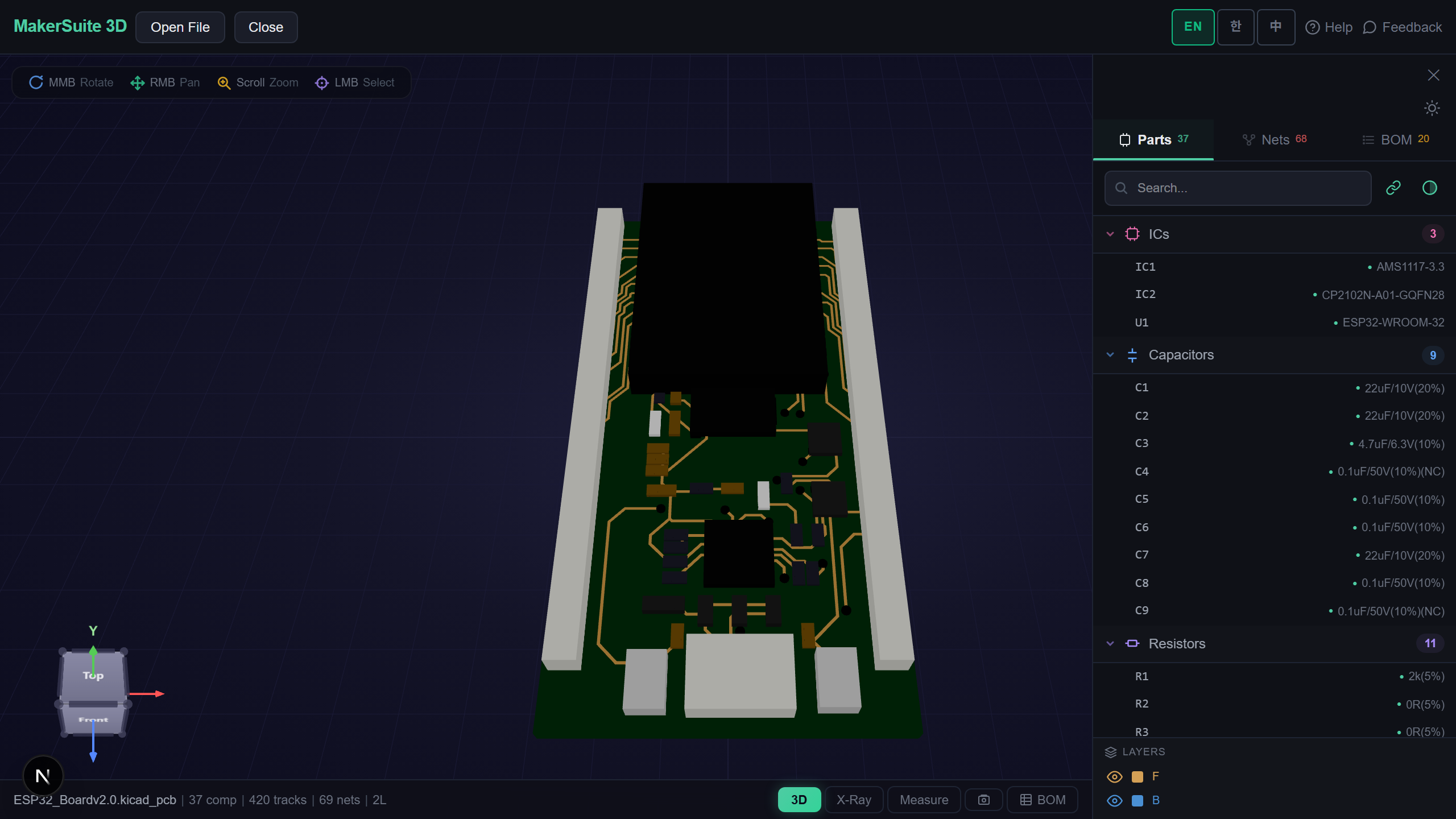
- Open pcbviewer.app — drop your .kicad_pcb on MakerSuite 3D first to confirm the source is clean. Any layer issues, component rotation problems, or net data gaps in the source will compound through the conversion.
- Try ODB++ first — KiCad PCB Editor > File > Fabrication Outputs > ODB++. Open the resulting .tgz in Altium via File > Import > ODB++. Inspect: do components show up at the right position, do net names match, is the board outline correct?
- If ODB++ produces issues, try IPC-2581 export from KiCad and import in Altium. Newer format, fewer translation bugs in Altium 24+. Same scope of preserved data.
- Decide whether to live with the converted board (no editable schematic, fab-only handoff) or rebuild manually for a real Altium-native project. Budget rule of thumb: any board you'll edit for >6 months in Altium is worth rebuilding manually.
- Verify the conversion by exporting the Altium board to Gerber and dropping the original KiCad and converted Altium Gerbers side-by-side in MakerSuite 3D. Visual diff catches missing pads, layer drift, and silent translation errors.
Compare the original KiCad board and the converted Altium output visually — drop both Gerber exports in MakerSuite 3D to catch silent translation errors before signing off.
Try MakerSuite 3D FreeWhy This Migration Is Painful
KiCad and Altium took different architectural paths. KiCad uses S-expression text files with separated schematic/PCB and library files. Altium uses a binary OLE2/CFB project container (.PrjPcb) with embedded schematic, PCB, and library data. The fundamental representation gap means there is no canonical conversion — you're either translating through a fabrication-only intermediate format (losing schematic) or doing a custom binary-format rewrite (which is what third-party translators charge for). Add that Altium has commercial incentive not to make KiCad migration easy, and the result is a permanent friction point in the EDA tool world. The honest advice: if you have a working KiCad project, keep it in KiCad. If your team mandates Altium for compliance/PLM/customer requirements, plan a manual rebuild rather than a one-shot conversion.
When KiCad to Altium Conversions Happen
- Customer requirement — buyer specs Altium-native deliverables, KiCad source has to be re-implemented in Altium
- PLM integration — corporate PLM system (Windchill, Teamcenter) pre-configured for Altium, KiCad doesn't fit
- Team mandate — hiring engineers trained on Altium, KiCad project has to convert for ongoing maintenance
- Simulation tools — Altium ecosystem (SimTools, Mixed Signal) needed for analog work that KiCad's ngspice integration can't handle
- Multi-board project — existing project family in Altium, new KiCad-designed board has to integrate with the existing fleet
Verify the Conversion in Your Browser
PCB source files contain your full design IP. Uploading .kicad_pcb or .PcbDoc to a cloud-based converter or viewer is a real risk for NDA work. MakerSuite 3D parses both KiCad and Altium files entirely in your browser via JavaScript — no server, no upload, no cached copy. Drop the original KiCad on one tab and the converted Altium on another to compare layer by layer. Any silent regression — flipped layers, missing zones, rotated parts — shows up immediately in the 3D view, and your geometry never leaves the machine.
When Manual Rebuild Beats Conversion
For a board you actively maintain and plan to revise dozens of times in Altium, the lossy import is a tax that compounds with every revision. Each time the imported board hits an Altium feature it doesn't fully understand (rule-aware polygon pours, dynamic copper, hierarchical schematics with sheet symbols), you patch around it manually. Six revisions in, your Altium project is a mosaic of imported and rebuilt geometry that nobody can audit. For active projects worth more than a few hundred hours of design time, rebuild from scratch in Altium using the KiCad version as a reference — slower upfront, faster forever after.
The honest first question is whether you actually need Altium. If the team is mandating it for non-technical reasons (a director who used Altium 15 years ago, a customer requiring it without specifying why), push back with concrete numbers. Altium licenses run $9,000+ per seat per year. KiCad delivers PCIe Gen4 designs, RF boards, and 16-layer mixed-signal stackups in production. The only honest reasons to migrate are specific Altium features you actually use (Draftsman, ActiveBOM, Variant Management) or true ecosystem requirements (Altium 365 Workspace integration). For everything else, the conversion cost outweighs the benefit.
Frequently Asked Questions
Why doesn't Altium have a KiCad importer?
Two reasons. First, Altium has commercial incentive — KiCad is free, growing fast, and removing migration friction would help users leave Altium more easily than join. Second, the conversion is genuinely hard: Altium's binary OLE2/CFB project format and KiCad's S-expression text format have different schematic-to-PCB linking semantics, library structures, and rule engines. EAGLE→Altium and OrCAD→Altium importers exist because Altium acquired commercial agreements; KiCad has no acquirer to negotiate with. The third-party translator market (Altium Translation Services, professional services firms) fills the gap for paying customers.
What does ODB++ from KiCad actually transfer to Altium?
Layout-only. ODB++ is a fabrication format from Mentor Graphics (Siemens) — it bundles all copper layer artwork, drill data, board outline, component placements, and net data into a single .tgz archive. Altium imports it as a board (.PcbDoc) but no schematic, no library connections, no editable schematic-to-PCB linkage. You get a working layout that can be modified in Altium and re-fabricated, but every component is a one-off footprint with no library backing. Suitable for fab-only handoff; not suitable for ongoing engineering changes.
Is IPC-2581 better than ODB++ for this conversion?
Functionally similar, but IPC-2581 has fewer translation bugs in modern Altium versions. IPC-2581 is the open IPC standard equivalent of ODB++ — XML-based, royalty-free, designed to be vendor-neutral. KiCad 7+ exports both. In Altium 24+, IPC-2581 import is more recently maintained and handles edge cases (split planes, thermal spokes, exotic via shapes) more reliably. ODB++ still works but is more likely to need cleanup. Try IPC-2581 first; fall back to ODB++ if your Altium version doesn't import it cleanly.
Should I pay for a third-party translator?
Maybe, depending on your timeline and budget. Altium Translation Services and similar vendors charge $500-2000 per project for a full conversion that includes schematic regeneration. Worth it if: (1) the project is large (>500 components) and rebuilding manually would take weeks, (2) you need editable schematic-to-PCB linkage in Altium for ongoing maintenance, (3) the customer or PLM system specifically requires Altium-native source. Skip it if: (1) the board is small and rebuilding takes hours, (2) you only need fabrication output (ODB++ does that for free), (3) the project is one-shot and won't see further changes.
What's the realistic time estimate for manual rebuild?
Rule of thumb: 30-60 minutes per 10 components for an experienced Altium user. A 100-component board takes a full day; a 500-component board takes a week. Schematic capture is faster than PCB layout because Altium's schematic editor is highly scriptable and the netlist comes from KiCad as a reference. PCB layout is the bottleneck — re-routing in Altium follows your judgment, not the original KiCad routes, so it's a real design effort. Plan accordingly. The honest cost-benefit: under 100 components, manual rebuild beats automated translation for quality. Over 500, automated translation wins on time but loses on cleanliness.
Related Articles
Drop your KiCad or Altium files — verify the migration visually
Launch PCB Viewer