How to Export KiCad PCB to STEP — MCAD Handoff Guide
When Your PCB Needs to Meet a Mechanical Design
You've finished routing in KiCad and now mechanical needs the board to check enclosure clearance, heat-sink fitment, or connector alignment. A screenshot won't cut it — they need real CAD geometry they can dimension, interfere-check, and assemble. STEP (AP214) is the universal neutral format every MCAD tool reads: Fusion 360, SolidWorks, Inventor, Creo, FreeCAD, Onshape. Here's the clean way to export from KiCad so it lands without broken references or missing parts.
What STEP Export Actually Produces
KiCad's STEP exporter walks your board and every attached 3D model, then writes a single .step file containing the PCB substrate as a solid body plus every component as a sub-assembly with its own solid geometry. The result is parametric B-rep, not a mesh — which means MCAD tools can measure edge radii, detect interferences at micron precision, and treat the board as a real mechanical object. Compare this to WRL (KiCad's legacy format) which only stores render meshes with no solid bodies.
What Makes a Clean STEP Export
- Every footprint has a 3D model — open Footprint Properties → 3D Models tab and confirm a .step or .wrl path is set. Missing models export as empty bounding boxes.
- 3D model paths are resolved — Preferences → Configure Paths must define KICAD6_3DMODEL_DIR (KiCad 6) or KICAD8_3DMODEL_DIR (KiCad 8). Unresolved paths silently drop components.
- Board outline is a closed polygon — ERC's 'unclosed outline' error cascades into STEP and produces an invalid solid body that Fusion will reject.
- Substitute models for placeholders — for parts without vendor STEP models, add the Samacsys or 3DContentCentral equivalent. Empty .wrl placeholders explode the file size with useless mesh data.
- Use STEP AP214 over AP203 — AP214 carries colour and assembly hierarchy; AP203 is older and strips both. KiCad defaults to AP214 in recent versions.
- Check with a viewer before handoff — open your exported STEP in a free browser viewer first. Save a Fusion import cycle if the export is broken.
Export Workflow (KiCad 8)
- In KiCad PCB Editor, choose File → Export → STEP (.step) — the dialog lets you pick the export origin (Drill/Place or Grid) and whether to substitute missing models with bounding boxes.
- Set the origin to match your mechanical datum — usually the Drill/Place origin aligns with the mounting hole your MCAD team uses as (0,0,0).
- Tick Overwrite existing file only if you're iterating; leave Fuse shapes unticked (it increases export time 5–10× for marginal benefit).
- Hit Export and wait — large boards (>500 components with real STEP models) can take 1–3 minutes because OpenCascade processes every B-rep face.
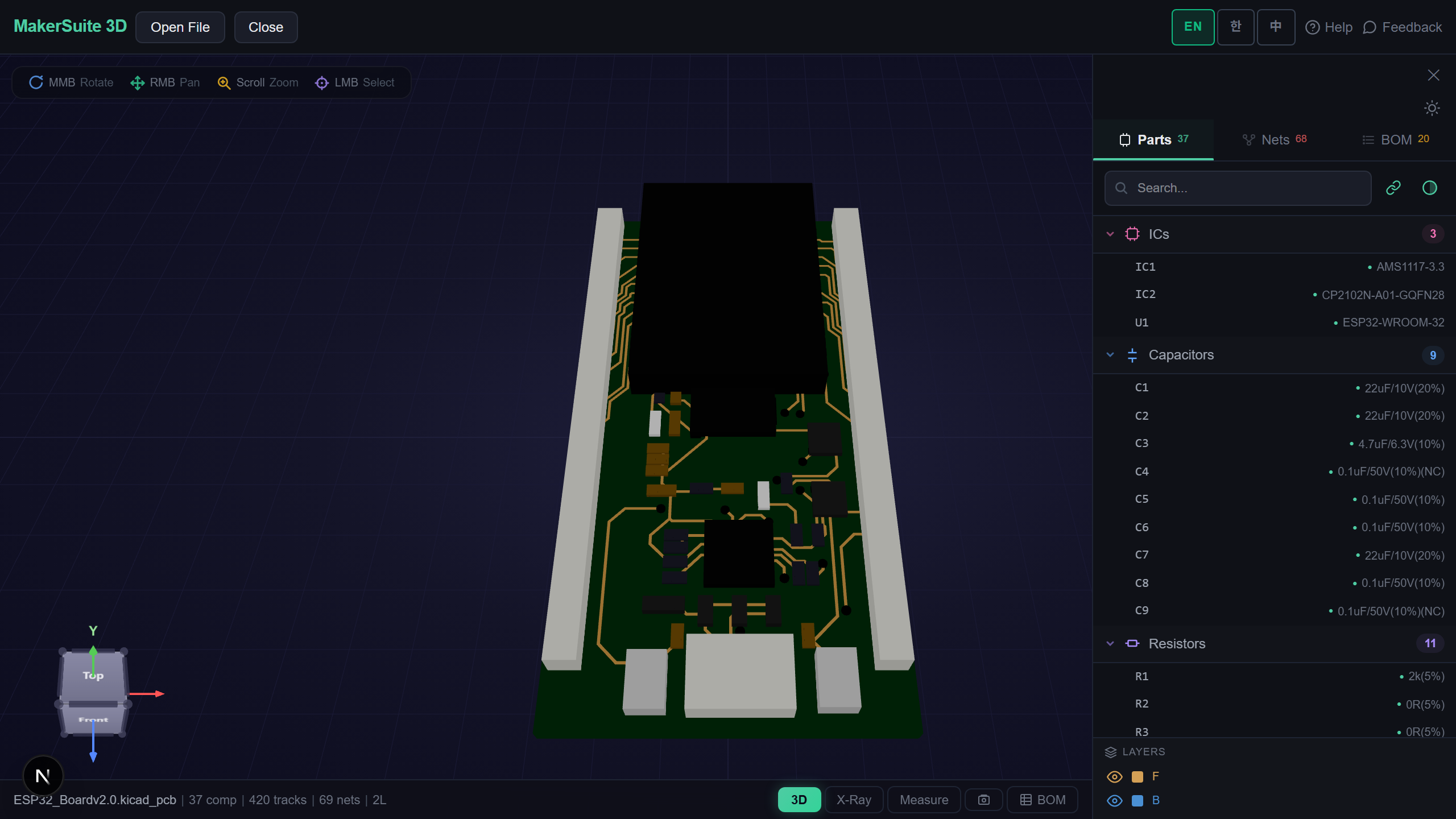
- Verify — drop the exported STEP onto pcbviewer.app/tools/3d-viewer — the PCB substrate, components, and net names come in with the assembly hierarchy intact, and you can measure and interference-check before ever opening Fusion.
Exported a STEP? Drop it in our free browser viewer — no install.
Try MakerSuite 3D FreeWhy This Step Is Where Most MCAD Handoffs Fail
Mechanical engineers routinely get 'empty' STEP files from electrical engineers who never attached 3D models to their footprints. The KiCad STEP exporter doesn't warn about missing models — it just exports the board body and silently skips components. The result lands in SolidWorks as a naked PCB substrate, mechanical rejects it, and the whole back-and-forth wastes a day. Verifying your STEP in a browser viewer before sending catches this in 10 seconds.
When You Need a STEP Export
- Enclosure design handoff — mechanical needs clearance for tallest components, board-mount connectors, and heat sinks
- Heat-sink fitment check — thermal engineer needs the exact pin footprint to design a clamped or bonded heatsink
- Panel assembly — drop the PCB into the full product CAD to verify fasteners don't collide with traces
- Customer deliverables — many contract manufacturers require STEP alongside Gerber for DFM review
- Documentation renders — a STEP in KeyShot or Blender Cycles looks vastly better than a Gerber viewer screenshot
Privacy — Why a Browser Viewer for Verification
If your STEP contains unreleased product geometry (say, a prototype for a paying client), uploading to cloud viewers is a red flag. MakerSuite 3D's STEP viewer runs occt-import-js WASM entirely in your browser — no upload, no server round-trip. The file you drop never leaves the tab. Same OpenCascade kernel Fusion 360 uses, zero NDA exposure.
Frequently Asked Questions
Which KiCad versions support STEP export?
STEP export has been in KiCad since version 5 (2018), but KiCad 7 and 8 produce the cleanest assemblies with proper hierarchy, fewer broken references, and support for threaded holes. If you're still on 5.x, expect some components to export as bounding boxes instead of real geometry — upgrade to 8.x for production MCAD handoff.
Why does my exported STEP file look empty?
Two usual suspects: (1) your footprints don't have 3D models attached — open Footprint Properties → 3D Models tab and point each one to a .step or .wrl file; (2) KiCad's built-in library path wasn't resolved — check Preferences → Configure Paths for KICAD6_3DMODEL_DIR or KICAD8_3DMODEL_DIR. Without models attached, STEP export still produces the PCB substrate but all components are missing.
Can I open the exported STEP file in Fusion 360 or SolidWorks?
Yes — STEP (AP214) is the universal neutral CAD format. Fusion 360, SolidWorks, Inventor, Creo, CATIA, FreeCAD, and Onshape all read it. The PCB comes in as a single assembly with the board body plus every component as a sub-part. You can measure, assign materials, and drop it into a larger mechanical design.
How do I check the exported STEP without installing CAD software?
Drop it onto MakerSuite 3D's free browser STEP viewer — it parses the AP214 assembly using occt-import-js (the same OpenCascade kernel Fusion uses) and shows the full hierarchy with measurements. No Fusion license, no FreeCAD install, no upload. Linked below.
What's the difference between STEP and WRL export?
STEP (AP214) is parametric B-rep CAD geometry — every surface is a mathematical definition, ideal for CAD and manufacturing. WRL (VRML) is mesh-based and was KiCad's legacy rendering format — fast for viewing but useless for mechanical CAD because there are no solid bodies. Always use STEP for MCAD handoff; WRL only if you're feeding a legacy renderer.
Related Articles
Drop your KiCad STEP — verify the assembly in seconds
Launch 3D Viewer