Free PCB Viewer for Mac — Browser-Based, Apple Silicon Ready
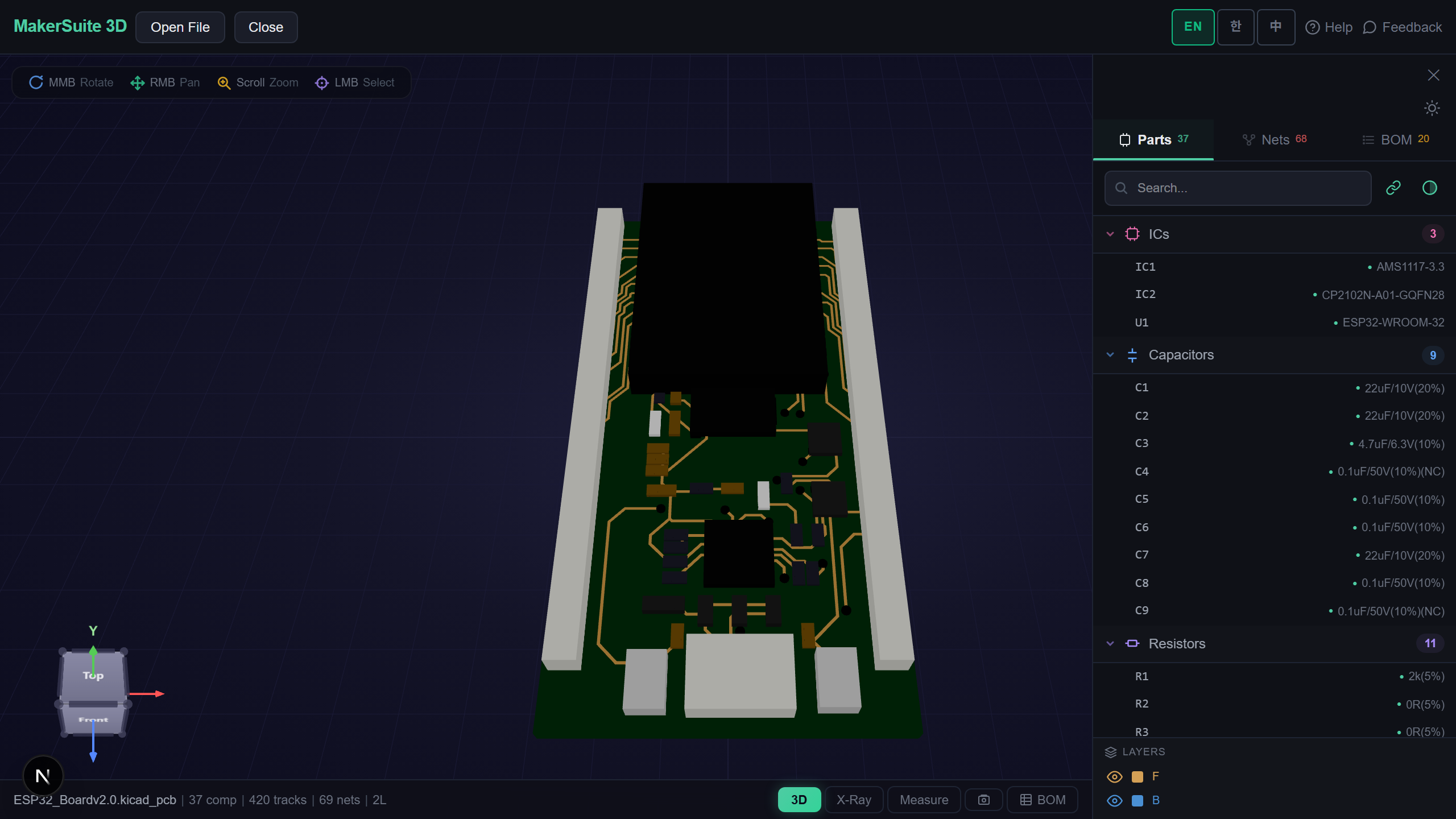
PCB on Mac Without Parallels
Mac users in PCB engineering have lived with a workaround tax for decades — Altium and OrCAD never shipped on macOS, KiCad's Mac builds lag Windows, and even file viewing requires either virtualization or a stripped-down vendor tool. MakerSuite 3D removes that friction by running entirely in Safari, Chrome, Firefox, or Edge — every Mac browser is a full PCB viewer with native Apple Silicon performance.
Why Browser-Based Beats VM
Running Altium under Parallels Desktop or VMware Fusion costs $99–149/year per seat, eats 4–8 GB of RAM, adds Windows licensing, and on Apple Silicon adds another layer of x86 emulation. For viewing-only workflows (design review, customer handoff, BOM generation, manufacturing prep), that overhead is wasted. A browser-based viewer hits the same use cases at zero cost, native ARM performance, and zero install. The vendor tool only earns its keep when you're actively designing — which most reviewers, project managers, and customers aren't doing.
What Mac Users Get
- Native Apple Silicon — runs in Safari/Chrome's native ARM build, no Rosetta 2, no x86 emulation, no Parallels overhead.
- All five formats — KiCad (.kicad_pcb), Altium (.PcbDoc), Eagle (.brd), EasyEDA (.json), Gerber (RS-274X) all parse in-browser.
- 3D rendering — STEP component models, PCB stackup, copper layers, silkscreen, and mask all render via WebGL on M-series GPU.
- Trackpad gestures — pinch-zoom, two-finger pan, force-click integrate with macOS gesture conventions natively.
- Safari Reader Mode compatibility — the BOM table renders cleanly for sharing or printing without the 3D viewport.
- AirDrop friendly — drop a .kicad_pcb received via AirDrop directly onto the canvas; no sandboxing prompts.
How to View PCB Files on Mac in Five Steps
- Open pcbviewer.app in Safari, Chrome, Firefox, or Edge — any Mac browser works.
- Drop your KiCad, Altium, Eagle, EasyEDA, or Gerber file (or zip) onto the canvas. Parsing happens locally; no upload.
- Use trackpad gestures (pinch-zoom, two-finger pan) or the ViewCube to inspect the board. Three-finger swipe for navigation between layers.
- Open the BOM panel. LCSC, DigiKey, and Mouser supplier searches run in parallel for cross-supplier price comparison.
- Export the result — PNG screenshot, BOM CSV, or share-link for handoff to non-Mac collaborators.
PCB review on Mac, no Parallels — drop your KiCad or Altium file in Safari and inspect natively.
Try MakerSuite 3D FreeWhy Apple Silicon Matters Here
M1/M2/M3/M4 Macs have unified memory architecture and exceptional GPU memory bandwidth — three.js with WebGL benefits more than typical desktop CPU-bound apps. Parsing a 50 MB Altium .PcbDoc binary blob runs faster on an M2 than on a comparable x86 laptop because the WASM runtime hits ARM-native code. The fact that the viewer is browser-based means Apple Silicon users get every Apple Silicon advantage automatically — no separate ARM build to download, no architecture mismatch.
When Mac Users Reach for This
- Design review — opening teammate's KiCad project for code-review-style comments without spinning up a VM
- Customer handoff — non-EDA recipients (mechanical, manufacturing, sales) can review the board on their MacBook
- BOM analysis — supplier search and price comparison from the kitchen counter, not a Windows desktop
- Education — students with university-issued MacBooks can complete PCB courses without owning a Windows machine
- Field service — engineers troubleshooting on-site with a MacBook can pull up the board file in a browser
Browser-Side Parsing, No Upload
PCB files often contain trade-secret designs and unreleased product schematics. MakerSuite 3D parses everything client-side in your Mac's browser — no server upload, no cached copy. KiCad, Altium, Eagle, EasyEDA, and Gerber files stay on your machine. Compatible with iCloud Drive, Dropbox, and Google Drive — drop a file directly from any Finder location.
Frequently Asked Questions
Why is PCB software on macOS so limited?
Historic Windows-first development. Altium Designer, OrCAD, PADS, and most enterprise PCB tools were built on Windows in the 1990s and never ported to macOS — the EDA market is too small to justify a Mac port for vendors with stable Windows revenue. KiCad runs natively on macOS (it's open-source, cross-platform from the start), but Altium and similar paid tools only run on Mac via Parallels, VMware Fusion, or Wine/CrossOver — all imperfect. A browser-based viewer sidesteps the entire compatibility problem because every Mac runs Chrome, Safari, Firefox, and Edge natively.
Does this work on Apple Silicon (M1/M2/M3/M4)?
Yes. The viewer is pure JavaScript running in your browser, so it uses whatever browser engine is installed — Chrome, Safari, Firefox, Edge — all of which have native Apple Silicon builds. No Rosetta 2 emulation, no x86 binary translation, full native ARM performance. STEP file parsing uses occt-import-js (WebAssembly), which compiles to native ARM via the browser's WASM runtime. M-series Mac users see the same or better performance as x86 Macs.
Can I use this on macOS without internet?
Mostly yes. The viewer's static assets (HTML, JS, WASM) cache in the browser after first load, so PCB parsing and 3D rendering work offline. The parts that need internet: STEP 3D model CDN (component models load from models.pcbviewer.app), supplier lookup (LCSC/DigiKey/Mouser APIs need network), and search engine indexing. For airgapped engineering reviews, drop the .kicad_pcb or .PcbDoc — geometry, copper layers, and silkscreen all render without external requests after the initial page load.
How does this compare to KiCad on macOS?
Different use cases. KiCad is a full EDA suite for designing boards from scratch — schematic capture, PCB layout, library management, DRC, simulation. MakerSuite 3D is a viewer — for opening, inspecting, and presenting boards designed elsewhere. KiCad on macOS handles the design workflow; MakerSuite 3D handles the review workflow. They complement each other: design in KiCad on Mac, share with non-KiCad reviewers via MakerSuite 3D's browser link.
What about Altium Designer on Mac?
Altium has no native Mac version and no announced plans for one. Mac users running Altium today use Parallels Desktop ($99/year), VMware Fusion (free for personal use as of 2024), or Wine/CrossOver. Performance is acceptable but not native, and Apple Silicon users add a layer of x86 emulation on top. For viewing-only workflows (design review, customer handoff, BOM generation), MakerSuite 3D opens .PcbDoc directly in Safari without virtualization. Designing in Altium on Mac still requires a VM; reviewing doesn't.
Related Articles
Free PCB viewer for Mac — drop your file in Safari and inspect natively
Launch on Mac